
Introduction
If you follow private equity, you have probably heard of Audax Private Equity. This Boston-based firm has become a true powerhouse in the middle market since it was founded in 1999. In 2026, the firm manages billions of dollars in assets and has completed thousands of acquisitions.
What makes Audax stand out? Their strategy is called "buy-and-build." They find a strong platform company and then help it grow quickly through many smaller add-on purchases. This approach works across many industries, including business services, healthcare, and technology.
Audax has a long track record of success. They have invested in more than 175 companies and have a deep team of experts to help those businesses grow. To learn more about their history and how they operate, you can visit the official Audax Group website.

In this profile, we will take a closer look at Audax’s history, investment focus, leadership, and portfolio performance. We will also see how they stack up against other major firms like Webster Equity Partners, Palladium Equity Partners, Odyssey Investment Partners, and Valor Equity Partners. Understanding how these large firms operate can give you a better sense of how the private equity world works.

A firm that navigates these complex investments relies on deep market intelligence. If you want to stay informed about the latest trends driving these deals, you can get clear daily AI updates from The AI Newsletter Worth Reading.

This is a great way to track the technology shifts shaping firms like Audax.
To go even deeper into how major firms build their power and influence, check out this article on how top private equity firms build market power. It gives a broader view of the strategies that make these investors so successful.
Firm Overview: Key Facts and Figures
Let us start with the basic facts about Audax’s size and reach. The firm was founded in 1999 and has its headquarters in Boston, Massachusetts. Over the years, it has expanded to offices in San Francisco, New York, London, and Hong Kong. That global presence helps Audax find and support great companies across North America and beyond.
How big is Audax in 2026? The firm’s three business lines (Private Equity, Private Debt, and Strategic Capital) together manage roughly $36 billion in assets.
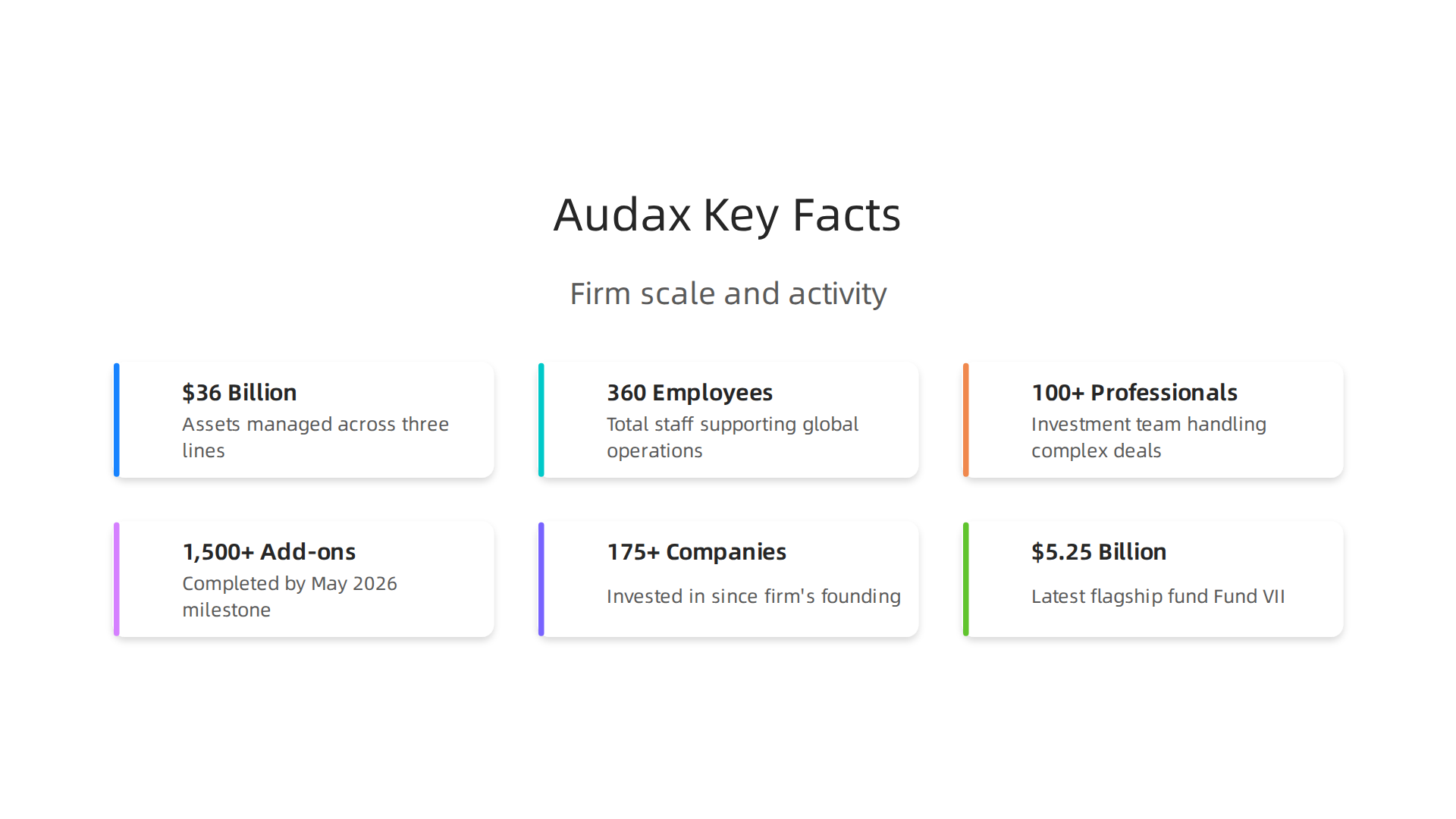
The Private Equity division alone controls about $19 billion. With more than 360 employees and over 100 investment professionals, Audax has the team power to handle complex deals. You can check out the Audax Group’s Boston office profile for more details on its employee culture and growth.
What about deal activity? Audax focuses strictly on the middle market. They buy a strong platform company and then help it grow by adding smaller businesses over time. This "buy-and-build" strategy has been incredibly active. In 2021, they completed their 1,000th add-on acquisition. By May 2026, they crossed the 1,500th add-on milestone. That shows how deeply they work with their portfolio companies to build scale. The Audax’s 1,500th add-on acquisition milestone gives a closer look at that achievement.
Since 1999, Audax Private Equity has invested in more than 175 companies across industries like healthcare, business services, and technology. They have also raised some huge funds. Their latest flagship fund, Fund VII, closed at $5.25 billion, and their lower middle market fund, Origins Fund I, raised $774 million. That gives them plenty of capital to keep making deals.
So how does Audax compare with other big middle market players like Webster Equity Partners or Palladium Equity Partners? All these firms use similar platform strategies, but Audax stands out for its sheer volume of add-on deals. If you enjoy learning about how major private equity firms built their power, you might want to read about how KKR private equity built its power. It shows a different path to the top.
Firm History and Evolution
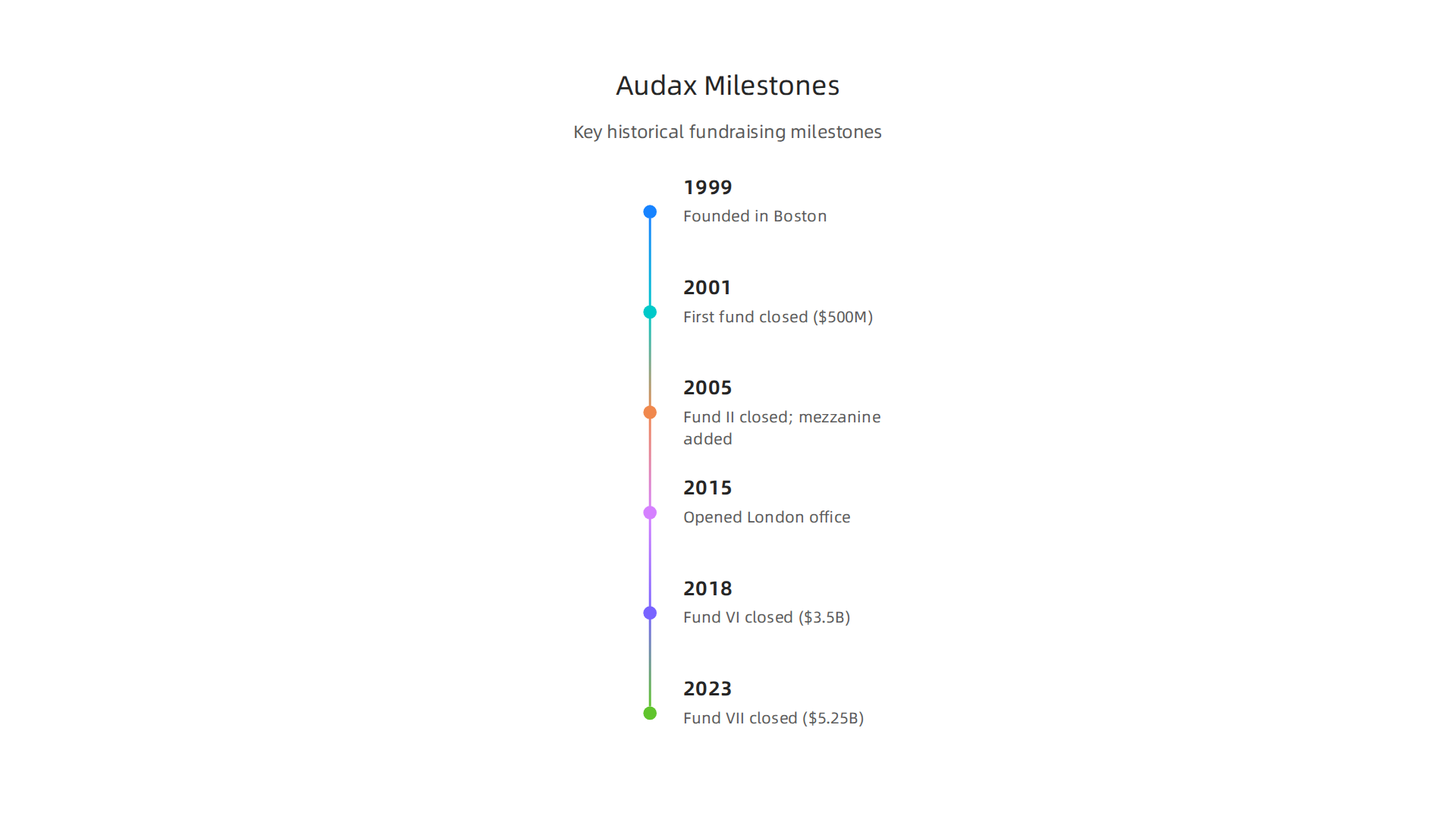
Audax Private Equity did not become one of the top middle market players overnight. The firm has a rich history that started in 1999 when Geoffrey Rehnert and Marc Wolpow founded Audax Group in Boston.
The original focus was on small-cap buyouts, backing smaller companies that needed capital and operational support. Over time, that narrow focus broadened into today’s full middle-market platform.
The early years set the stage for big growth. In 2001, Audax closed its first private equity fund at $500 million. That gave the team the firepower to start buying and building companies. By 2005, the firm had raised Fund II ($700 million) and added a mezzanine debt practice. The expansion into middle-market buyouts came naturally as the firm built experience and credibility.
A major turning point came in 2015. Audax opened its London office and expanded into Europe. That move gave the firm access to a new pool of investment opportunities and deal flow. Around the same time, the firm added a dedicated growth equity practice through Audax Strategic Capital. These moves helped the firm become a truly global player.
The timeline on the Audax Group website shows a clear pattern of steady growth. Fund III hit $1 billion in 2007. Fund IV raised $1.25 billion in 2012. By 2018, Fund VI closed at $3.5 billion. Each fund got larger as the firm proved its buy-and-build model worked. And in 2023, Fund VII closed at $5.25 billion, the largest in firm history.
How does this compare with other firms? While Webster Equity Partners, Palladium Equity Partners, Odyssey Investment Partners, and Valor Equity Partners also use platform strategies, few can match Audax’s two decades of consistent execution. The firm’s history shows a discipline that has lasted through market cycles.
For founders and investors who want to understand how PE firms evolve, it helps to see the full picture. If you are raising capital or evaluating fund partners, staying informed is key. Check out The Deep View Newsletter for daily AI and tech updates that can sharpen your market insight.
Investment Strategy and Sector Focus
Now that you understand Audax’s history, let’s look at how the firm actually makes money. The core of Audax Private Equity’s approach is the "buy-and-build" model. This means Audax acquires a strong platform company in the middle market and then grows it by buying smaller add-on companies that fit into the same story.

Think of it like building a house. You start with a solid foundation (the platform company). Then you add rooms one at a time (the add-on acquisitions). Over time, the house becomes much larger and more valuable than the individual pieces ever were. Audax aims to triple or even quadruple the size of its platform companies during the investment period.
The firm targets six core industries where this model works best:
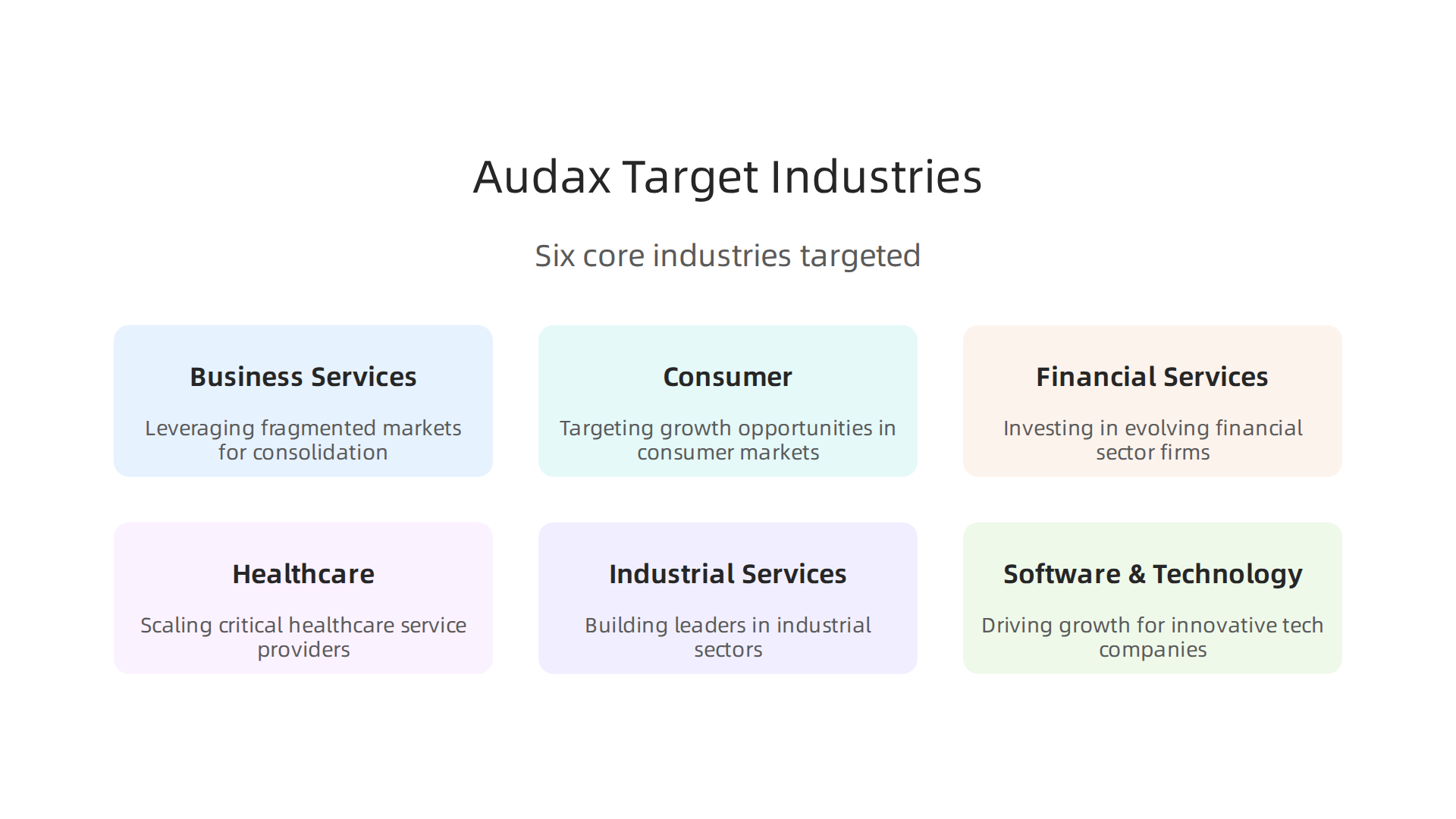
- Business Services
- Consumer
- Financial Services
- Healthcare
- Industrial Services & Technologies
- Software & Technology
These sectors all share one thing in common: they have fragmented markets where smaller players can be combined to create a market leader. You can see the full list of current and past investments on the Audax Private Equity portfolio page.
On the deal size side, Audax focuses on enterprise values between $50 million and $500 million for its flagship strategy. The firm also runs an Origins strategy for the lower middle market, targeting companies with $5 million to $20 million in EBITDA and enterprise values up to $200 million. This two-tier approach gives Audax a wide net.
What makes this different from competitors? While Webster Equity Partners, Palladium Equity Partners, Odyssey Investment Partners, and Valor Equity Partners also use buy-and-build models, few have Audax’s level of operational support. The firm has a dedicated value creation team that helps portfolio companies with strategy, revenue growth, and efficiency. The Audax Private Equity approach page describes this as the "Audax Value Agenda," a framework designed to accelerate growth at every portfolio company.
For founders and investors trying to understand how private equity firms operate, comparing different PE models can be useful. If you want to see how another giant in the space works, read our deep dive on how KKR Private Equity became one of the most powerful names in finance. It shows a different approach to the same middle market opportunity.
Leadership and Key Partners
The "buy-and-build" model only works when the right people are behind it. Audax Private Equity has built a deep bench of experienced leaders who have been with the firm for decades.

This kind of continuity is rare in private equity and gives Audax a strong edge when executing complex roll-up strategies.
At the top, the firm is led by Co-Presidents. One key leader is Young Lee, who joined Audax back in 2000. Over his 25-plus years at the firm, Young has been involved in nearly 350 platform and add-on transactions. Before Audax, he worked at Donaldson, Lufkin & Jenrette and J.P. Morgan. You can see his full background on the Young Lee, Partner and Co-President profile.
The leadership team also includes deep sector specialists. Iveshu Bhatia is a Managing Director who co-heads the Software & Technology practice. His background in tech M&A at Lazard Freres helps Audax identify strong software platforms for its buy-and-build approach. Learn more about Iveshu Bhatia’s experience on the team page.
Beyond individual leaders, the overall team structure is built for scale. Audax has over 270 employees and more than 100 investment professionals. The senior leadership team averages over 26 years in private credit and 15 years at the firm. This level of tenure creates deep relationships with lenders, advisors, and management teams. You can browse the full Audax Private Equity team directory to see the complete list of partners and managing directors.
For founders and operators trying to understand how PE firms work, it helps to know where they fit. Many entrepreneurs confuse private equity with venture capital, but they finance companies at very different stages. Understanding the difference is critical when planning your own fundraising journey. Learn about the critical difference between venture capital and private equity to see which path is right for your business.
Staying informed about how technology is reshaping finance is more important than ever. Leaders at firms like Audax are laser-focused on AI and digital transformation. To stay ahead, you need a clear daily briefing on the developments that matter. The AI Newsletter Worth Reading delivers that directly to your inbox.
Notable Portfolio Companies and Exits
Of course, all that strategic thinking and leadership talent only matters if it produces real results. And audax private equity has built a track record that speaks for itself. Since the firm started in 1999, it has invested in more than 170 platforms and completed over 1,300 add-on acquisitions. Those numbers come directly from the audax private equity linkedin page as of 2026.
So what kinds of companies does the firm back? The answer cuts across six core industries. Take Chartis, a business services firm that helps organizations manage risk and compliance. Audax invested in Chartis to help it scale through both organic growth and strategic add-ons. Another example is Fortis, a payment processing company where Audax partnered with management to build a bigger, more competitive player. Then there is Enviromatic, a provider of building management systems. You can explore the full roster on the Audax Private Equity portfolio page.
What makes these companies special is how they grow under Audax ownership. The firm does not just buy a business and leave it alone. It actively helps management teams find and integrate smaller acquisitions that add new customers, technology, or geographic reach. That is the buy-and-build model in action.
The exit record is equally strong. In 2025 and early 2026, Audax had a busy stretch of realizations. Thermogenics was the first full exit from the firm’s lower middle market Origins strategy. That exit came nearly three years to the day after the initial investment. Around the same time, Audax sold CW Advisors and Stout, a financial advisory and investment banking firm. In fact, within a 12-month period, the firm secured eight realizations across its Flagship and Origins strategies. That kind of deal velocity shows just how active Audax remains.
While firms like Webster Equity Partners and Palladium Equity Partners also use buy-and-build approaches in the middle market, few match Audax’s sheer volume of add-on transactions. Odyssey Investment Partners and Valor Equity Partners focus on different niches, but the common thread is a disciplined method for creating value through acquisitions.
For founders and operators, understanding how a firm like Audax builds and exits companies can inform your own strategy. If you are raising capital, you want investors who know how to scale a business through smart M&A. Learn more about how another major player operates in how KKR private equity became one of the most powerful names in finance to see how the model works at scale.
Performance Metrics and Fundraising Track Record
All those successful exits and portfolio growth raise a natural question. How has audax private equity actually performed for its investors? The numbers tell a convincing story.

In early 2026, the firm was ranked in the top 2% globally in the 2025 HEC Paris-Dow Jones ranking. That is the third year in a row the firm made the list. The ranking looks at funds raised between 2012 and 2021. It measures IRR, DPI, and TVPI. Being in the top 2% puts Audax ahead of nearly every other large buyout firm in the world.
One reason for that strong performance is consistency. Audax does not rely on one lucky fund. Across multiple vintages, the returns stay solid and the dispersion between deals stays low. That means the firm makes good investments again and again, not just once.
The track record helped Audax raise its Flagship Fund VI in 2025. Audax Private Equity Fund VI closed at $5.25 billion in 2025, well above its original target. Investors clearly believe in the buy-and-build model. That fund gives the firm plenty of firepower to keep making platform investments and add-on acquisitions for years to come.
For founders and operators raising capital, this performance matters. It shows that audax private equity can deliver strong returns while helping companies grow. Understanding how a firm performs can guide your own fundraising strategy. To learn more about the difference between venture capital and private equity, check out venture capital private equity the critical difference for startup fundraising.
Want to keep up with market trends and investment insights like these? The AI Newsletter Worth Reading brings you clear daily updates on AI and tech that affect fundraising and deal flow.
Comparison with Industry Peers
How does audax private equity stack up against other firms in the mid-market space? The comparison shows a clear picture. Firms like Webster Equity Partners, Palladium Equity Partners, Odyssey Investment Partners, and Valor Equity Partners all compete for similar deals. But Audax stands apart for a few key reasons.
One big differentiator is the buy-and-build approach. While many peers make platform investments and add occasional add-ons, Audax treats add-on acquisitions as a core part of its strategy. By early 2026, the firm had completed more than 1,400 add-on acquisitions since 1999. That volume far exceeds what most mid-market firms achieve. It creates a compounding effect. Each platform becomes stronger with every add-on, which drives better returns.
Another difference is operational discipline. Audax does not just write checks. The firm has a rigorous operational focus that helps portfolio companies improve margins, enter new markets, and build stronger management teams. This hands-on support sets them apart from firms that rely more on financial engineering.
The performance numbers back this up. Across multiple fund vintages, Audax has consistently exceeded the Cambridge Associates mid-market benchmark. That benchmark tracks the performance of hundreds of similar funds. Beating it year after year shows real skill, not luck. In 2025, the firm ranked in the top 2% globally in the HEC Paris-Dow Jones ranking, placing it well ahead of most large buyout firms.
For founders and investors trying to understand the landscape, looking at how audax private equity compares to peers is useful. It shows that a disciplined, repeatable model can produce strong results. To see how another major firm approaches the space, check out how KKR private equity became one of the most powerful names in finance.
Summary
This profile explains who Audax Private Equity is, how the Boston-based firm built a top-tier middle-market franchise using a buy-and-build approach, and why that matters for founders and investors. It covers Audax’s growth since 1999, its global footprint, current scale (roughly $36 billion across businesses with a $5.25 billion flagship fund), and the firm’s focus on repeatable add-on acquisitions across six core industries. The article details the buy-and-build mechanics, typical deal sizes for flagship and Origins strategies, the firm’s leadership and operational support model, plus notable portfolio wins and exits. It highlights performance metrics—top-2% HEC Paris-Dow Jones ranking—and explains how Audax’s volume of add-ons and value-creation team differentiate it from peers. Readers will learn how Audax selects and scales platforms, what to expect when engaging the firm, and how to compare it with other middle-market private equity investors.