

Why ‘Tech for Good’ Is a Critical Fundraising Differentiator in 2026
In 2026, founders need to know that investors are looking for more than just good ideas. They also want to see that your startup is doing good for the world. This idea is called "tech for good." It means using technology to solve big problems like climate change, health issues, or helping communities. It’s a special way to stand out when you are trying to raise money.
Think about it: many investors today don’t just want to make a profit. They also want their money to help make the world a better place. This is called impact investing, and it’s getting really big. Reports show that the impact investing market is expected to grow from $629.07 billion in 2025 to $748.35 billion in 2026. This shows a huge jump in interest from people who want to invest with a purpose Impact Investing Business Research Report 2026: $748.35 Billion.
So, if your startup can show how its technology not only makes money but also helps people or the planet, you have a big advantage.

It’s not enough to just say you are doing good. You have to prove it. This is where many founders face a challenge. They need to figure out how to clearly show the good they are doing while also growing their business. It’s tricky to measure impact and make sure your business can stand on its own feet at the same time. Learning how to properly measure and talk about your company’s positive influence is key for attracting investors who care about "tech for good." You can explore a Tech for Good roadmap to learn more.
If you are a founder looking to understand these new trends and how to best position your startup, staying informed is vital.
Get clear daily AI updates from The AI Newsletter Worth Reading.
Why ‘Tech for Good’ Matters for Startup Fundraising
To really make your startup shine in 2026, founders must do more than just talk about impact. You need to weave your good intentions right into your business plan. This means showing how your mission to do good is deeply connected to how your company makes money. When you do this, you unlock doors to special groups of investors.
For example, impact investors are people and groups whose main goal is to make both money and a positive change in the world. They will look for companies that have a clear plan for social or environmental good. Then there are the corporate social responsibility (CSR) departments of large companies. These groups often have money set aside to invest in or work with startups that fit their own goals for helping society. Also, many angel investors, who are individual wealthy investors, are now specifically looking for "tech for good" companies. They want to put their money into projects that match their personal values, like helping the startup ecosystem in USA thrive by solving real problems.
It’s important to remember that these investors still want to see a strong business. Your good mission should not be a replacement for making a profit, but rather an extra layer of value. As one report on impact investing notes, financial success and social impact can go hand-in-hand Impact Investing: A Theory of Financing Social Enterprises.
So, what do these investors look at beyond your sales numbers? They have special checks during their due diligence process.
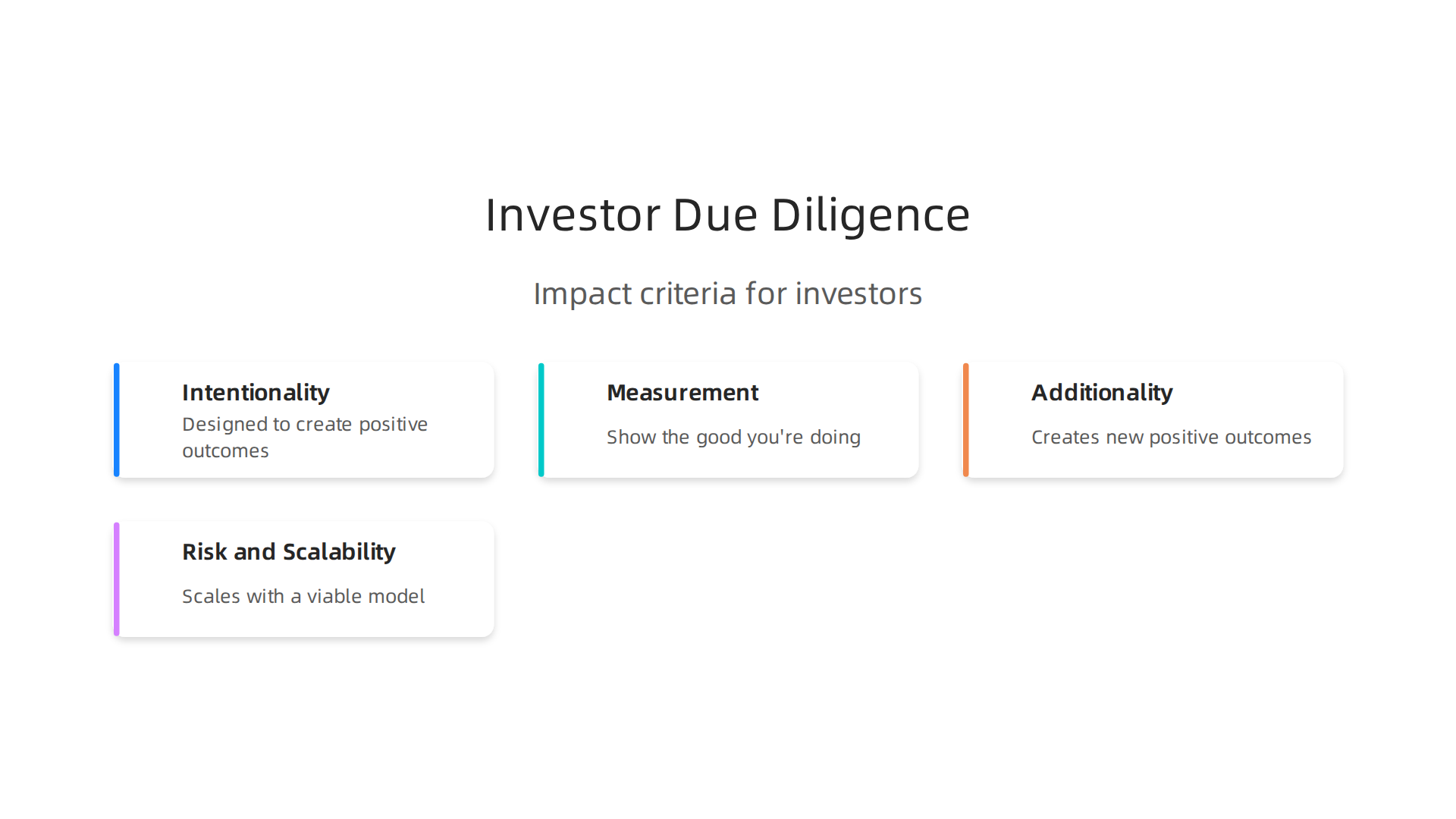
Here are some key things they look for:
- Intentionality: Is your startup designed from the start to create a specific, positive outcome? They want to see that making an impact isn’t just a side effect, but a core part of what you do.
- Measurement: How do you actually show the good you are doing? Investors will ask for clear ways to measure your impact. This might involve using special tools like the IRIS+ system, which helps track and report on social, environmental, and financial performance IRIS+ System | Data.
- Additionality: Would the positive impact you create happen anyway without your startup? Impact investors want to fund efforts that bring new good to the world, not just something that would naturally occur.
- Risk and Scalability: They also check if your solution can grow and if your business model is strong enough to last. Even with a good mission, a weak business model won’t attract them. For example, during investor due diligence, they will test if your product can survive with customers and if your team knows how to make things happen Investor Due Diligence for Startups – SproutVest.
Aligning your mission with your business model helps show investors that your "tech for good" startup is not only financially sound but also truly dedicated to making a difference. This approach can set you apart when seeking early stage investing or larger rounds of capital.
To really build a "tech for good" startup that stands out to investors, it’s not enough to just want to do good. You have to put ethical thinking right into how you design your products. This means making sure your technology is fair, safe, and helpful for everyone from the very start.
Here are some main ideas for building tech in an ethical way:

- Privacy-by-Design: Think about privacy early on, not as an afterthought. This means making sure that your product collects only the information it truly needs. It also means keeping that information safe and giving users clear choices about their data.
- Inclusivity: Design your tech so that it works well for all kinds of people. Think about different ages, abilities, backgrounds, and languages. An inclusive product welcomes everyone.
- Accessibility: Make your product easy for people with disabilities to use. This could mean adding features for screen readers, using clear colors, or making controls simple to operate.
- Transparency: Be open about how your technology works. If you’re using AI, explain how it makes decisions. If you collect data, tell people what you’re doing with it in plain language.
- Fairness: Try to make sure your tech doesn’t accidentally treat some groups of people better or worse than others. This is especially important for AI tools, which can sometimes have unfair biases if not checked carefully. The World Economic Forum talks about how responsible innovation should be human-centered and transparent in their guide on Shaping Tomorrow: Responsible Innovation for a Brighter Future.
How to Embed Ethics into Your Startup
Founders can take real steps to make ethics part of their product development. It starts with setting clear rules for what your tech should and should not do. Then, you need to follow these rules in your day-to-day work.

- Start Early: Begin thinking about ethical questions during your first product ideas and designs. It’s much harder to fix ethical problems later on. A great place to start is with a guide like the Responsible Innovation Primer for Founders, which offers insights from over 100 influential founders and investors.
- Make it a Team Effort: Everyone on your team, from engineers to marketers, should understand and care about these ethical principles.
- Use Checklists and Frameworks: In 2026, there are many tools to help. For example, a responsible AI checklist can help you check your AI tools for fairness and make sure they’re built without bias. There are also detailed guides like the Responsible AI in 2026: A 3-step Guide for Governance that show you how to set up rules for your company.
- Test for Bias: If your tech uses data, like for AI, always test it to see if there are any unfair biases hiding in the data. Fix these biases before your product goes live. You can learn more about how to find and fund high potential tech startup ideas in 2026 that incorporate these principles.
- Review Regularly: Ethical standards can change, and your product will grow. So, it’s good to check your ethical practices often. Think of it as a constant effort to keep your tech aligned with your "tech for good" mission.
By weaving ethical practices into your product roadmap and engineering workflows, you not only build better technology but also show investors that your startup is serious about making a positive impact. This strong commitment helps your company thrive in the broader startup ecosystem in USA.
Stay ahead of the curve in the fast-changing world of technology and artificial intelligence.
Get clear daily AI updates from The AI Newsletter Worth Reading.
After building ethical thinking into your products, the next big step for a "tech for good" startup is showing the world, especially investors, the good you are doing. This means measuring your social impact. It’s not enough to just say your tech helps people; you need to prove it with clear information.
Measuring Social Impact: Frameworks, Metrics, and Reporting
To really show your startup’s positive impact, you need good ways to measure it. Think of it like a roadmap for your "tech for good" journey. These tools help you understand, track, and share how your company is making a difference.
Common Frameworks for Impact
One popular way to measure impact is by using special guidelines. In 2026, many startups and investors look at systems like IRIS+ (Impact Reporting and Investment Standards). This is like a common language for everyone to talk about social, environmental, and financial results. It helps you report your impact in a way that others can easily understand and compare.
The IRIS+ system offers standards that help companies set up their impact measurement and management efforts. It also provides a catalog of metrics that align with big goals like the Sustainable Development Goals (SDGs) set by the United Nations. This means your "tech for good" startup can measure its work in ways that connect to global efforts to make the world better. The system even helps you understand impact using five main ideas: What happened? Who was affected? How much change was there? Was your company key to this change? And what are the risks involved? You can learn more about these ideas in the IRIS+ and the Five Dimensions of Impact guide.
Choosing the Right Metrics (KPIs)
When you are an early-stage startup, you need to pick Key Performance Indicators (KPIs) that are both believable to investors and easy for your small team to track.
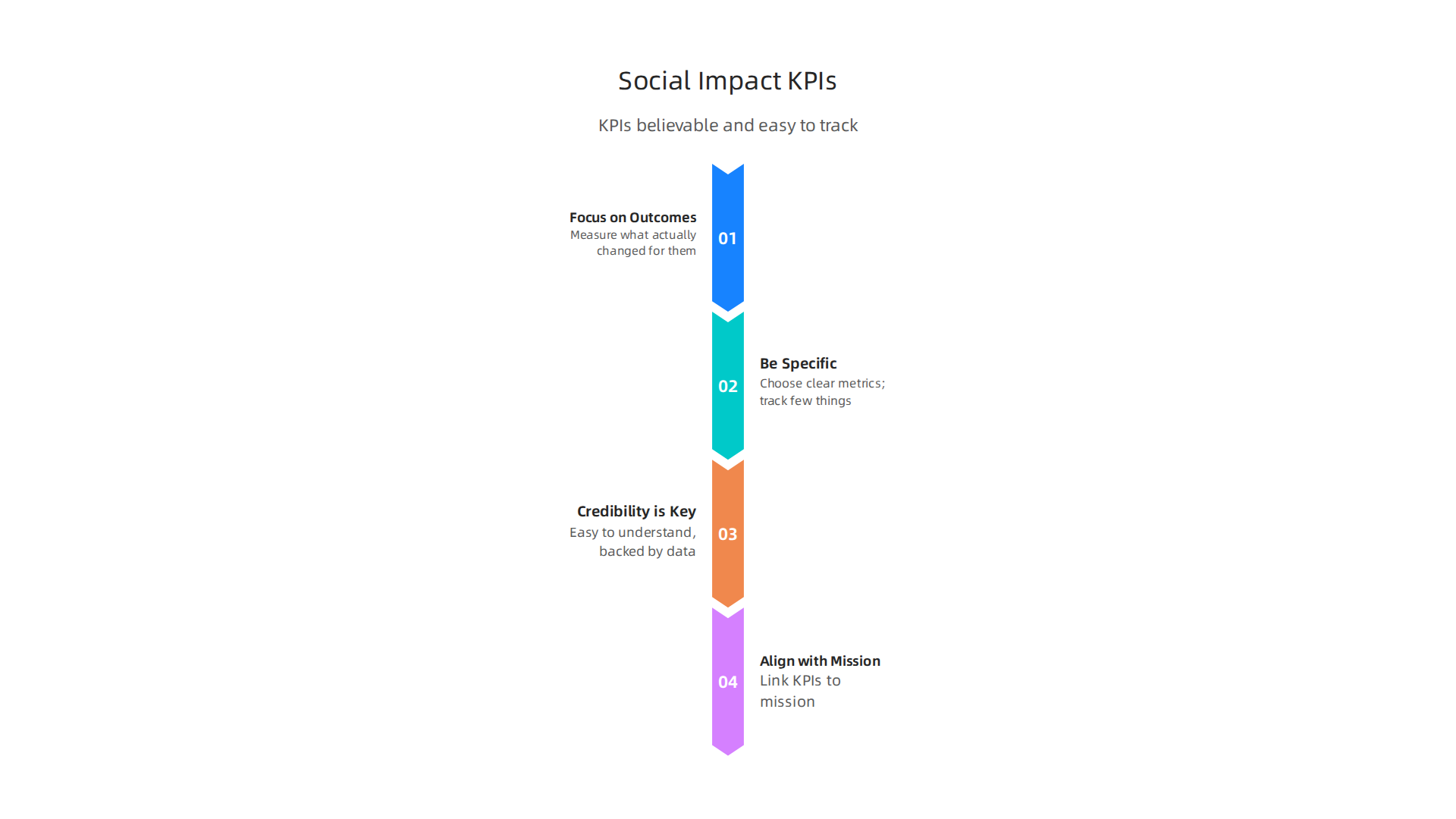
These are like your scorecards for success.
- Focus on Outcomes: Instead of just counting how many people used your app (outputs), try to measure what actually changed for them (outcomes). Did their lives get better? Did they learn a new skill? For example, if your "tech for good" app helps people find jobs, don’t just count downloads. Instead, track how many users actually got a job through your app.
- Be Specific and Simple: Choose a few clear metrics that directly show your social impact. Don’t try to track too many things at once.
- Credibility is Key: Investors want to see real evidence. Your metrics should be easy to understand and backed by solid data. The more clear and trustworthy your impact data, the more attractive your startup will be to those looking to attract and partner with investors in businesses for startup growth.
- Align with Your Mission: Make sure your KPIs clearly link back to your "tech for good" mission. If your mission is to improve education, your metrics should show improvements in learning or access to knowledge.
Reporting Your Impact
Once you have your measurements, you need to share them clearly. This is called impact reporting. It involves telling the story of your impact using data. Good reporting makes it easy for investors and other important people to see the value your startup brings. This means sharing your results in easy-to-understand ways, perhaps through simple reports or presentations. Keeping up a regular reporting rhythm, whether it’s monthly or quarterly, keeps your stakeholders informed without overwhelming them, as highlighted in guides on stakeholder update cadence. You want to make sure your reports are honest and focus on the real results you’ve achieved, not just what you plan to do, according to tips on communicating impact frameworks.
Measuring how much good your "tech for good" startup does is super important. But it’s just as important to make sure your technology itself is built in a fair and safe way, especially when you use smart computer programs like AI. In 2026, building responsible AI and handling data carefully is a must for any company that wants to make a real positive impact.
Building Responsible AI and Data Practices for Impact
When you use AI and data in your products, there are some important things to watch out for. If you don’t, your tech could cause harm even if you mean for it to do good.
Big Risks with AI and Data
- Bias: Imagine if your AI app helps people get jobs, but it only shows jobs to certain groups of people because of how it was trained. That’s bias. AI learns from the data it gets, and if that data is unfair, the AI will be unfair too. It’s like teaching a child with a biased textbook; they’ll learn the wrong things. Startups need to carefully check their data to make sure it’s fair and not leaving anyone out. One expert guide for 2026 says to establish clear ethical principles and run bias checks before you even launch your product.
- Privacy: Your users trust you with their personal information. Keeping that information safe is a big deal. If their data gets out, it can cause problems for them and hurt your company’s trust. You need strong rules about how you collect, use, and store data to protect everyone’s privacy.
- Explainability: Sometimes, AI makes a decision, but you don’t know why. This is like a magic trick where you only see the outcome, not how it happened. For "tech for good" products, it’s really important to understand how the AI works. If an AI helps someone get a loan, they need to know why it said yes or no. This "explainability" helps build trust and lets you fix problems if the AI makes a bad choice.
How to Build Safer AI
Even for small startups, you can put simple plans in place to make sure your AI and data practices are responsible.
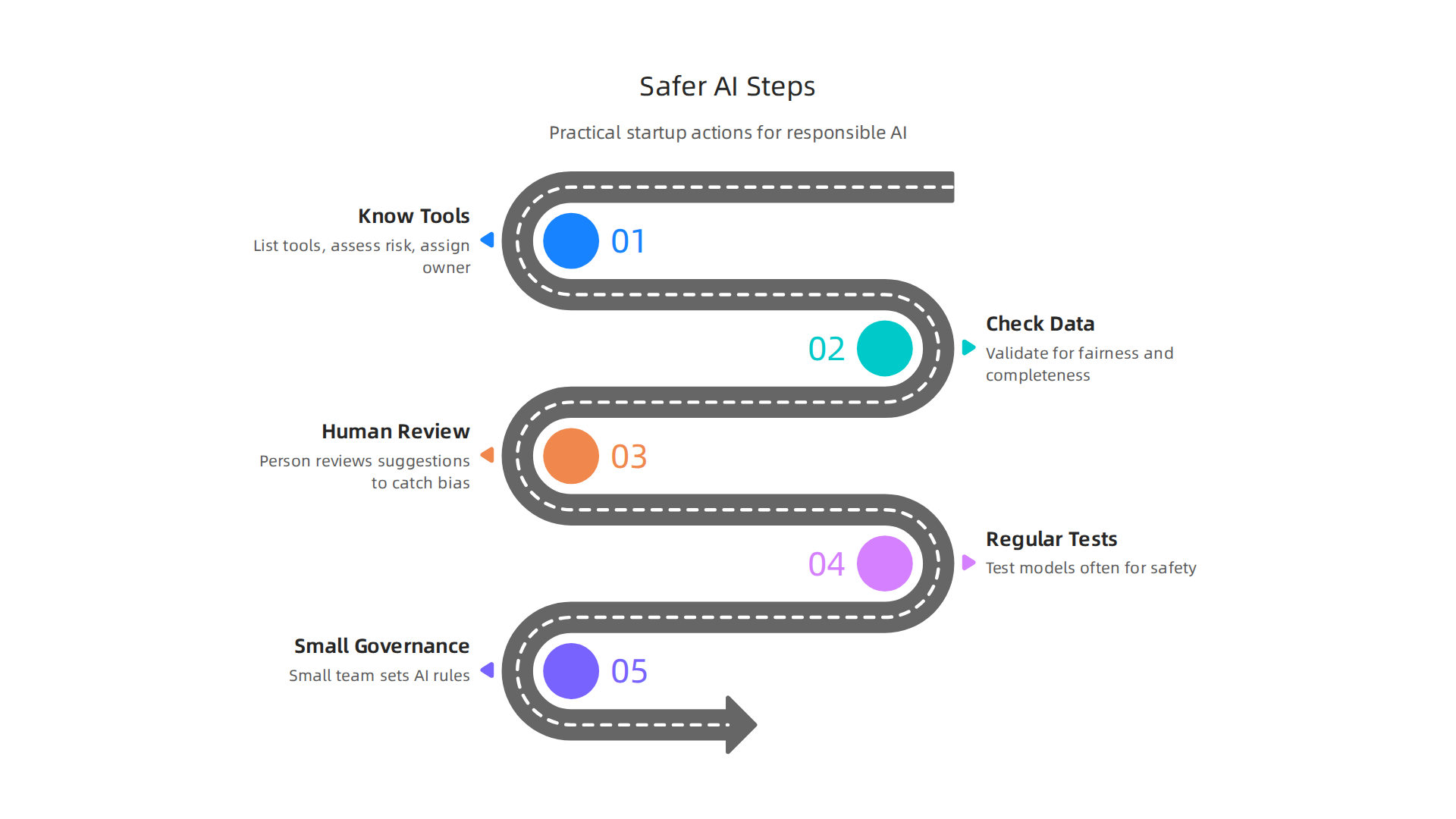
- Know Your AI Tools: First, make a list of all the AI tools you use, both the ones you build and the ones you buy. Then, think about how risky each tool is. Does it make big decisions that affect people’s lives? A responsible AI checklist for small businesses suggests a simple plan: write down your AI tools, sort them by risk, and put one person in charge of each.
- Check Your Data: Before you use any data to train your AI, make sure it’s good and fair. See if there are any missing parts or if it favors one group over another. This is called validating your data.
- Keep Humans in the Loop: Don’t let AI make important decisions all by itself. Always have a person review what the AI suggests, especially for things that could harm someone. This human touch helps catch mistakes and biases.
- Regular Checks: Even after your product is out, keep checking your AI often. Run tests and review its results to make sure it’s still working fairly and safely. You can even bring in outside experts to look at your high-risk systems. Staying on top of things helps ensure your tech continues to make a positive difference. For founders looking to launch new products, understanding how AI works and how it affects the market can make a big difference in the success of your project, as discussed in how to understand global investment groups powering fundraising strategy.
- Simple Rules: You don’t need a huge team for this. You can create a small group that meets regularly to talk about new AI features, potential risks, and how to keep things fair. This helps embed responsible behavior into your company’s culture from the start. A helpful guide for 2026 recommends making an AI inventory audit and setting up a small governance committee.
By taking these steps, your "tech for good" startup can not only measure its positive impact but also ensure that impact is built on a foundation of trust and fairness.
Want to stay informed about the latest in AI and how it affects startups?
The AI Newsletter Worth Reading
Ensuring your tech is responsible is key to building trust. And when it comes to getting money from investors, trust is everything. For "tech for good" startups, showing how you make a positive change is just as important as having a great business idea. Investors, especially those focused on impact, want to see clear proof of your good work.
Investor Perspectives: What Funders Look For in Tech-for-Good Startups
The world of investing is changing. More and more people want to put their money into companies that do good things, not just make money. This is called impact investing. In 2026, the impact investing market is growing quickly, with estimates putting its value around $748.35 billion. That’s a lot of money looking for good causes to support, according to an Impact Investing Business Research Report 2026. So, how do you get their attention?
Show Your Impact Clearly
When you talk to investors, you need to prove your "tech for good" startup is making a real difference. It’s not enough to just say it.
- Your Plan for Change: Investors want to see your "Theory of Change." This is like a map that shows how your startup’s actions lead to good results. For example, if your app helps people find clean water, how does that lead to better health in communities?
- Numbers to Prove It: You need "Impact KPIs" (Key Performance Indicators). These are measurable numbers that show your good work. How many people did you help? By how much did their lives improve? Investors will check these claims carefully. One guide for 2026 suggests that during due diligence, investors specifically look for your Theory of Change and Impact KPIs to confirm your product’s true addition to positive change, as detailed in ESG & impact due diligence in 2026: what investors check.
Show You Can Grow Big
Beyond impact, investors want to know your business can grow. This is called traction and scalability.
- Traction: This means you have some early success. Maybe you have users, pilot programs, or small amounts of money coming in. It shows your idea works in the real world.
- Scalability: Can your good idea reach many more people? If your solution helps 100 people, can it help 100,000 or even a million without costing a fortune? Investors are interested in companies that can make a big impact on a large scale. Impact investors can help social businesses grow and reach a larger scale, increasing their positive influence, as noted in Impact Investing: A Theory of Financing Social Enterprises. A clear roadmap through different startup growth stages helps show this potential.
Having a strong plan for growth in your create your winning funding package is very appealing.
Red Flags Investors Watch Out For
Even with a strong mission, some things can make investors hesitate:
- No Clear Business Plan: Impact is wonderful, but your "tech for good" startup still needs to make money to keep going. If you can’t show how you’ll be profitable, investors might worry you won’t last. A lack of a clear business model is a common concern in Impact investing in the framework of business and human rights.
- Exaggerated Claims: Don’t promise impact you can’t prove. Investors do their homework. Be honest and have data to back up your impact claims.
- Hiding Problems: Investors do a deep dive, called "due diligence," into your company. If you’re not upfront about challenges or problems, it hurts trust. Being open about your numbers and operations is key during Investor Due Diligence for Startups.
To successfully how to attract venture capital funds, your "tech for good" startup needs to be ready to show both its heart and its smarts. This also applies to startups seeking specific funding, like those looking to secure disabled veteran business start up grants, where demonstrating clear impact and a solid business model are equally important.
To truly show both your heart and your smarts, "tech for good" startups must build strong business plans. It’s not enough to have a great idea that helps people; you also need to make money to keep that good work going. This means choosing smart ways to earn money that fit with your mission.
Business Models That Do Good
For a "tech for good" startup, your business model should help your positive impact grow. Here are a few ways to think about this:
- B2B Partnerships: You can work with bigger companies. For example, if your tech helps clean water, you might partner with a water utility company or a big brand that cares about clean water. They pay you, and your tech gets to help more people. This can also involve tech transfer, where your solution is adapted for wider use.
- Tiered Pricing: Offer your service at different price levels. Maybe individuals or small non-profits get it for free or very cheap, while larger organizations or businesses pay more. This helps you serve those most in need while still bringing in revenue.
- Outcome-Based Contracts: This is when you only get paid if your tech achieves certain results. For instance, if your app helps people find jobs, the government or a company might pay you based on how many people you successfully help employ. This shows a direct link between your service and its good outcome.
When you create your business model, it’s important to make sure it also covers your costs. Impact investors still want to see that your "tech for good" venture has strong financial viability, as highlighted in a guide on The 6 Core Pillars of Due Diligence in Impact Investing for 2026. A clear path to making money helps ensure your project can continue its mission for a long time.
Financial Planning and Sustainability
Measuring your good impact takes time and money. This "operational overhead" needs to be part of your financial plan. You’ll need resources to collect data, check your progress, and report on your results. These extra steps are important for showing investors you’re serious about your mission, but they add costs.
Thinking about your "runway" is key. This is how long you can keep your business running with the money you have. A longer runway gives you more time to reach your goals and prove your business model. To succeed, founders in the startup ecosystem in usa need to be smart about balancing impact spending with business growth.
Ultimately, balancing your mission with smart financial choices is about making your positive impact last. A responsible innovation needs to be sustainable, collaborative, and human-centric to thrive, as noted in the Shaping Tomorrow: Responsible Innovation for a Brighter Future report. If you can’t pay your team or cover your costs, your ability to do good will stop. Developing a clear tech for good roadmap to attract investment and measure impact will put you on the right path.
Understanding the tech market and investor expectations is an ongoing task. Stay informed with daily insights.
The AI Newsletter Worth Reading: Get clear daily AI updates from The Deep View Newsletter.
After setting up solid business plans and figuring out how to make money, the next big step for any "tech for good" startup is to clearly show the good it does. It’s not enough to just do good; you also need to tell your story in a way that people understand and trust. This is about being open and proving your impact to everyone, from your users to your investors.
Transparent Storytelling for Trust
When you talk about the good your tech does, you need to use both heartfelt stories and real facts. People want to hear about the lives you’ve changed, but investors also want to see the numbers to back it up.

To truly communicate your impact, you should combine clear data with human stories, showing how your work makes a real difference in the world. This helps you build trust with customers and attract money from those who believe in your mission. When sharing your story, aim to highlight what changed because of your tech, how important these changes are, and how much you contributed.
Reporting Your Impact Clearly
For a "tech for good" company, regular reporting shows you are serious about your goals. It helps people see your progress over time. One helpful tool for this is the Impact Reporting and Investment Standards (IRIS+). Think of IRIS+ as a common language for talking about social, environmental, and money-related performance. It helps you measure different parts of your impact, like the "who," "what," and "how much" of the good you’re doing, making your reports easier to understand for investors. These standards help you measure impacts across different areas.
The key is to pick a reporting rhythm that works for your startup and its resources. Some groups send out big reports once a year, while others might share smaller updates more often. It’s important to tailor your reports to who is reading them. Your reports should focus on the actual results you achieved, not just what you planned to do. For example, if you’re talking to investors, you might share weekly updates on important numbers or monthly reports with deeper details. This approach helps keep everyone informed without using up too much of your time and effort. Preparing a strong plan for sharing your impact is a big part of creating your winning funding package for startup success.
Summary
This article explains why