

Introduction: Why Breakthrough Tech Matters Now More Than Ever
Do you feel like technology is moving faster than you can keep up? You are not alone. In 2026, breakthrough tech is showing up everywhere. Artificial intelligence is learning to reason on its own. Biotech is engineering living cells to solve medical and environmental problems. Quantum computing is starting to crack real-world challenges. And clean energy breakthroughs like sodium-ion batteries and fusion research are reshaping global sustainability efforts.
According to the Top 10 Technology Trends for 2026, this moment is unique because multiple breakthroughs are happening at the same time. AI has moved beyond simple automation into reasoning. Robotics has become intelligent and collaborative. Communication networks are advancing toward near-zero latency with 6G. These changes are not science fiction any more. They are forcing real decisions in boardrooms and startup offices today.
But here is the problem for founders: information overload. You see a flood of news about agentic AI, brain-computer interfaces, humanoid robots, and autonomous vehicles. How do you know which trends are actually investable? How do you budget for long research and development cycles when the ground keeps shifting under your feet?

This guide cuts through the noise. We have gathered data-driven insights on the most important breakthrough tech trends of 2026. You will learn practical budgeting strategies for long R&D cycles. You will also discover effective fundraising tactics that match the pace of innovation def happening right now. Whether you are building in AI, biotech, clean energy, or any block tech sector, this information will help you make smarter decisions.
If you want to stay ahead of the curve every single day, consider getting clear daily AI updates from The AI Newsletter Worth Reading.

It delivers the latest developments in artificial intelligence and technology straight to your inbox, so you never miss a critical shift.
Let us start by looking at the biggest trends that are reshaping entire industries this year.
What Is Breakthrough Tech? Defining the Frontier in 2026
You hear the term breakthrough tech everywhere in 2026. But what does it actually mean for a founder trying to decide where to invest time and money? Let us pin down a clear definition so you can spot real opportunities and avoid hype.
Breakthrough tech refers to emerging technologies that have reached a critical inflection point. They are no longer lab experiments or early prototypes. They are starting to reshape industries, attract serious capital, and force real strategic decisions. According to the top 10 technology trends for 2026, these are not isolated advances. They are happening together across several fields at once.
The major categories include:
- Artificial Intelligence and Machine Learning: Systems that reason, plan, and act autonomously. Agentic AI is the big shift here.
- Biotechnology and Genomics: Engineering living cells to develop new drugs, treat diseases, and solve environmental problems.
- Quantum Computing: Machines that solve complex optimization and simulation problems that classical computers cannot handle.
- Advanced Materials: New substances like sodium-ion battery materials that make clean energy cheaper and products lighter.
- Clean Energy: Fusion research and next-generation storage technologies pushing toward commercial viability.
Each of these fields is seeing rapid progress. Investment in breakthrough research and development is growing at double-digit percentages annually. Both private venture capital and government funding are flowing in. This means competition is fierce, but opportunities are huge.
For a founder, understanding this landscape helps you align your innovation def (your definition of what makes your technology genuinely new) with what investors expect. They want to see that your product sits at one of these frontiers. They also want confidence that you understand the long development cycles and regulatory hurdles that come with deep tech.
If you are building in any of these areas, you need a clear framework to communicate your work. A good starting point is the technology definition for 2026, which lays out how investors think about what counts as breakthrough versus incremental improvement.
So before you pitch, ask yourself: Is your tech actually at an inflection point? Can you show that the science is real and the market timing is right? Answering those questions clearly is the first step to winning serious funding.
The 2026 Venture Capital Landscape for Deep Tech
So the market timing question from earlier. The answer in 2026 is clear: deep tech is not just hot. It is the dominant force in venture capital. But the rules have changed. And you need to understand them before you go out to raise.
Deep tech now accounts for 36% of total global VC funding. That is nearly triple its share from 2016. According to an analysis of deep tech market data in 2026, the growth has been steady but accelerated sharply after 2022. The release of ChatGPT and the explosion of demand for AI infrastructure changed everything.
Here is what the numbers look like this year.
The market is splitting in two. Total deal count dropped 17%, but total funding rose 47%. Mega rounds of $100 million or more surged 77% and now capture 65% of all venture capital. As the deep tech funding playbook for 2026 explains, proven companies attract massive capital while unproven teams face a much harder path.
What does this mean for you as a founder?
Average round sizes are higher than SaaS. But the trade off is slower due diligence and more milestones. Deep tech investors want to see four things: intellectual property, proof of concept, a strong team, and clear scalability.
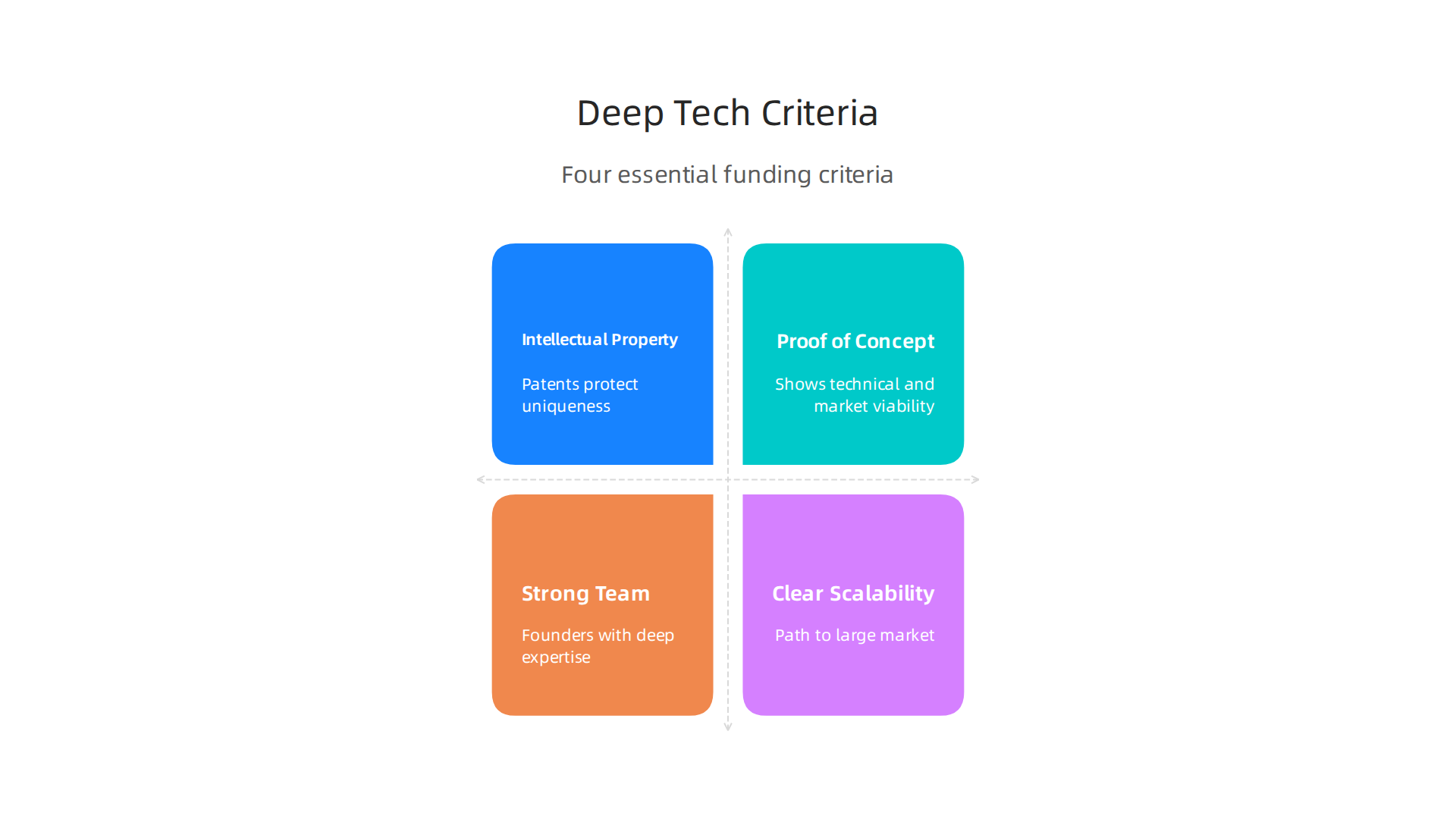
These four criteria form the new standard for evaluating deep tech startups in 2026.
Sector matters hugely. At seed stage, round sizes look similar across sectors, averaging $4 to $5 million. The divergence hits at Series A. AI companies raise $50 million or more because they need compute infrastructure and expensive talent. Biotech rounds average over $30 million. Climate tech raises much smaller rounds, around $7 million, because the capital goes to pilot projects rather than full buildout.
Geography is shifting too. The United States still leads in absolute dollars, accounting for about 45% of all deals. But other regions are catching up fast. According to the Swiss Deeptech Report 2026, Switzerland now directs 63% of its venture capital to deeptech, the highest share of any nation in the world.

Israel and Sweden lead when measured by funding relative to GDP.
Corporate venture capital is the second largest source of early deep tech funding. Family offices, sovereign wealth funds, and government backed vehicles are also co-investing alongside traditional VCs at Series A and beyond.
The bottom line is simple. The window for deep tech is wide open, but it is also more selective than ever. You need to understand the sector specific trends for your vertical, target the right geographic hubs, and prepare for a longer fundraising cycle with more rigorous scrutiny.

And if you want to stay ahead of the AI driven shifts that are reshaping this entire landscape, you should get clear daily AI updates from a trusted source. The pace of change is too fast to follow on your own.
The next section will walk through the specific milestones and metrics that deep tech investors expect to see at each stage of your fundraising journey.
Budgeting for Innovation: Strategies That Work
Here is the hard truth. Many deep tech startups fail not because their technology is bad, but because they run out of money before reaching a key milestone. The long R&D timelines, expensive equipment, and specialized talent create a cash burn that can kill even the most promising breakthrough tech. The challenge is balancing your long-term vision with short-term survival.

So how do you budget for innovation without burning out?
The most effective framework is the 70-20-10 rule. According to detailed R&D budgeting approaches for deep tech innovation, you allocate 70% of your research budget to core improvements, 20% to adjacent innovations, and 10% to future breakthrough bets. This keeps you focused on your main product while still exploring new opportunities. Many successful deep tech companies use this split to manage risk.
What about the actual numbers? Industry benchmarks show that deep tech startups at the seed stage typically spend 60 to 80% of their budget on research and development. That is much higher than a SaaS company, which might spend 30 to 40%. Sales and marketing get a smaller slice, often only 10 to 20% until you have a product ready. The mistake founders make is copying the budget models of software startups. Your capital allocation must match your real cost drivers like lab equipment, prototyping, and compliance.
Another proven strategy is milestone-based budgeting. Instead of setting an annual budget and hoping it works, you tie each dollar to a specific technical or regulatory milestone. This helps you avoid overspending on unproven ideas and gives investors confidence that you manage money wisely. It also forces you to define your innovation definition clearly. What does success look like at each stage? Write it down and fund it accordingly.
You should also explore non-dilutive funding sources like government grants to extend your runway. Grants do not require giving up equity, which is critical when you are still validating your block tech.
Building a smart budget is not just about survival. It is about showing investors you understand the business side of breakthrough tech. And to keep your strategy sharp, you need to stay informed about the fast-moving tech landscape. If you want to stay on top of the trends that affect your budgeting decisions, get daily AI updates from The AI Newsletter Worth Reading.
The 70-20-10 Rule for R&D Allocation
You might wonder how to split your innovation budget without guessing. The 70-20-10 rule gives you a clear framework. Put 70% of your research money into core R&D. That means improving your main product or technology. Then use 20% for experimental projects related to your core. And finally, put 10% into adjacent bets, like new markets or completely different technologies.
This split has worked for many successful companies. It keeps your team focused on what makes money today while still exploring tomorrow’s ideas. The balance protects you from betting everything on one risky idea. It also stops you from ignoring future opportunities.
But you cannot just copy the numbers blindly. If you are in biotech, your core research might need more than 70%. In hardware, prototyping costs might push your experimental budget higher. The key is to understand your sector’s real cost drivers. For deep tech startups, these key cost drivers for deep-tech startups often include expensive lab equipment and long validation times. Adjust the percentages to match your reality.
The 70-20-10 rule works best when you pair it with milestone-based budgeting. Tie each portion of the budget to a specific outcome. That way, you know exactly where your money is going and why. If a 20% experimental project does not hit its milestones, you can shift that money back to core R&D.
This approach also helps you explain your spending to investors. They want to see that you have a plan for managing risk while chasing breakthrough tech. A clear allocation model shows you understand the business side of innovation.
If you want to dive deeper into how to present your technology strategy to investors, check out this guide on tech tools for startups in 2026 that attract investors. It gives you practical ways to match your tools and budget to what investors are looking for.
What Investors Really Want from Breakthrough Startups
You have your R&D budget figured out. Now comes the hard part: convincing investors to write you a check for your breakthrough tech. In 2026, the venture market is more selective than ever. Investors are not just looking for cool science. They want a clear path to a big market, strong protection around your technology, and a team that can execute.
Technology defensibility comes first. Investors want to know that your idea is hard to copy. That means patents, trade secrets, or proprietary data that gives you a moat. According to the ICLUB deep tech investment guide, the four new standards for evaluating deep tech startups include IP, proof of concept, team, and scalability. If you cannot show a strong patent portfolio, many investors will pass.
Market size matters more than early revenue. Investors fund moonshots with long timelines. They want to see a total addressable market big enough to return their fund. A deep tech startup with a billion-dollar market opportunity is more attractive than one with early sales in a small niche. The valuation premium goes to companies that can prove their technology can scale.
Your founding team is everything. Domain expertise and execution track record are the number one factor investors evaluate. They want founders who have deep technical knowledge and know how to ship a product. They also look for coachability and team dynamics. A strong technical founder who has failed before and learned from it is often more attractive than a first-time founder with a perfect resume.
Due diligence goes deep. Investors now conduct detailed technology readiness assessments. They check if your technology is at proof-of-concept, prototype, or production stage. They review your patents for breadth, geographic coverage, and remaining life. They also look at your scientific publications and internal R&D reports to verify claims. Expect weeks of technical review, not days.
Common reasons deep tech deals fall through. The biggest killers are an unclear go-to-market timeline, regulatory risks, and a lack of a strong advisory network. If you are in biotech or climate tech, you need a roadmap for regulatory approvals like FDA or CE certifications. If you do not have advisors who know the industry, investors will worry about your ability to navigate those hurdles.
To set yourself up for success, make sure your pitch clearly connects your breakthrough tech to a real market need. Show how your IP protects you. And demonstrate that you have the team and advisory network to handle the long road ahead.
If you want to learn how to frame your technology for investors more effectively, check out this guide on framing tech for startup fundraising success.

And if you want to stay on top of the latest AI breakthroughs that could shape your pitch, get clear daily AI updates from The Deep View Newsletter.
From Lab to Market: Commercializing Breakthrough Tech
So you have investor interest. But how do you actually turn a lab discovery into a real product? That is the hard part. The journey from a breakthrough idea to something you can sell often takes 5 to 10 years. You need patient capital that does not expect overnight revenue, and you need to validate your technology in phases.
The best deep tech companies do not go it alone. They build bridges between universities, government labs, and industry partners. This mix gives them access to funding, expertise, and real-world testing grounds.

For example, look at Blue River Technology, a startup born from Stanford research. They used computer vision for smart farming. Instead of trying to build everything themselves, they partnered with John Deere. After years of conversations and vetting, Deere acquired them for $305 million in 2017. That is a textbook case of pairing breakthrough tech with a corporate partner that can scale it. You can read more about how corporates and startups commercialise deep tech IP in this LinkedIn article.
Another way to speed things up is iterative prototyping and early customer feedback. Instead of waiting years for a perfect product, successful founders build rough versions and test them with real users. This shrinks the time to market and helps you avoid costly mistakes. Each round of feedback makes your technology more practical and more attractive to investors.
Patient capital matters here. Venture firms that specialize in deep tech know that revenue will come later. They evaluate you on your technical readiness, your patent portfolio, and your team’s ability to execute over a long timeline. If you can show steady progress through phased validation, you keep them on board.
Finally, do not underestimate the power of corporate venture capital. Big companies like John Deere, Shell, and Siemens have investment arms that fund and partner with deep tech startups. These relationships can give you credibility, distribution, and funding without the pressure of a traditional VC timeline. If you want to understand how to build those ties, read our guide on corporate venture capital for startup fundraising.
Moving from lab to market is a marathon. The founders who succeed are the ones who plan for a long race, build smart partnerships, and keep testing their ideas in the real world. Your breakthrough tech can change an industry, but only if you commercialize it step by step.
How AI Is Supercharging Breakthrough Innovation
AI is not just another tool in the lab. It is the engine that is speeding up how we discover new drugs, design materials, model climate change, and even write quantum algorithms. This is the biggest shift in innovation def since the internet itself. If you are a founder working on breakthrough tech, you need to understand where AI fits in your own research and development process. It can slash your timelines and cut your costs dramatically.
Let us look at one area where this is happening right now: drug discovery. The old way of finding a new drug takes over a decade and costs billions of dollars. AI is changing that. In 2026, the market for AI in drug discovery is expected to exceed $24.51 billion. Researchers are using AI to predict how proteins fold, simulate chemical reactions, and even design new molecules from scratch. The global pharmaceutical pipeline now has over 3,000 drug candidates that were developed or repurposed with AI assistance. That is a massive leap forward. Companies like Pfizer are partnering with AI research labs like Boltz to build foundation models for biomolecular design. You can explore more about how AI is shaking up drug discovery in this year of 2026.

But drug discovery is just one piece of the puzzle. AI is also transforming materials science. Imagine trying to find a new battery material that is lighter, cheaper, and safer than lithium ion. In the past, researchers had to test thousands of combinations manually. Today, AI models can run virtual experiments and predict which compounds will work best. This is called computational screening, and it is cutting years off the development cycle.
The same thing is happening in climate modeling. AI can process massive amounts of data from satellites, sensors, and weather stations to make more accurate predictions about storms, droughts, and rising sea levels. That helps governments and companies plan ahead and respond faster.
And then there is quantum computing. While full scale quantum computers are still a few years out, AI is already helping researchers design better quantum algorithms. In 2026, about 18 percent of global quantum algorithm revenue is expected to come from AI applications. The two technologies are starting to feed each other.
So what does this mean for you as a founder? You do not need to be building an AI model yourself. But you do need to look at your own R&D pipeline and ask: Where can AI speed things up? Maybe it means using AI to analyze your test data faster. Maybe it means running virtual simulations instead of building physical prototypes. The founders who win in budget technology are the ones who use AI to get more done with less money and less time.
If you want to stay on top of the latest AI breakthroughs and how they affect startup fundraising, there is one daily source that cuts through the noise. Get clear daily AI updates from The Deep View Newsletter. It is the easiest way to keep your finger on the pulse of AI without spending hours reading scattered reports.
Summary
This article explains what counts as breakthrough technology in 2026 and gives founders practical guidance on funding, budgeting, and commercialization. It defines breakthrough tech categories—AI, biotech, quantum, advanced materials, and clean energy—and outlines the changed venture landscape where deep tech now captures a large share of capital but with fewer, larger rounds and much deeper due diligence. You’ll learn a budgeting framework (the 70-20-10 split), milestone-based funding tactics, and why non-dilutive and corporate capital matter. The guide also details what investors demand—IP, proof-of-concept, team, and scalability—and how to move innovations from lab to market using partnerships and iterative prototyping. Finally, it shows how AI is accelerating drug discovery, materials design, and other R&D tasks so founders can cut timelines and costs while better preparing pitches for selective deep‑tech investors.