
Why ‘Framing Tech’ Matters for Fundraising Today
Getting money for your startup can be tough. You have a great idea and a cool product, but sometimes investors don’t quite get it. This often happens because of how you talk about your technology. This is where "framing tech" comes in. It’s not just about what your tech products do, but how you explain them to people who might give you money.

In 2026, technology is changing super fast. Things like AI are growing quicker than ever before, becoming part of many new ideas Artificial Intelligence Index Report | Stanford HAI. With so many new tech products coming out, investors are looking for clear stories, not just fancy tech words. How you "frame" your technology helps them see the big picture and why your idea is worth their money. It’s about showing the value, not just the details.
Many founders get stuck here. You might be super good at building your graph tech or other innovative technology, knowing all the ins and outs. But when you talk to investors, they need to hear a different kind of story. They want to know:
- How does your technology solve a big problem?
- Who will use it and why will they love it?
- How will it make money?
- Why is your technology better than what’s already out there?
The gap is between the deep technical talk and the clear, exciting business story. Investors are looking at big trends in the market and how new technology fits into investment products 2026 Trends Shaping Investment Products – BlackRock. You need to bridge that gap with your framing tech approach.
This guide will show you how to do just that. We’ll look at easy frameworks you can use, important numbers (metrics) that investors care about, and real examples of how others have talked about their technology y to get funded. We’ll help you learn the best ways to present your technology, so you can attract the right investors and get the funding you need. Understanding the right way to define your technology for investors can make a huge difference in your fundraising journey. You can learn more about this by reading our piece on technology definition 2026 the framework every founder needs for investor clarity.
To truly succeed, founders also need to stay updated on the latest shifts in technology and market intelligence.
Get clear daily AI updates from The AI Newsletter Worth Reading.
When we talk about "framing tech," we’re not just saying "explain your technology." It’s a special way of looking at how you tell your startup’s story, especially the tech part, so that investors truly understand its value and potential. It’s about turning complex details into a clear, exciting vision.
Framing tech means putting together four key parts:
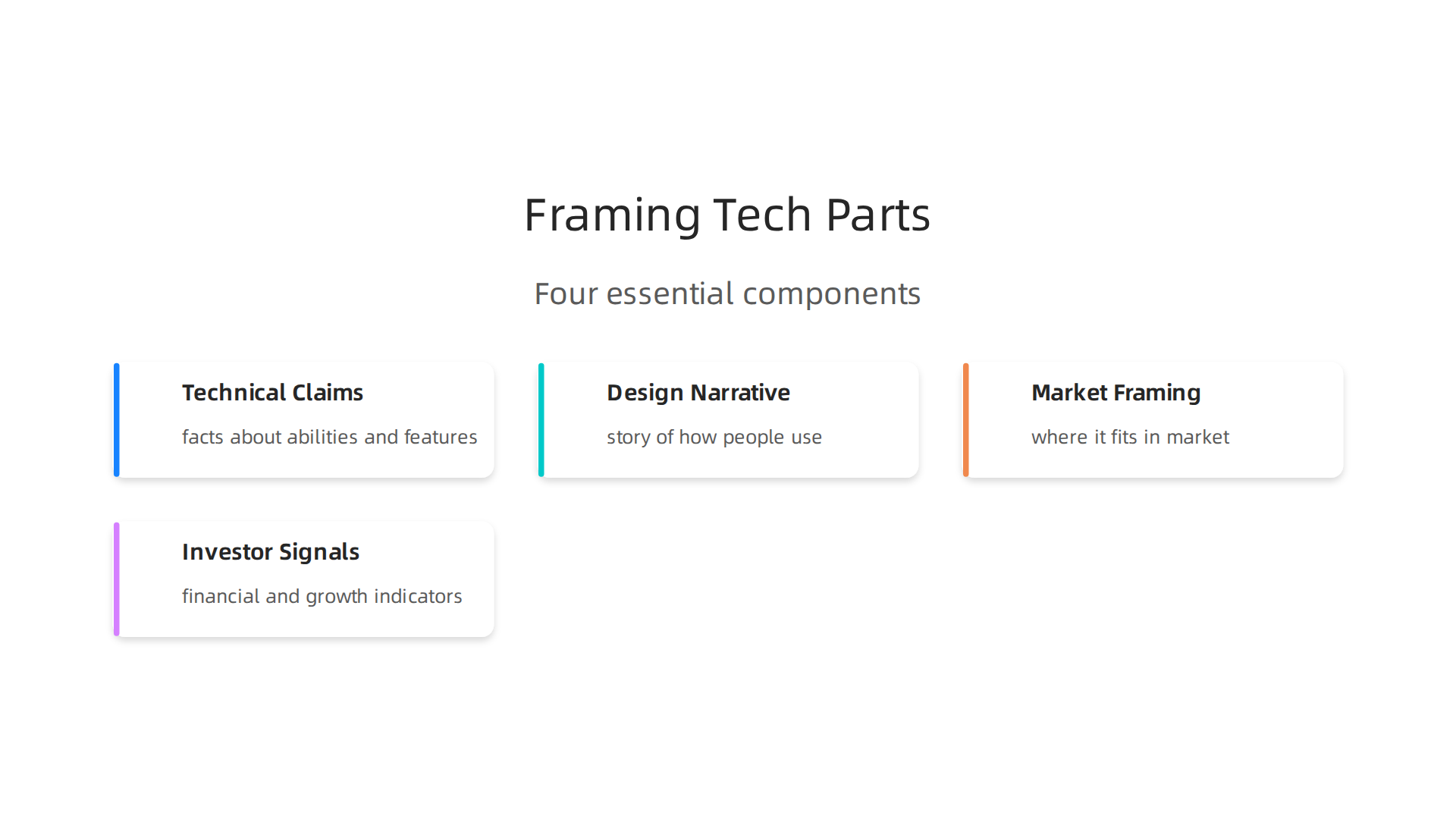
- Technical Claims: This is about what your technology actually does. If you’ve built an amazing piece of graph tech or another innovative [technology y], these are the facts about its abilities, features, and how it works. You might know all the details, but for investors, you need to make these claims easy to grasp.
- Design Narrative: This part tells the story of how people will use your [tech products]. What’s the experience like? How does it make their lives better or work easier? It’s about showing the user’s journey and why they’ll love your solution.
- Market Framing: Here, you explain where your technology fits in the big picture. What problem does it solve for a specific group of people? How is it different and better than what’s already out there? This shows investors that your idea has a real place in the market and can attract many customers. In 2026, understanding market trends is key, with new reports highlighting emerging trends that redefine IT strategies Tech Trends 2026 Report Released: Eight Emerging….
- Investor Signals: This is about showing the money part. How will your technology grow into a big business? What numbers or plans prove it can make a lot of profit? Investors are always looking for clear signals that their money will grow.
Why Poor ‘Framing Tech’ Can Hurt Your Startup
When founders don’t use good [framing tech], it can cause big problems that stop them from getting funded.
- Misunderstandings: If your explanation is unclear, investors might not get what your technology does or why it’s special. They might think it’s just another idea without a clear path to success.
- Problems during Due Diligence: Due diligence is when investors dig deep to check everything about your company. If your initial explanation was confusing, this part becomes much harder. They might find it tough to confirm your tech’s real potential or how well it works.
- Lower Company Value: If investors don’t fully understand the value of your [tech products], they might think your company is worth less. This means you get less money for your shares, or you have to give away more of your company to get the funding you need. Valuing early-stage startups can be tricky, and clear communication helps a lot.
- Loss of Investor Trust: If you can’t explain your technology simply and effectively, investors might wonder if you truly understand your own business, or if you’re trying to hide something. Trust is super important in fundraising.
In short, good [framing tech] helps you avoid these pitfalls. It makes your startup appealing, easy to understand, and trustworthy, which are all crucial steps to getting the investment you need.
Learning how to frame your tech well is super important. Now, let’s look at some simple ways founders can tell their tech story to investors. Think of these as different starting points for your conversation.
Practical Frameworks for Framing Technology in Fundraising
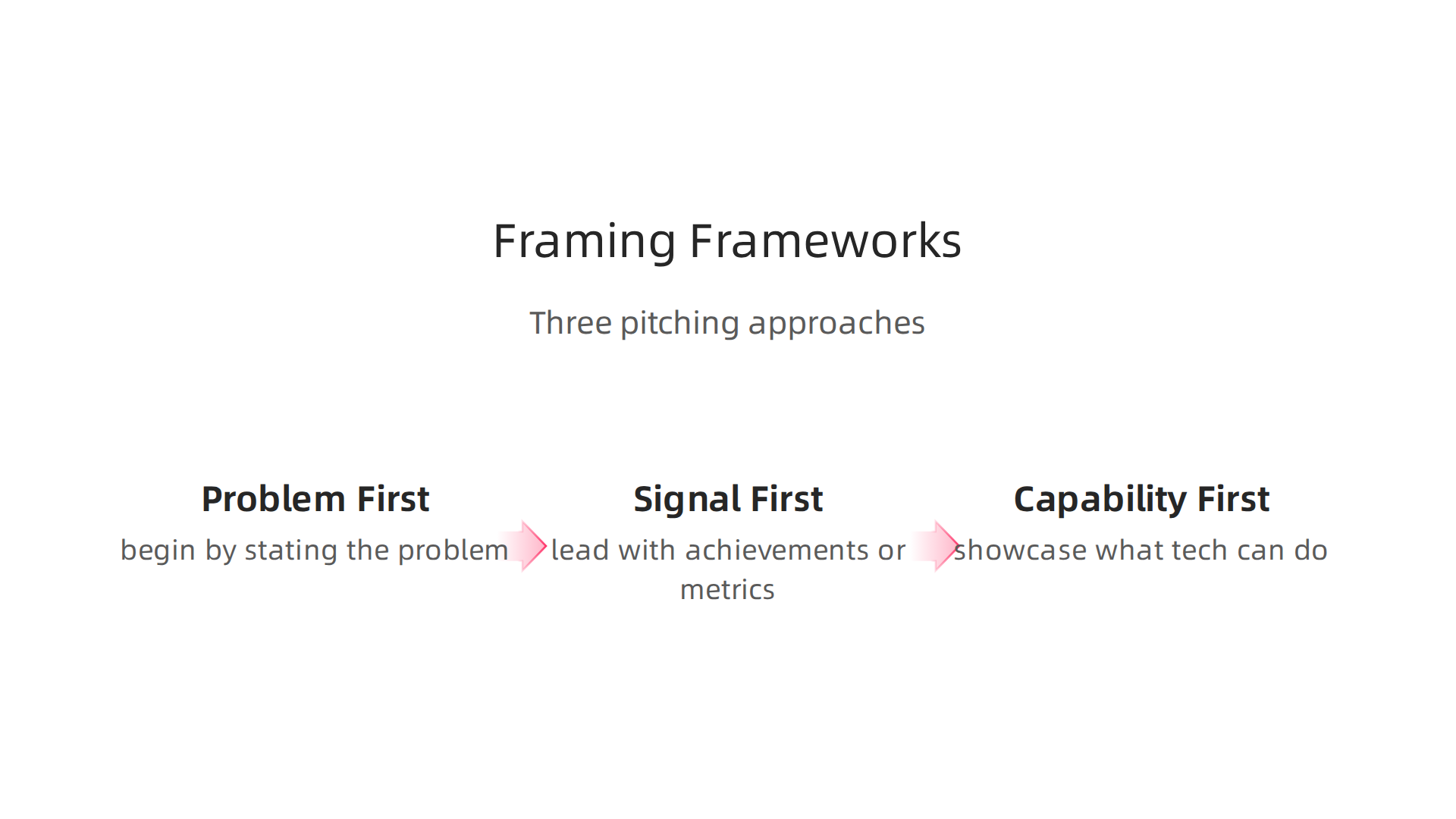
To make sure investors truly "get" your [tech products], you can use different ways to tell your story. Here are three practical frameworks, or approaches, that can help you when you’re fundraising:
-
Problem-First Approach: This is a great way to start if your technology solves a very clear and painful problem for many people.
- How it works: You begin by describing the big problem in the market. Make it clear why this problem is important and how it affects people or businesses. Then, you introduce your technology as the perfect solution to that problem.
- When to use it: Use this approach when the problem is easy for investors to understand and when your tech offers a really smart, new way to fix it. It works well for areas where existing solutions just aren’t good enough.
-
Signal-First Approach: Sometimes, you have amazing results that speak louder than words. This approach focuses on those strong signs of success.
- How it works: You start with impressive numbers or achievements, like fast growth in users, high customer satisfaction, or big revenue. These are your "signals" that your tech is working. Then, you explain how your underlying technology is the reason for these great results.
- When to use it: This is best when you have clear data or proof that your business is taking off. Investors are always looking for strong signals that show potential for a big return on their money, as new reports on investment products highlight for 2026 2026 Trends Shaping Investment Products – BlackRock.
-
Capability-First Approach: This framework is for when your technology itself is incredibly new or powerful, like a groundbreaking piece of [graph tech] or a never-before-seen [technology y].
- How it works: You lead by showing off what your technology can do. You explain its unique features and capabilities. Then, you connect those amazing abilities to the problems it solves and the value it creates for users and the market.
- When to use it: This works best for highly innovative or complex technologies, like advanced AI tools. You might even show a quick demo of your tech in action. Many founders are now using advanced AI tools for investor pitches to showcase their capabilities effectively.
No matter which approach you choose, the goal of [framing tech] is to make your story easy to follow and exciting for investors.
Your Simple Checklist for Framing Tech
Before you talk to investors, use this quick checklist to make sure your technology story is clear and powerful:
- What big problem does your technology solve? Can you explain it in one sentence?
- Who are your users, and how does your tech make their lives better or easier?
- What are the key things your technology can do that no one else can?
- What makes your tech truly special and different from other solutions?
- How will your technology lead to a successful business and make money for investors?
By thinking through these points, you can make sure your pitch is strong and covers all the important parts investors want to know. Learning how to properly explain your tech is a key part of attracting investors and growing your startup. It’s crucial for founders to develop a strong technology background for startup fundraising in 2026 to succeed.
To keep up with the latest advancements, especially in rapidly evolving areas like artificial intelligence, it’s wise to have trusted sources. Get clear daily AI updates from The AI Newsletter Worth Reading.
Talking about your tech is one thing, but showing it can be even better, especially for investors who aren’t tech experts. In 2026, new AI and design tools make it much easier to bring your ideas to life. These tools help with [framing tech] by making its value clear and easy to see.
Using AI and Design Tools to Shape Investor Narratives
It’s one thing to explain your groundbreaking [tech products] in words. It’s another to show investors exactly what they can do.
Modern AI-assisted tools and smart design practices help make your technology’s value real for anyone, no matter their technical background.
Think about using:
- AI-assisted prototypes: These are like simple, working versions of your product. Investors can click through them to get a feel for how your app or system works. They can see the user experience firsthand, which helps them understand the problem you’re solving and how your solution helps.
- Generative demos: These tools can create short, impressive videos or interactive displays of your technology in action. For example, if you have amazing [graph tech] that visualizes complex data, a generative demo can quickly show how it turns numbers into clear pictures. If your new [technology y] creates unique content, a demo can show that content being made. This can be much more impactful than just talking about it. Many teams are actually using AI tools for better design processes, as explored in The 2026 AI Design Field Report (tools, process, and what’s working).
- Design systems: Even if your tech is complex, a clear and polished look shows professionalism. Using a design system means all parts of your product look and feel consistent. This shows investors that you care about the user experience and have a well-thought-out plan for your product’s future.
When you’re fundraising, you don’t need a perfect, finished product to show a demo. The goal is to give investors a taste of what’s possible and make your technology tangible.
Simple Ways to Use Demos in Your Pitch:
- Keep it short: A demo should only last a minute or two. Show the most exciting and important parts.
- Focus on the "aha!" moment: What’s the one thing that will make investors say, "Wow, that’s smart!"? Show that.
- Don’t over-promise: Only show what your technology can actually do or what you can easily make it do in a simple prototype. Be honest about what’s still in development.
- Explain simply: While the demo runs, explain clearly what they are seeing and how it solves the big problem you talked about.
By using these modern tools, founders can tell a much stronger story. It shows you’re not just dreaming, but actually building. This hands-on approach to [framing tech] can make a huge difference in how investors see your company’s potential. Understanding the deeper workings of your systems also helps. It’s often true that Founders Who Understand Computer Systems Technology Attract More Investors. This strong understanding, combined with clear demos, can truly boost your fundraising efforts.
Showing your technology is a great step, and the next is telling a clear, strong story about it. This means explaining how your product’s design makes users happy and brings value that investors care about. In 2026, smart design isn’t just about good looks, it’s about showing real business results.
Design-Led Product Stories That Drive Valuation
Investors want to know how your [tech products] will grow and make money. A great way to show this is by connecting your design choices directly to things like user retention, how much users engage with your product, and how your product turns users into paying customers. This is what we call a "design-led product story." It’s about explaining the "why" behind your design and how it helps your business succeed.
Think of it this way: every good design choice is a step towards a happier customer and a stronger business. Storytelling in design helps create empathy and makes connections with users, which is important for your product’s success and your pitch to investors, as discussed in "What is Storytelling? — updated 2026" from IxDF.
Here are the key things investors look at, and how design plays a big part:
- Retention (Keeping Users): If your product is easy to use and delightful, people will keep coming back. Good design makes a product sticky. For example, a clear onboarding process helps new users get started easily, which means they are more likely to stay. This translates into better user retention rates, a key number for investors.
- Engagement (Users Love Using It): When users find your product valuable and enjoyable, they spend more time using it. Maybe your [graph tech] makes complex data easy and fun to explore, so users keep playing with it. Or perhaps your interface makes sharing content simple. High engagement shows investors that your product truly solves a problem and keeps users hooked.
- Monetization Signals (Making Money): Design can guide users towards features that lead to sales. This doesn’t mean tricking them, but making it clear why a premium feature or subscription is worth it. A well-designed upgrade path or a free trial that highlights key paid features can naturally lead users to become paying customers. This thoughtful approach to design and monetization is a topic explored in "Monetization Considerations in Product Design".
Connecting Design Choices to Investor Claims
To help you tell this story, here’s a simple way to link your product’s design to what investors want to hear.
This table can help designers and product managers frame their work in a way that shows direct business value.
| Design Goal | User Benefit | Investor KPI (What Investors See) | Investor Claim (What You Tell Them) |
|---|---|---|---|
| Intuitive User Interface | Users learn and use features quickly | Faster onboarding, Higher completion rates | "Our design reduces the time it takes for new users to complete their first task by 50%, boosting initial engagement." |
| Personalized Experiences | Users feel the product is made for them | Increased user satisfaction, Longer sessions | "Personalized feeds mean users spend 20% more time on our platform, showing strong content relevance." |
| Seamless Integration | Easy to connect with other tools/apps | Reduced friction, Wider adoption | "Our [technology y] integrates with top platforms, removing roadblocks for users and accelerating market penetration." |
| Clear Value Proposition | Users understand what they gain | Higher conversion to premium features | "Our premium feature design clearly highlights benefits, resulting in a 15% conversion rate from free to paid users." |
| Accessible Design | Product usable by everyone | Broader market reach, Positive brand image | "By prioritizing accessibility, our [tech products] appeal to a larger user base, growing our market potential." |
By using this approach, you’re not just showing beautiful designs; you’re clearly [framing tech] as a driver for business success. This allows investors to see not just the cool features, but the real impact those features have on your bottom line. It’s a powerful way to accelerate your fundraising efforts. Getting a deep understanding of what investors are looking for in 2026 can also be very helpful. If you want more in-depth insights into the world of AI and technology, beyond just fundraising news, consider signing up for The Deep View Newsletter. It’s a great way to stay informed about broader tech market intelligence.
To truly understand what investors want, you need to show them how your [tech products] lead to real numbers. It’s not enough to say your design is great; you must prove it with data.

In 2026, investors look closely at specific metrics to see if your startup is growing in a smart way. These numbers turn your ideas and designs into clear signals of business health and future success.
Here are the most important metrics that help in [framing tech] as a strong investment:
Core Investor Metrics
- LTV (Lifetime Value): This metric tells investors how much money a customer is expected to bring to your business over their whole time using your product. A high LTV means your product keeps users happy and paying, which shows a strong, lasting business. Good design that improves engagement and retention directly helps boost LTV.
- CAC (Customer Acquisition Cost): This is how much it costs you to get one new customer. Investors want to see that you can get new users without spending too much money. If your product is so good it spreads by word of mouth, or if your marketing is very efficient because your solution is so compelling, your CAC will be low. This tells investors you have a scalable business model.
- Engagement Cohorts: This sounds fancy, but it just means looking at how different groups of users (called cohorts) behave over time. For example, you might look at all the users who signed up in January and see how many are still using your product in February, March, and so on. This shows if your product truly keeps users hooked. If your [graph tech] makes data analysis super engaging, you’ll see users in older cohorts still actively using it. These metrics are key ones investors will be watching closely in 2026 to understand your startup’s performance and potential for growth, as noted by Abacum in their look at startup metrics to track for growth and investors.
Choosing Your Lead Metrics
It’s easy to get lost in too many numbers. Investors don’t want to see every single piece of data you have. Instead, they want to see 3 to 5 "lead metrics" that clearly show your product’s momentum. These are the numbers that prove your business is moving in the right direction and growing.
When picking your lead metrics:
- Keep it simple: Choose metrics that are easy to understand and directly relate to your business goals.
- Focus on growth: Pick metrics that show how your product is getting more users, more engagement, or making more money.
- Show progress over time: Investors love to see trends. Show how your chosen metrics have improved month over month or quarter over quarter.
- Connect to your story: Make sure these metrics support the "design-led product story" you’re telling. If your [technology y] makes a process much faster, show a metric that proves that speed increase.
A clear, well-structured pitch deck will highlight these important metrics, showing investors that you understand your business deeply. Many successful startups use certain approaches in their pitch decks to secure funding, and understanding what works can be a huge advantage. You can even learn from an analysis of 1000 winning pitch decks to see what works in 2026.
Remember, investors are looking for proof that your company is ready to grow. By carefully choosing and presenting your lead metrics, you show them not just what your [tech products] can do, but how they contribute to a strong, valuable business. For founders, having a solid grasp of how technology impacts these numbers and investor appeal is vital for successful fundraising, and you can learn more about why founders need a strong technology background for startup fundraising in 2026.
After picking your key metrics and crafting your design-led story, the next big step is to show it off to investors. This is where your work on [framing tech] truly shines, guiding investors through your vision in pitch decks, live meetings, and during talks about term sheets.
In Your Pitch Deck
Your pitch deck is like the first handshake with an investor. It needs to tell a clear, simple story about your company and its potential. When you are presenting your [tech products], make sure your framing helps explain your big ideas easily.
Here’s how to do it:
- Problem Slide: Start by showing a big problem that needs fixing. Your [framing tech] should immediately hint at how your product solves this problem in a new and better way. Investors want to see that your solution isn’t just cool, but truly useful.
- Solution Slide: This is where you introduce your product. Clearly explain what your unique [technology y] does and how it works. Don’t use too much jargon. Instead, focus on the benefits for the user. Think about how top startups explain their ideas in their presentations, as detailed in guides like the one on pitch deck structure that investors want to see in 2026.
- Market Opportunity & Traction: Use those important lead metrics you chose earlier. If your product uses [graph tech] to show growth in a very clear way, highlight that. Show how your product is already making a difference and how big the opportunity is. Good design helps make your data easy to understand, following Pitch Deck Design Best Practices 2026: What Investors Expect.
- Team: Show off your team’s skills, especially those related to your unique technology. This builds trust that you can deliver on your promises.
Remember, a pitch deck is a story, not just a list of facts. Good storytelling helps investors connect with your vision, as explained in What is Storytelling? — updated 2026.
During Live Meetings
When you talk to investors face-to-face, your goal is to make your [framing tech] come alive. You’ve prepared your deck, now practice telling your story with passion and clarity.
- Keep it Simple: Even if your technology is complex, explain it in a way anyone can understand. Focus on the value your [tech products] bring.
- Be Ready for Questions: Investors will ask tough questions. Use your metrics and your clear framing to answer them confidently. Show how your technology is a key part of your success. If you can explain your company’s core Technology Definition 2026 The Framework Every Founder Needs for Investor Clarity, you’ll build even more trust.
- Show, Don’t Just Tell: If you have a working product, show a quick demo. Seeing your [framing tech] in action can be very powerful.
Shaping Investor Expectations and Term Sheets
A strong, clear story about your [tech products] doesn’t just get you meetings; it changes how investors see your company’s value.

When investors truly understand your technology, its market, and your growth potential, they see less risk.
This good understanding can give you a stronger hand when discussing term sheets. Investors might be more willing to offer better valuations or more favorable terms because they believe in your vision and the way you’ve framed your technology. Clear framing reduces uncertainty, which is always a good thing for fundraising. Building a strong technology presence, like understanding Stark Tech 2026 Attracting Investors and Accelerating Fundraising, helps set these higher expectations.
To stay sharp on the latest tech and investor trends, especially in areas like AI that are constantly evolving, it’s smart to keep learning.
Get clear daily AI updates from The AI Newsletter Worth Reading.
Summary
This article explains why