

Why ‘Technology’ Needs a New Definition in 2026
What does the word "technology" really mean these days? You hear it everywhere. A new food product is "tech." A carbon capture startup is "tech." So is a sock subscription box. The word has grown so loose that it often confuses more than it clarifies. If you are a founder pitching to investors or an analyst tracking markets, this matters a lot.
Most dictionaries describe technology simply as the practical use of scientific knowledge. That is broad enough to cover almost everything. But when you sit across from a venture capitalist, a fuzzy technology definition can lead to real problems. You might talk about your "AI platform" while they think you are building a traditional enterprise software tool. Misunderstandings like that kill deals.

That is why, in 2026, we need a better framework. A clear, actionable technology definition helps everyone get on the same page. It allows founders to explain their "tech motive" with confidence. It helps investors sort through noise during "this week in tech" updates. And it ensures that terms like "desert tech" or "pb tech" actually mean something specific to your audience.
This article gives you a structured, evidence-based way to define technology. We break down its core parts and show how they shift across sectors. If you want to raise capital or just talk smarter about your work, this framework is for you. And if you need more help choosing the right words for your pitch, check out our guide on technology synonyms to attract the right investors.
The Historical Evolution of the Term ‘Technology’
The word “technology” did not start out meaning smartphones and AI. If you go back far enough, its roots are simpler and much more human.
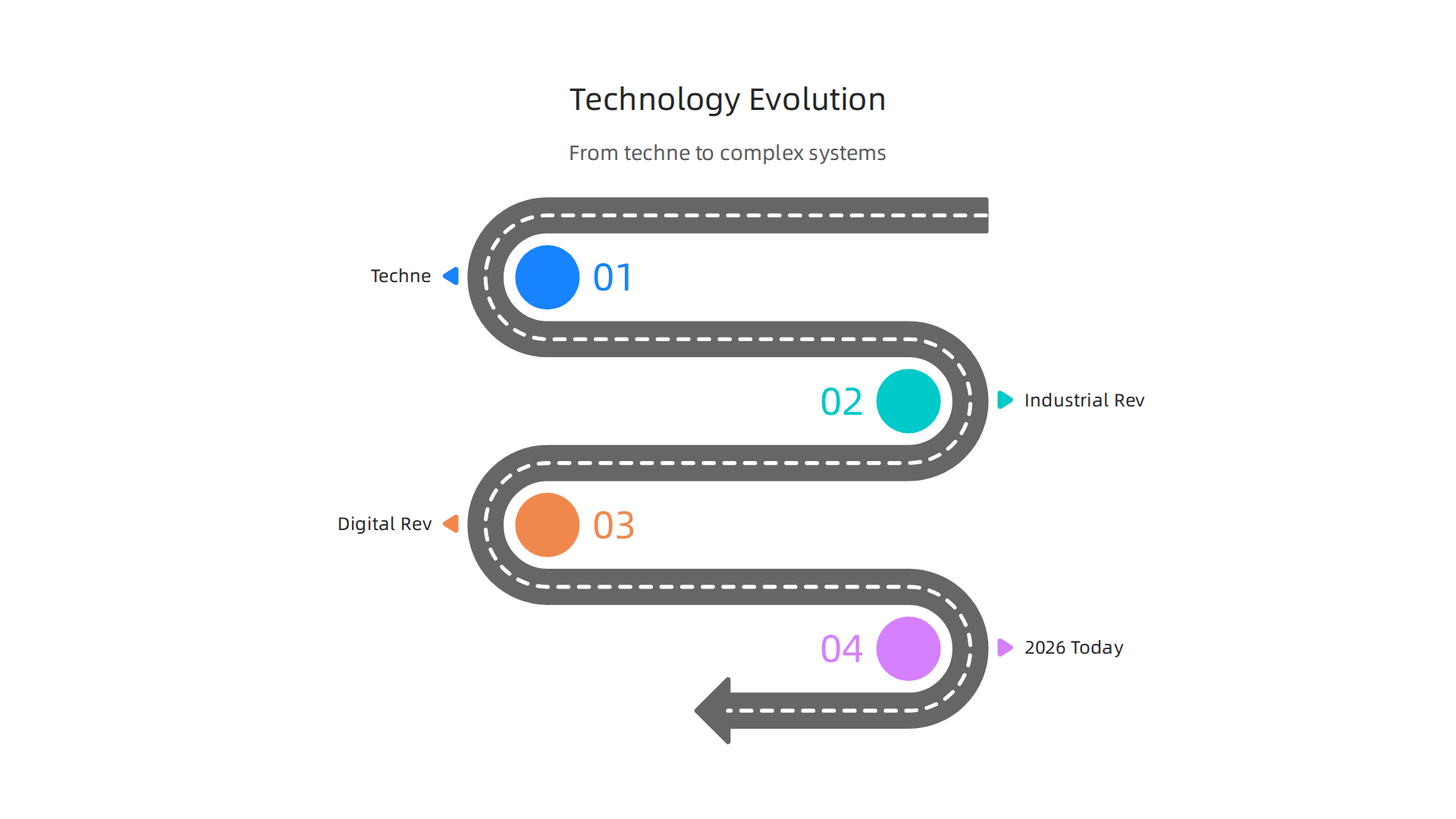
The term comes from the ancient Greek word techne, which means art, skill, or craft. Back then, technology was about the doing of something well, not the machine itself. A carpenter using a chisel had techne. A potter shaping clay had it too. That original technology definition focused on practical skill, not on the tool.
Over time, the meaning shifted. During the Industrial Revolution, technology started to refer more to the machines and processes that powered factories. A steam engine was a technology. So was the assembly line. This was a big jump: the word now described physical inventions that changed how people worked and lived.
Then came the digital revolution. Computers, software, and the internet made technology less visible and more abstract. A piece of code running on a server became a technology. The definition broadened again to include not just hardware but information systems. That is why today, when you check this week in tech news, you read about everything from new AI models to carbon capture plants.
Now in 2026, we are at another inflection point. Quantum computing, advanced AI, and biotech are blurring the lines even more. The U.S. government has listed quantum computing and post-quantum encryption as critical emerging technologies, showing how the definition now includes entire fields of research that barely existed twenty years ago.
Why does this history matter for you as a founder? Because every innovation sits inside a long tradition. When you explain your startup’s tech motive, you are adding your chapter to a story that began with ancient crafts. Knowing the lineage helps you sound credible. It shows investors that you understand where your technology fits in the bigger picture. Instead of calling your product “disruptive tech,” you can trace it back to a specific skill or knowledge tradition. That makes your pitch stronger.
If you want to frame your innovation in a way that resonates with investors, check out our guide on seed enterprise investment strategies for 2026. It will help you connect your technology definition to the real funding conversations happening right now.
Core Components That Define Modern Technology
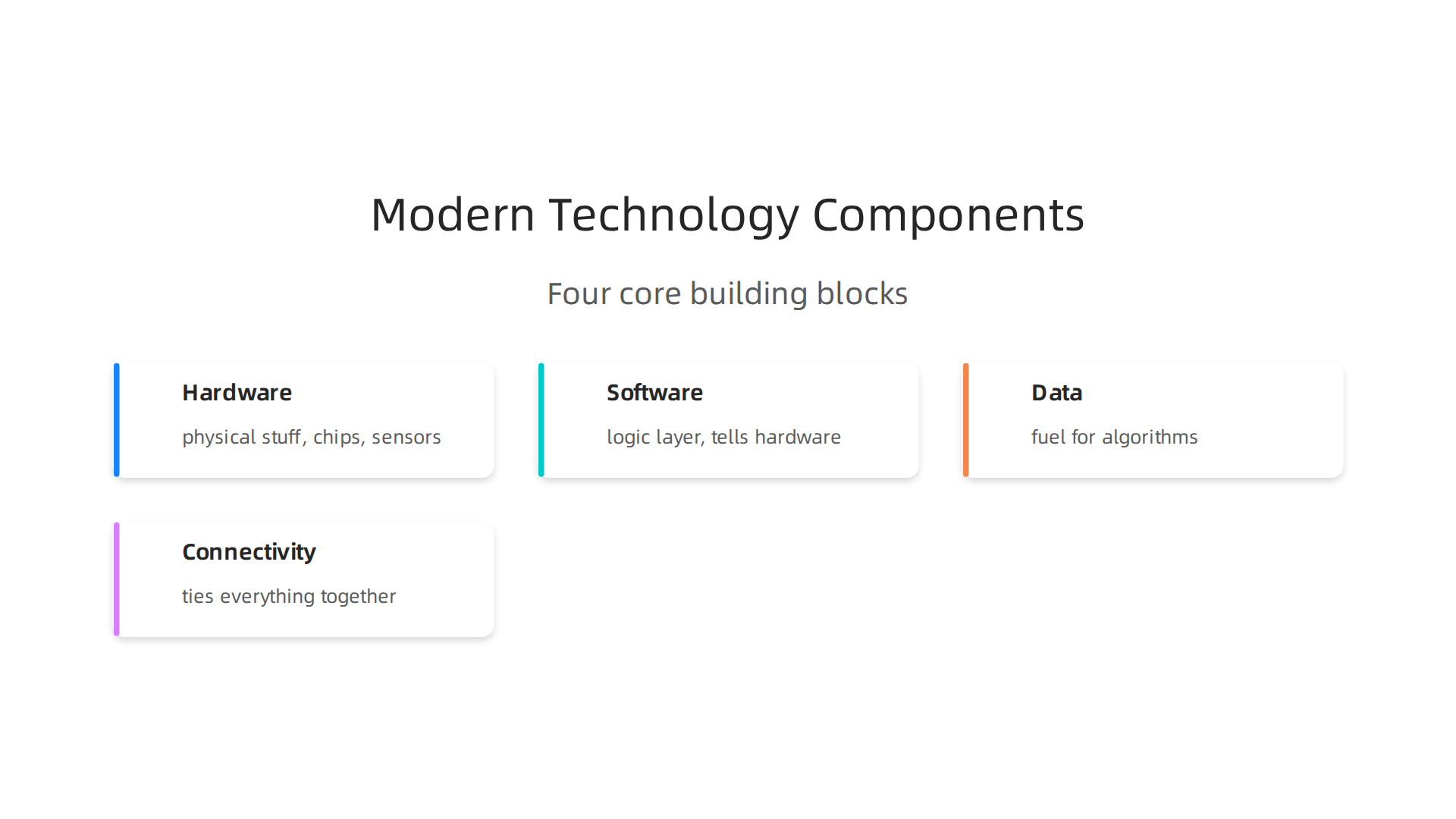
So we have traced how the word evolved from ancient craft to modern systems. But what actually makes up the technology you are building right now? Four universal building blocks sit at the core: hardware, software, data, and connectivity.
Every startup, from a desert tech water sensor company to a generative AI platform, rests on these four pieces.
Hardware is the physical stuff. Chips, sensors, servers, and devices. Investors want to know if your hardware is proprietary or off the shelf. That distinction changes your go to market timeline and your capital needs.
Software is the logic layer. The code that tells the hardware what to do. In 2026, software often eats hardware, but the hardware still needs to exist. Your tech motive becomes clearer when you explain how your software unlocks something the hardware alone cannot do.
Data is the fuel. Without good data, even the best algorithm falls flat. Investors will ask about data sources, quality, and moats. A startup with exclusive data access has a very different technology definition than one relying on public datasets.
Connectivity is the glue that ties everything together. It includes the network layers that allow hardware, software, and data to talk to each other. The OSI model breaks this into seven layers, from the physical cable to the application you see on screen.
Modern internet architecture, as described in a recent CRS report on internet layers, stacks these components so that your cloud app can reach a sensor in the field.
Here is the key insight for founders: the most interesting startups in this week in tech news are not inventing brand new components. They are recombining existing ones in novel ways. A pb tech startup might combine a cheap hardware sensor, a clever software algorithm, and a new connectivity protocol to solve a problem that was impossible five years ago.
When you prepare your pitch, get clear on which of these four blocks is your secret sauce. If you want help framing your innovation for the right audience, check out our guide on technology synonyms to attract the right investors. It will help you translate these building blocks into the language that resonates in the boardroom.
Hardware and Infrastructure
Now let’s focus on the first building block: hardware and the infrastructure that connects it. This is the physical layer of your technology definition. Think servers, networking gear, sensors, and the chips powering everything. Standards like IEEE 802.3dk-2026 define how Ethernet connects local and metropolitan networks, forming the backbone of modern infrastructure. And as systems grow more complex, the challenge of making different devices talk to each other, known as interoperability, becomes critical. The IIoT interoperability survey explores how heterogeneous devices exchange meaningful information across networks.
In 2026, three trends dominate this week in tech coverage of hardware. First, edge computing moves processing closer to where data is created. Standards bodies like AIOTI are actively defining edge computing standards to make this work across industries. Second, quantum hardware is leaving labs for early commercial use. Third, supply chain innovations are making it easier to source critical components without long delays.
Here is the practical takeaway: your hardware strategy affects unit economics and investor conversations. If you are building a desert tech startup or a pb tech company, investors will want to know if your hardware is proprietary or off the shelf. That choice shapes your tech motive and fundraising timeline. For more on framing your hardware advantage for investors, check out our guide on seed enterprise investment strategies in 2026.
Software and Algorithms
Now that we have covered the physical hardware layer, let’s talk about what brings that hardware to life. Software and algorithms form the intelligent core of any technology definition. This layer includes operating systems that manage resources, application software that solves real problems, and AI/ML models that learn and adapt over time.
The OSI model helps us understand how software components talk to each other across seven layers. But here is what matters for founders: the line between "software" and "service" is melting away fast in 2026. With SaaS platforms and AI agents, you no longer buy a program. You subscribe to a capability.
This shift changes your tech motive too. If you are building a desert tech logistics platform or a pb tech consumer app, your software choices affect unit economics and investor conversations. Open-source ecosystems let you move fast and save money early, while proprietary software can create a defensible moat.
The this week in tech headlines show cloud computing and software-defined networking as the standard. As the ITU-T update notes, these technologies now support location-based services and beyond. For a deeper look at how your software stack shapes investor perceptions, check out our guide on technology synonyms to attract the right investors.
Data and Connectivity
Software may be the brain, but data is the lifeblood. In 2026, data needs strong connectivity to flow where it is needed.
Data as an enabler.
Big data and data lakes are the raw materials for your tech motive. You might have spotted it in a this week in tech newsletter: data sovereignty and edge computing are hot topics. The Landscape of Edge Computing Standards report shows how processing data closer to its source makes everything faster. A smart technology definition includes how you manage this flow. Using data the right way impresses investors. Read more on data-driven investment strategies in 2026.
Connectivity unlocks potential.
None of this works without robust connectivity. 5G is the baseline, and 6G pushes ahead. For desert tech projects like remote logistics, satellite internet is a game changer. For a pb tech consumer app, IoT protocols ensure every device connects smoothly. Internet architecture relies on layered standards to operate.
H2 Major Technology Sectors: Definitions and Trends for 2026
If you listen to the this week in tech news, you hear a lot of buzz around AI, cloud, and cybersecurity. But here is the problem for founders: investors scan your pitch deck in seconds. If your technology definition is vague or wrong, they move on.
In 2026, labeling your startup correctly matters more than ever. Each major sector has its own investor language, valuation rules, and growth expectations.
Let us break down the big ones.
AI and Machine Learning dominate headlines. According to a 2026 private markets analysis, 61% of new unicorns in 2025 were AI companies. AI startups reach a billion-dollar valuation in about 3.4 years, roughly half the time of other companies. Your tech motive here is speed and data moats. But AI also touches everything else, from healthcare to logistics.
Cloud Computing is the backbone. Investors look for scalable infrastructure and recurring revenue. Cybersecurity overlaps heavily with AI now. The CB Insights Tech Trends 2026 report shows how AI powered security systems are moving from nice to have to must have.
Your technology definition for a cybersecurity startup should clearly say whether you use AI or not, because investors ask.
Internet of Things (IoT) connects devices in fields like desert tech remote monitoring or pb tech consumer gadgets. IoT definitions often blur with edge computing. A good rule: name the sector that matches your primary value.
Biotech and CleanTech have their own vocabularies. Biotech investors care about FDA milestones and clinical data. CleanTech investors look for carbon impact and regulatory tailwinds. The Deloitte Tech Trends 2026 report highlights how these sectors borrow technology from AI and cloud, creating hybrid definitions.
Here is the kicker: sector definitions overlap constantly. AI is inside cybersecurity. Cloud powers IoT. CleanTech uses biotech processes. That overlap is fine, but you must label your primary sector accurately. If you pitch an AI company to a biotech fund, you waste time and trust.

To get the labels right, learn how to describe your startup in investor language. Our guide on technology synonyms to attract the right investors shows you exactly how to frame your technology definition for each fund type.
Getting the sector right is not just about buzzwords. It is about signaling to the right investor pool that you understand your market, your competition, and your path to revenue.
Why This Matters for Startup Fundraising
Here is the thing. Knowing the sectors is step one. But understanding why your technology definition matters for your actual bank account is step two.
Investors are busy. They scan hundreds of decks a month. To make quick decisions, they use your sector label as a shortcut. They literally bucket you. An AI company goes in the AI pile. A biotech company goes in the biotech pile. Each pile has different risk rules, different valuation formulas, and different expectations for growth.
So what happens if your label is wrong?
You get misfiled. And misfiled startups rarely get funded.

First, you hit the wrong valuation benchmarks.
Let us say your startup uses AI to optimize water usage on farms. That is desert tech remote monitoring. But if you call it general desert tech, a VC might compare your company to slow hardware plays. If you call it what it really is, an AI-powered SaaS platform with recurring revenue, you belong in the AI bucket. And AI companies are valued much higher, much faster. According to a look at top red flags investors look for in startups, confusing positioning is a sure way to get passed over. You want to be in the bucket that highlights your speed and data advantages.
Second, you confuse your target audience.
If you pitch an AI solution to a clean tech fund that invests in solar panels, they will not understand your value. Your tech motive gets lost. You waste time explaining basic concepts instead of talking about your traction.
Third, you fail due diligence.
Investors ask hard questions about your market size and competition. If your technology definition is fuzzy, they will assume you do not understand your own industry. A sharp definition shows you know your space inside and out. Whether you are building pb tech for consumers or enterprise cloud tools, clarity signals competence.
The good news is you can fix this before you send your deck. You need to learn which words attract the right funds and which words push them away. Our guide on technology synonyms to attract the right investors is a perfect place to start.
After you nail your label, you need a fundraising strategy that matches your actual sector. Our piece on seed enterprise investment in 2026 gives you the data driven approach to build your case.
Listening to this week in tech news, you might think labels are just buzzwords. In reality, your technology definition is one of the most strategic tools in your fundraising toolkit. Use it wisely.
Emerging Technologies and Their Shifting Definitions
Here is the thing. Right when you think you have nailed your technology definition, the ground shifts. New fields are popping up that do not fit neatly into the old buckets. And if you are building in one of these spaces, your fundraising strategy needs to change fast.
Take quantum computing. It is not just one thing anymore. Stanford’s Quantum Technologies report breaks it down into three mature areas: quantum computing, quantum communication, and quantum sensing. Each of these has a different tech motive. Each attracts different investors. And each follows different growth rules.
Same goes for synthetic biology and neuromorphic computing. These fields mix biology, hardware, and software in ways that confuse old-school sector labels. If you call your neuromorphic chip a semiconductor play, you get compared to Intel. If you call it what it really is, an AI architecture play, suddenly you belong in the hottest part of the market.
So what is a founder to do?
Watch the regulators. Groups like the U.S. government’s Critical and Emerging Technologies List update their definitions every year. And the National Institute of Standards and Technology (NIST) just released post-quantum encryption standards that officially define what quantum-resistant tech looks like. These are not just paperwork. They are signals. When a regulator codifies a definition, investors start using it.
Founders who track these changes early get what we call the early mover advantage. You can label your desert tech or pb tech startup with a term that is about to become standard. You position yourself ahead of the pack. And you avoid the confusion that kills deals.
If you want to stay ahead of these shifts, your best tool is a clear, well-researched technology definition. Our guide on technology synonyms to attract the right investors helps you pick the words that match your actual innovation. Because in the world of this week in tech, the labels change fast. But your strategy does not have to.
Building Your Own Technology Definition Framework
So how do you actually build a clear technology definition for your startup? It feels like guesswork sometimes. But it does not have to be. A simple framework can turn confusion into confidence.

And it helps everyone your team, your investors, and your customers understand exactly what you are building.
Here is a three step process that works for founders in 2026.
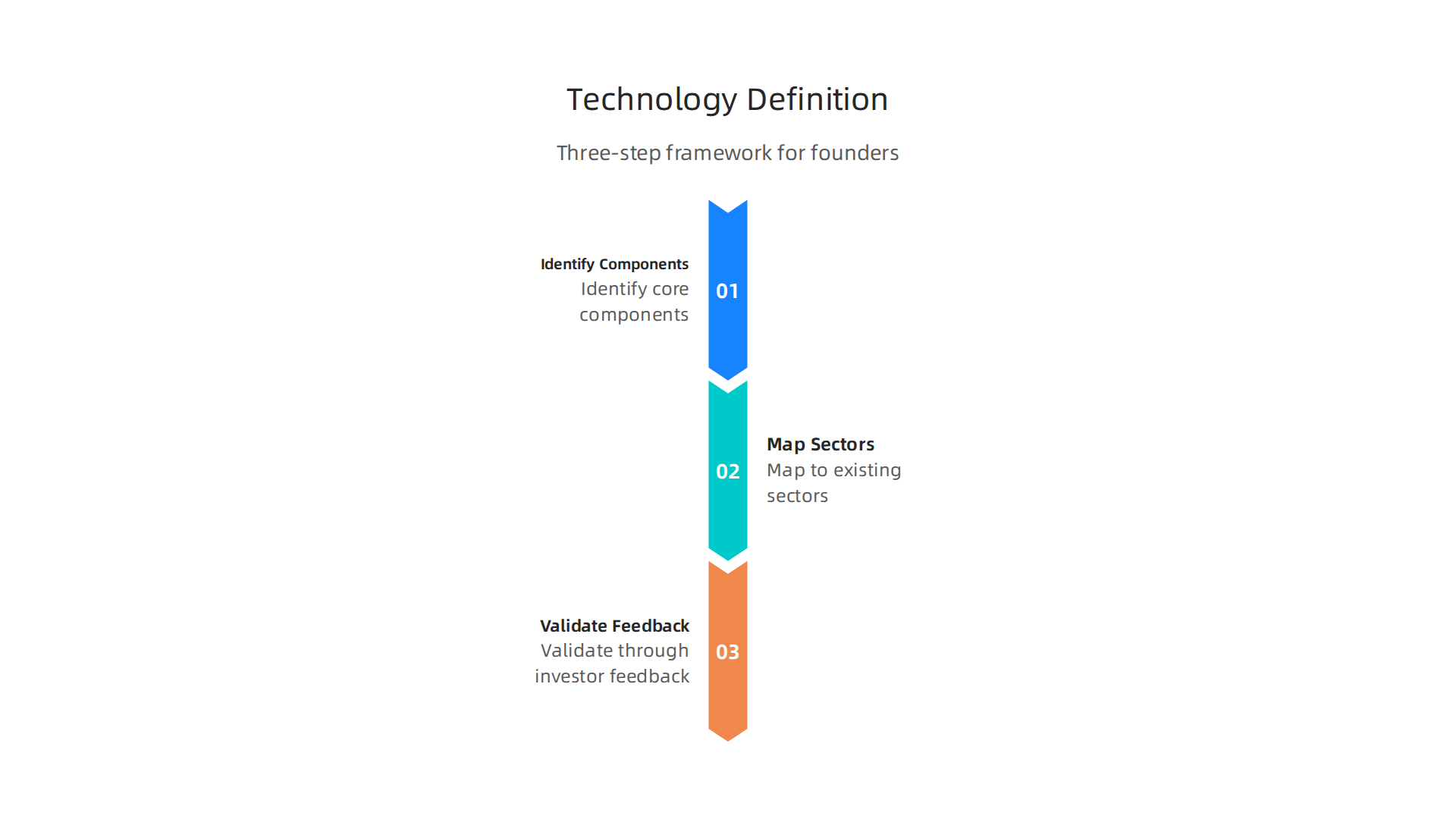
Step 1: Identify your core components.
Break your product down into its basic parts. What is the main function? What problem does it solve? What technical ingredients make it work? Write these down in plain language. Do not worry about fitting into a category yet. Just list what is real.
Step 2: Map to existing sectors.
Take your core components and find the closest match in known tech categories. Are you more of a software play? A hardware play? A mix? The South Summit article on top technologies shaping startups in 2026 reminds us that investors look for solid fundamentals over hype. So be honest about where you fit. You can also look at established taxonomies like the one from Kromatic on lean startup pivots to see how other startups have categorized themselves.
Step 3: Validate through investor feedback.
This is the step most founders skip. Take your draft technology definition and test it with real investors. Ask them: Does this label make sense? Would you put me in a different bucket? Their answers will sharpen your message fast. For deeper guidance on aligning your definition with fundraising goals, check out our piece on seed enterprise investment in 2026 and data-driven strategies to raise capital.
Using this framework reduces ambiguity. You stop guessing about your tech motive and start owning it. Whether you are building desert tech, pb tech, or something entirely new, a solid framework makes your story clear. And in the world of this week in tech, clear stories win.
Summary
This article argues that by 2026 the word