

Introduction
You might not follow defense tech companies closely. But if you are a founder or investor looking for the next big opportunity, here is something worth knowing. In the first quarter of 2026 alone, venture investors poured a record $19.8 billion into defense tech across 262 deals.

That number comes from the latest analysis on Defense Tech’s Funding Smashes Records Again in 2026.
This is not a small trend. It is a full-blown transformation of how countries think about security, technology, and where money flows. The same report notes that 2026 funding has already beaten all of 2025’s record $9.6 billion. And 2025 itself was massive. According to the 10 Fastest Growing Defense Tech Companies and Startups, defense tech startups raised $49.1 billion that year, nearly double the $27.2 billion from 2024.
So what is driving all this growth? Geopolitical tensions are part of the story. But a bigger piece is the rise of public private partnership models that let startups access government contracts and capital in ways that were nearly impossible just a few years ago. The Department of Defense is actively courting young companies now, not just the old giants.
For founders, this creates a rare opening. Defense tech is capital dense, but the payoffs can be huge. And for investors, the window to get in on the ground floor of the next generation of tech company categories 2026 is wide open.
Of course, navigating this space takes more than just a good idea. You need to understand how the ecosystem works, where the money is flowing, and how to position your startup for both government and venture funding. That is exactly what this guide covers.
If you want to stay ahead of the fast-moving shifts in AI and tech that affect defense and every other sector, The AI Newsletter Worth Reading delivers clear daily updates straight to your inbox.
What Are Defense Tech Companies? Defining the Ecosystem
What exactly falls under "defense tech companies"? The answer is broader than most people think. It is not just about missiles and fighter jets anymore. Today, defense tech covers a huge range of products from physical hardware to invisible software.
On the hardware side, you have drones, sensors, autonomous vehicles, and advanced manufacturing. On the software side, you have artificial intelligence systems that analyze battlefield data, cybersecurity tools that protect critical networks, and satellite technology for communications and surveillance. Some companies do both.
Key sub-sectors in this space include C4ISR (Command, Control, Communications, Computers, Intelligence, Surveillance, and Reconnaissance), space-based tech, autonomous systems, and advanced materials manufacturing.
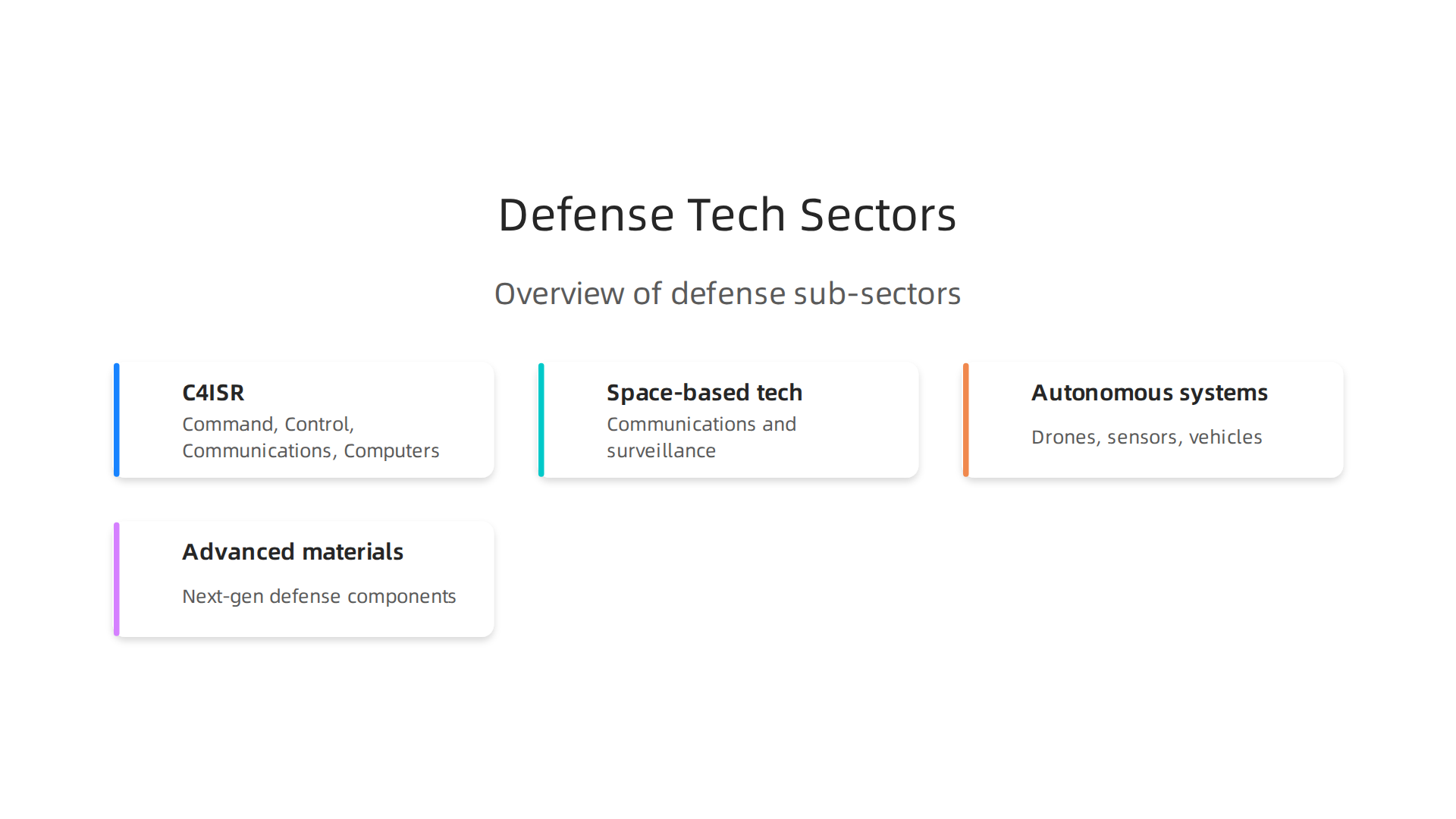
Each of these areas is attracting serious venture dollars right now.
One helpful breakdown from Bessemer Venture Partners maps out what they call the Defense Tech Landscape and Key Sub-Sectors.

Their roadmap explains how the Department of Defense now works with startups across multiple technology domains, from information and analytics to autonomy and energy.
This is where things get interesting for founders. The old line between traditional defense contractors like Lockheed Martin and agile startups like Anduril is blurring fast. Newer companies are winning contracts that once went only to giants. That shift creates a real opening for anyone building in this space.
If you are building something truly innovative, understanding how to position your technology for both government and commercial markets is key. Our guide on Breakthrough Tech 2026: How to Budget and Fundraise for Deep Innovation can help you think through the funding side of that equation.
The Rise of Strategic Public-Private Partnerships (PPPs) in Defense
One of the most powerful forces driving this shift is the rise of strategic public-private partnerships. These are not your grandfather’s government contracts. PPPs have evolved from simple buying and selling into true collaborative innovation programs.

Look at the Defense Innovation Unit (DIU). It was created specifically to help the Pentagon work with startups and commercial tech companies. DIU runs challenges, accelerator programs, and open solicitations to solve real military problems using dual-use technology. NATO has a similar effort called DIANA (Defence Innovation Accelerator for the North Atlantic). These programs change the game for any founder building in the defense space.
The whole DoD Innovation Ecosystem is now designed to pull in nontraditional players. Instead of waiting years for a contract, startups can prototype and demonstrate their tech in weeks or months.
A key tool making this possible is Other Transaction Authority (OTA). OTA agreements let government agencies skip the slow, rigid rules of traditional procurement. They move fast and work with small companies that would never survive a normal bidding process. As DoD Contracting for Startups 101 explains, OTA is one of the most accessible paths for young tech companies to land their first government deal.

For founders, the benefits go beyond revenue. A PPP or OTA contract acts as a stamp of credibility. It validates your technology in the eyes of private investors. It shows you can solve real problems for a demanding customer. That early validation reduces risk for VCs and angel investors, making it easier to raise your next round.
If you want to see how other founders are using these partnership models to raise capital, check out our guide on the open innovation network as a startup fundraising strategy. It explains how to leverage government and corporate collaborations to attract smart money.
This new landscape of public-private partnerships is good news for defense tech companies. It means you do not have to go it alone. The government is actively looking for your innovation. And the right partnership can set you up for years of growth.
Staying on top of these fast-moving trends is a full time job. That is why we recommend the The AI Newsletter Worth Reading. It gives you clear daily updates on AI and tech developments that directly affect defense innovation and startup funding.
Key Drivers Fueling Investment in Defense Tech
Beyond partnerships, a wave of capital is reshaping the landscape. In 2026, defense tech companies are attracting record investment from both venture capitalists and traditional defense contractors. The numbers tell a clear story.
Venture investment in defense tech hit approximately $17.8 billion in Q1 2026 alone, according to Defense Tech VC Opens 2026 Near Record Highs from FNEX Capital. That is just shy of the all-time quarterly peak. The momentum has been building for years. Geopolitical instability around the world is pushing governments to modernize their military capabilities at a pace we have not seen in decades. That creates a direct need for the kind of agile, innovative technology that startups can deliver.
At the same time, major technological shifts are creating entirely new categories for investment. Artificial intelligence, autonomous systems, and space-based capabilities are no longer science fiction. They are battlefield realities. And they are areas where big, slow defense contractors often struggle to innovate. This opens the door for lean defense tech companies to step in with fresh solutions.
That is why top venture firms like a16z and Sequoia have established dedicated funds for defense tech. They see the long term opportunity. According to Crunchbase, more than $14.6 billion in venture investment has poured into defense startups already in 2026, setting a new annual record. The energy behind this sector, or what some call the tech energy of defense innovation, is real and growing.
If you are building a startup in this space, knowing where to base your company can make a huge difference. Check out our guide on world tech centers 2026 how to pick the best hub for your startup fundraising to find the ecosystem that gives you the best shot at landing top investors.
The bottom line is simple. The money is flowing. The demand is urgent. And defense tech companies that can deliver real capability have a historic opportunity to scale.
How Startups Can Navigate PPPs: Opportunities and Pitfalls
For defense tech companies ready to turn government demand into real revenue, public-private partnerships are one of the most direct paths forward.


These PPPs connect startups with military and defense agencies that need your technology right now. But they come with their own rules.
The Opportunities
The biggest upside is early non-dilutive capital. Programs like the Small Business Innovation Research (SBIR) and Small Business Technology Transfer (STTR) grants give you money without giving up equity. According to the a16z guide on DoD Contracting for Startups 101, these programs are designed specifically for companies like yours.
Other Transaction Authority (OTA) agreements are another goldmine. They skip the usual slow government procurement process and let you move fast. You can prototype, test, and deliver your solution in months instead of years.
You also get instant credibility. A partnership with the Defense Innovation Unit or an innovation hub signals to private investors that your technology works in the real world. That can open doors to venture capital and strategic investors much faster.
The Pitfalls
Here is the honest side. Government procurement cycles can still drag on longer than your runway allows. Even with OTAs, you might wait months between decisions.
Intellectual property is another major concern. Some agreements require you to share or license your core technology. You need to read every clause carefully before signing.
There is also the single customer risk. If your entire business relies on one defense contract, you are vulnerable. A budget delay or political shift could freeze your revenue overnight.
How to Start Smart
The best approach is to use PPPs as a launchpad, not a lifeline. Secure a few grants or OTAs to build credibility and early revenue. Then use that momentum to attract private investors who can give you more flexibility.
If you want to stay ahead of the fast-moving tech trends that shape these opportunities, you need daily intelligence. That is exactly why we recommend The AI Newsletter Worth Reading. It delivers clear daily updates on AI and technology that help founders like you spot the next big defense tech opportunity before everyone else.
Key Considerations for Founders
Public-private partnerships are a powerful start, but defense tech companies need to think about a few other things to succeed long term.
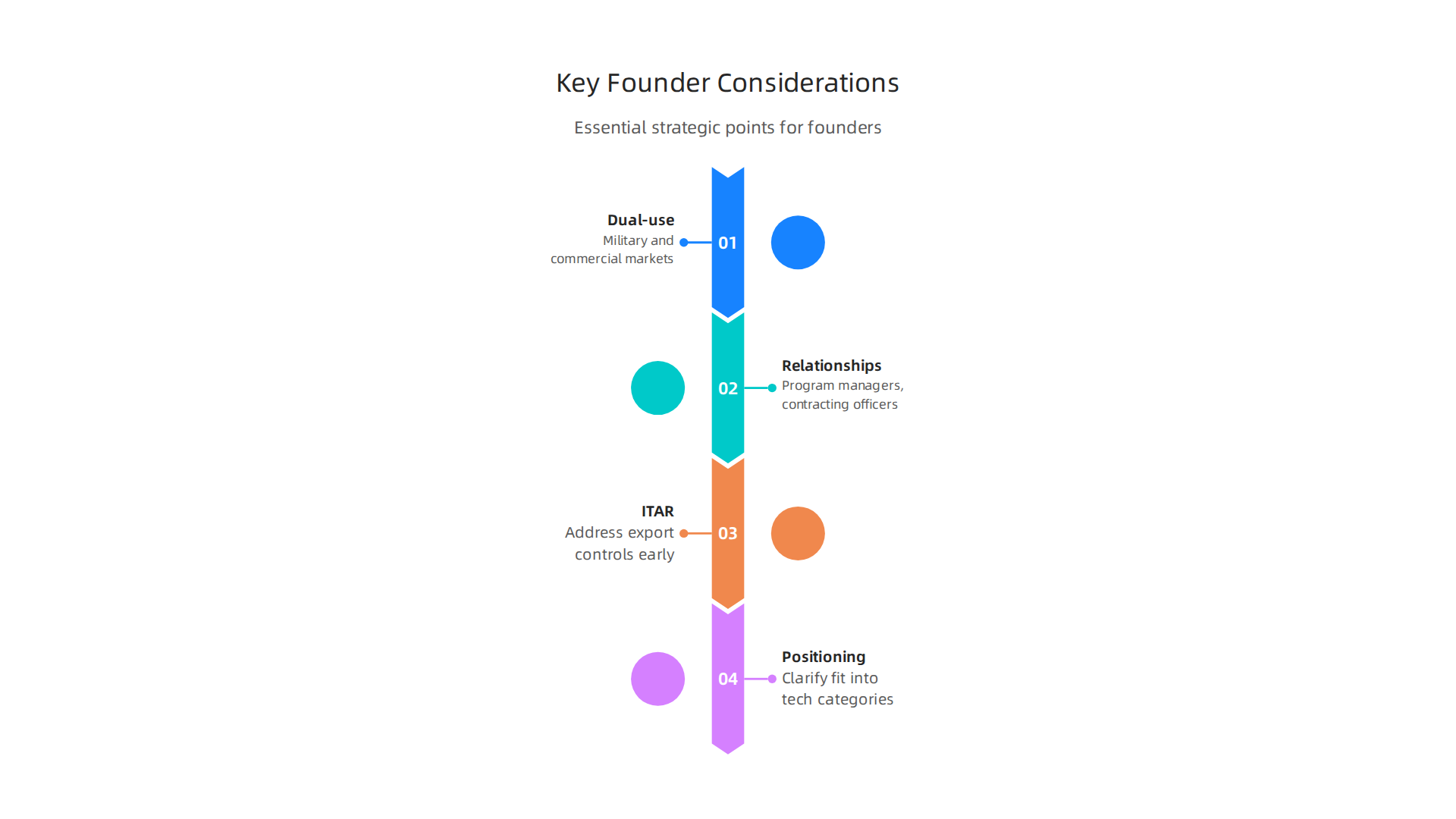
First, focus on dual-use technology. If your product works for both military customers and commercial markets, you attract a much wider group of investors. Investors love seeing that your technology has multiple paths to revenue. It reduces their risk and increases your fundraising options.
Second, build real relationships with the people who run these programs. Program managers and contracting officers at places like the Defense Innovation Unit or AFWERX can make or break your deal. They are the ones who understand your technology and can push it through the system. Take time to talk to them, ask questions, and show up consistently.
Third, understand ITAR and export controls early. If you plan to operate internationally, these rules are critical. The penalties for getting it wrong are severe. The DoD ecosystem includes resources to help you learn, and you can read more about the 2026 landscape in this guide to ITAR Compliance in 2026.
Finally, know your positioning. As you build your company, understanding how to fit into the broader tech company categories 2026 will help you attract the right investors and partners from the start.
Navigating Regulatory Hurdles
Beyond positioning, defense tech companies must push through a thicket of regulatory hurdles that can stall even the best technology.
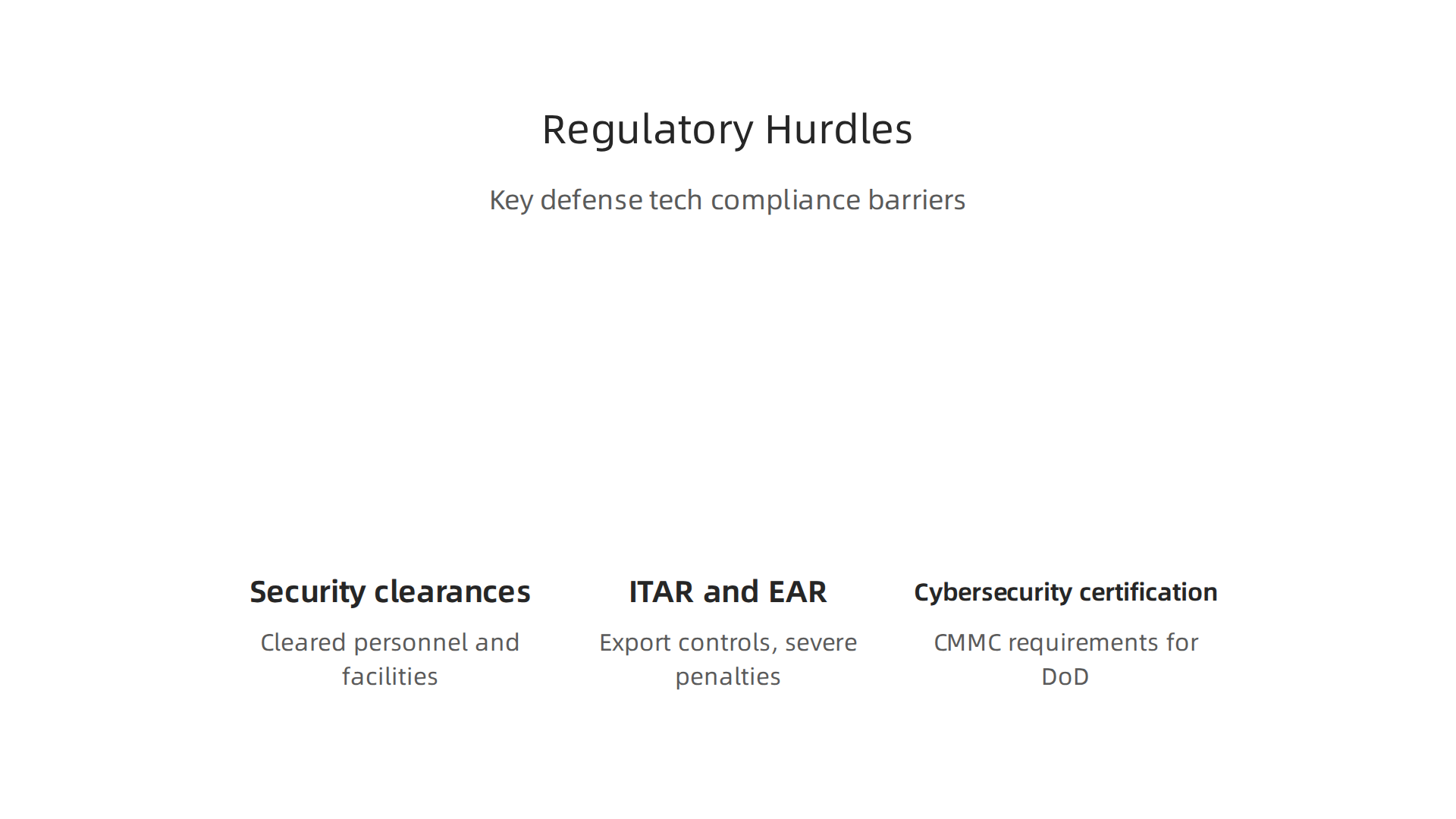
Let’s break down the biggest ones.
Security clearances are often the first wall. If your startup has never worked with the government, getting cleared personnel and facilities takes time and money. This can block you from bidding on contracts that handle classified information. Plan for this early.
ITAR and EAR compliance add another layer, especially if you hire globally or sell overseas. Export controls are strict, and the penalties for mistakes are severe. You need legal help to set up your compliance program from day one.
Cybersecurity certification (CMMC) is now a must-have for any company chasing DoD contracts. In 2026, CMMC requirements are rolling out in phases, and many solicitations already demand proof of certification. For a detailed look at what this means, check out the overview on CMMC cybersecurity compliance for defense contractors.

Tackling these hurdles takes focus, but it is manageable. One smart way to lower your risk is to manage shadow tech to mitigate risks and attract investors. And to stay ahead of regulatory and tech shifts that affect your funding path, you might find The AI Newsletter Worth Reading a helpful daily resource.
Investor Perspectives: Valuing Defense Tech Companies
Once you have the regulatory side under control, the next big question becomes: how do investors actually value defense tech companies? The answer looks different than what most SaaS founders expect.
Defense tech valuations do not follow the same rules as typical software startups. Investors rarely use standard SaaS metrics like monthly recurring revenue or customer acquisition cost here. Instead, they focus on revenue multiples tied to contract size and government backlog. A company with a strong pipeline of DoD contracts can command a higher multiple, even if its monthly subscriptions look modest. In 2026, with venture investment in defense tech hovering near record highs according to the Defense Tech VC Opens 2026 Near Record Highs report, understanding this valuation shift matters more than ever.
Another factor investors weigh heavily is dual-use potential. They want to see that your technology serves both military and commercial markets. Why? Because relying on a single customer like the U.S. government creates real risk. If a contract stalls or priorities shift, you need a fallback. Startups that can point to commercial revenue alongside defense work stand out. This public private partnership angle reduces perceived risk and often leads to better terms.
Late-stage defense tech companies face a different challenge: long sales cycles. Selling to the Pentagon can take 18 to 24 months or more. That timeline strains cash flow and pushes out revenue recognition. Investors account for this by applying a discount to projected earnings or by favoring companies with proven track records of contract wins. For a closer look at how different funding paths compare, the guide on venture capital and private equity offers useful context for founders navigating these decisions.
In short, winning investor confidence in defense tech means proving you understand these unique valuation rules. Show your contract backlog, highlight dual-use applications, and plan for slow sales cycles. Investors who know the sector reward founders who do.
Case Studies: Successful Defense Tech Startups and PPPs
The best way to understand how all this works is to look at a real example. And one company stands out above the rest: Anduril Industries.
Anduril started in 2017 with a software-first approach to defense. Instead of building hardware first and adding software later, they flipped the model. By 2026, that bet paid off in a big way. The US Army signed a contract with Anduril worth up to $20 billion for counter-drone technology, as covered in the Army awards Anduril $20B counter-drone contract report. That single deal shows how a startup can scale rapidly through a major government contract.
But what really made Anduril work was the public private partnership model. The company did not wait for Pentagon funding to build its technology. It raised venture capital first, built prototypes, and then showed the DoD what was possible. This approach reduced risk for the government and accelerated adoption. A detailed analysis of the company structure is available in the Anduril: The Software-First Prime Defense Contractor overview, which breaks down how they achieved a $114 billion valuation through this strategy.
Key takeaways for founders:
- Build a prototype before chasing a government contract. Show, don’t just tell.
- Use private capital to de-risk your technology for military buyers.
- Make sure your tech can serve commercial markets too. Anduril’s platforms work for border security and industrial monitoring, not just combat.
If you want to stay updated on how tech trends like defense innovation shape startup funding, try The AI Newsletter Worth Reading for daily insights on where smart money is moving in 2026.
For a broader look at how different tech ecosystems support defense startups, check out the guide on world tech centers in 2026 to see which hubs offer the best mix of VC access and government relationships.
Lessons from Leading Companies
Beyond Anduril, other defense tech companies have carved their own paths to success. Shield AI, for example, took a scrappier route. It started with Small Business Innovation Research (SBIR) grants from the DoD, proving its autonomous drone technology on a small budget. Once the technology worked, the company raised follow-on venture rounds to scale. This step-by-step approach lowered risk for both the military and private investors. The Defense Innovation at an Inflection Point case study shows how software-driven autonomy is reshaping the entire defense landscape.
So what do the most successful defense tech companies have in common? Three things stand out. First, a strong intellectual property portfolio that protects their core technology. Second, an experienced founding team that understands both the commercial and government sides of the business. Third, early engagement with military buyers even before a full product is ready. If you want to dive deeper into how deep tech startups fundraise, the guide on breakthrough tech 2026 covers budgeting and investor strategies that work for defense tech companies too.
Summary
This guide explains why defense tech has become a top startup and investment theme in 2026, with record venture funding and new public-private partnership models that let agile companies work directly with military customers. It defines the modern defense tech ecosystem—hardware, software, autonomy, C4ISR and space—and shows how programs like the Defense Innovation Unit, DIANA, OTAs and SBIR/STTR shorten procurement timelines and provide early, credibility-building revenue. The article walks founders through the main opportunities and pitfalls of PPPs, the regulatory hurdles to plan for (security clearances, ITAR, CMMC), and how investors value defense companies differently from typical SaaS firms. Practical advice covers dual-use positioning, building prototypes before pitching the DoD, managing IP and single-customer risk, and fundraising tactics that leverage government validation. Real-world examples such as Anduril and Shield AI illustrate strategies that worked, while sections on valuation and sales-cycle realities prepare founders and investors for the sector’s unique timelines. After reading, founders will know how to position technology, pursue government partnerships smartly, and attract the right capital while managing regulatory and commercialization risks.