

Introduction
You just had a great meeting with a potential investor. Your pitch deck was solid. Your numbers looked clean. But something felt off. When you talked about your company, the investor kept asking basic questions about what category you actually fit into.

Were you a hardware company? A software company? An AI company? Neither of you seemed totally sure.
Here is the thing. That confusion can cost you the deal.
The technology world in 2026 is more specialized than ever. We are not just talking about "computer companies" anymore. The ecosystem has split into clear lanes. You have hardware builders, software makers, AI and machine learning firms, cloud infrastructure providers, cybersecurity specialists, and more. Each lane has its own fundraising rules, its own investor expectations, and its own valuation benchmarks.
Understanding where you belong is not just a nice to have. It is a competitive advantage.
Consider what the data shows. Since 2016, nearly 60% of deep tech venture funding has gone to hardware related startups. That is three times more than the rest of the tech sector combined, according to Dealroom. Meanwhile, the fastest growing categories for Series B investment in recent years have been legaltech, climate tech, and AI, as reported by Growth List. And across 4,395 VC financings totaling $186 billion in 2025, vertical focused startups captured 53% of deal volume, per the Euclid Ventures Vertical Report.
These numbers tell a clear story. Investors are not writing checks across the board. They are picking lanes. If you pitch a generalist story, you will get a generalist outcome. But if you understand the category landscape, you can target the right funds, tailor your message, and stand out from the noise.
This article breaks down the major categories of tech companies in 2026 and how investors view each one. We look at hardware, software, AI, cloud, and cybersecurity. We explore fundraising dynamics specific to each lane. And we share practical ways to position your startup for the capital you need.
For a deeper look at how the tech world defines itself today, check out our guide on technology definition in 2026. It gives you a framework to explain your business clearly to any investor.
Let us start with the big picture. Because once you know which lane you belong in, everything else gets easier.
Understanding Tech Company Categories: From Hardware to Software
So how do you know which lane you are in? The days of simply grouping all tech ventures under the broad umbrella of computer companies are over. Today, the details of your category define your fundraising path.
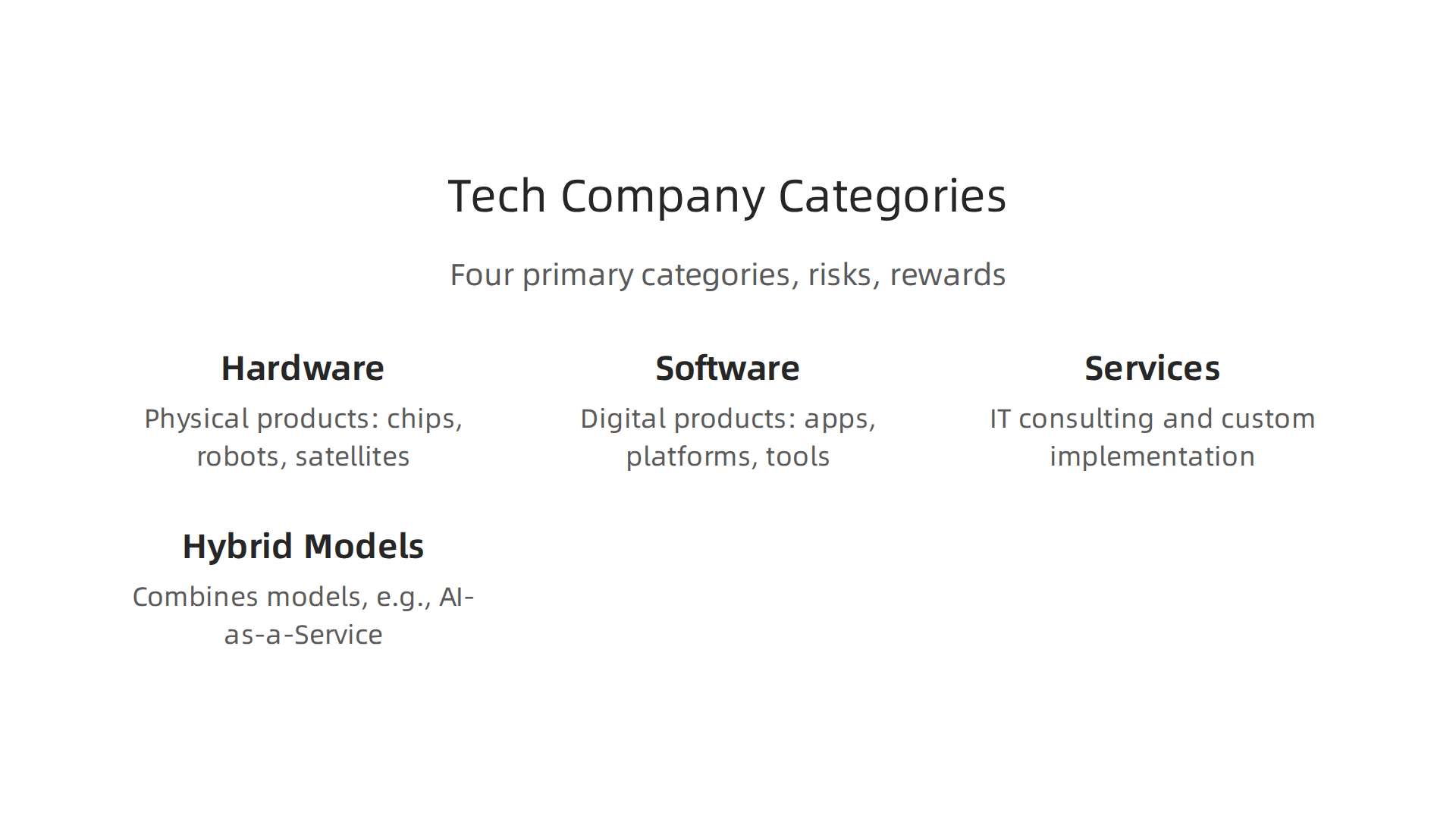
The tech world in 2026 breaks down into a few main categories. Each one has its own rules, risks, and rewards.
Understanding the difference is your first job as a founder.
Hardware: These companies build physical products. Think chips, robots, satellites, or medical devices. Hardware is capital intensive. You need money for parts, factories, and supply chains. Since 2016, almost 60% of deep tech venture funding has gone to hardware startups, according to Dealroom. That is three times more than the rest of the tech sector. If you are building hardware, you need investors who understand long cycles and heavy upfront costs.
Software: These companies build digital products. Apps, platforms, and tools you use in a browser. Software companies, especially SaaS, have lower upfront costs. They offer recurring revenue. Investors love that predictability today. But the competition for attention is fierce.
Services: This includes IT consulting or custom implementation. These companies grow slower. But they often have very strong unit economics and stable cash flow.
Hybrid Models: The newest category blends all the others. AI-as-a-Service is a great example. It mixes software, data, and sometimes hardware. These companies can be tricky to classify. But getting the classification right is critical for your pitch.
The Global Industry Classification Standard groups tech stocks into main categories like software, hardware, and services, as noted by NerdWallet. Founders need to do the same for their startups.
Think about how this plays out in the real world. A founder building a deep tech startup like RB Tech or Davis Tech needs a different funding strategy than one building a SaaS product at Gateway Tech or Lawrence Tech. The capital requirements, the investors you target, and your revenue model all shift based on your category.
Why does all this matter? First, it helps you benchmark. A hardware startup raising at a specific valuation needs a very different growth story than a SaaS startup at the same valuation. Second, investors are picking lanes now more than ever. In 2025, vertical focused startups captured 53% of all VC deal volume, per the Euclid Ventures Vertical Report. Meanwhile, legaltech, climate tech, and AI are the fastest growing categories for Series B investment, according to the Growth List.
If you pitch a generalist story, you get a generalist outcome. But if you know your category, you can target the right funds, tailor your message, and stand out from the noise.
Understanding these categories is just the first step. How you describe your company in your pitch deck matters just as much. Learn how to frame your business with the right language in our guide on technology synonyms to attract the right investors. It helps you avoid the confusion that costs deals.
The Rise of AI and Machine Learning Companies
You have seen the huge numbers. OpenAI valued at $500 billion. xAI at over $200 billion. Anthropic at $183 billion. These are not just headlines. They show where smart money is going in 2026.
AI and machine learning companies now attract the biggest share of venture capital anywhere in the world. In Q1 2026 alone, the top private funding rounds were all led by AI companies like OpenAI, Anthropic, and xAI, according to Forge Global. Across the whole year, AI startups worldwide pulled in about 34% of all venture capital, as Seedscope reports. The total AI funding market hit $337 billion across 395 tracked deals, with foundation models and AGI alone accounting for $240.8 billion, per aifunding.me.
But here is the thing. Raising money for an AI startup is not the same as raising for a traditional software company. Investors today look for three things above all else.
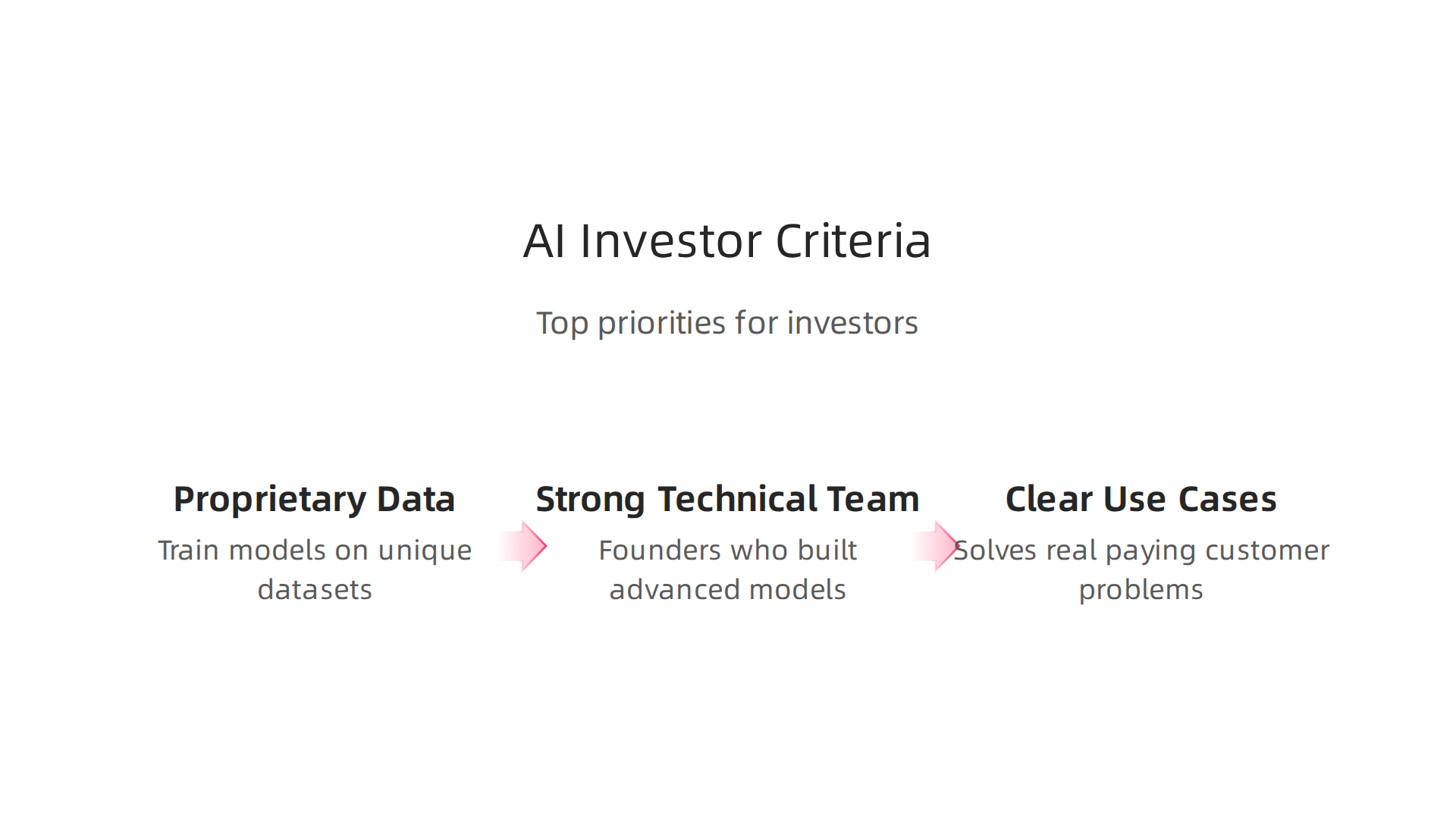
Proprietary data. Can you train your model on data that nobody else has? If you are building a vertical AI platform for legaltech or climate tech, your data is your moat. Generic models are a dime a dozen now.
Strong technical teams. You need people who have built at this level before. Investors want to see a team that can execute fast and adapt as the technology shifts.
Clear use cases. "We use AI" is not enough. You need to show exactly how your product solves a real problem for paying customers. The era of raising on a demo and a dream is over.

Startups like RB Tech and Davis Tech are finding their lanes by combining AI with deep domain expertise. Other founders at Gateway Tech or Lawrence Tech are taking a different approach, building AI tools for their specific industries. No matter which path you choose, you need to frame your company in a way investors understand.
That is why getting your technology definition right matters so much. If you call yourself a "computer company" today, investors will ask for specifics. Are you hardware, software, or AI? The days of vague labels are gone.
You also need to navigate growing regulatory uncertainty. The EU AI Act is coming into force, and similar rules are being discussed in other markets. Investors now ask about compliance early in the due diligence process. If you are building in healthcare, finance, or legal, this is a key part of your pitch.
Differentiation is another big challenge. With over 8,800 AI startups tracked and aggregate funding of $329.1 billion, the market is crowded, as Seedtable notes. You need a clear reason why your company will win.
The good news? AI is still early in many verticals. Enterprise AI, generative AI, and autonomous agents are the hottest categories in 2026. If you can show proprietary data, a strong team, and a real use case, investors will pay attention.
For a deeper look at how to plan your fundraising around these trends, check out our guide on seed and enterprise investment in 2026. It gives you data-driven strategies to match what AI investors are looking for today.
Cloud Computing and SaaS: The New Infrastructure
While AI companies grab the headlines, the real backbone of the tech world in 2026 is cloud computing and SaaS. Think about it. Every AI model needs computing power. Every startup needs software to run. Every enterprise needs storage. That is what cloud and SaaS provide.
The numbers are staggering. The global cloud computing market is expected to hit $1.04 trillion in 2026, according to Mordor Intelligence. By 2033, it could reach $3.3 trillion, per Grand View Research. SaaS alone makes up about 54% of all cloud revenue in 2026, as Quantumrun reports. The SaaS market worldwide is projected to reach $512.27 billion this year, notes Statista.
Here is the thing. This category is not new. But it is changing fast.
The maturation challenge. Many traditional SaaS categories are getting crowded. Generic CRM, project management, and email marketing tools face slower growth. Investors know this. They do not get excited about "just another SaaS product" anymore.
Where the new opportunities are. The real growth in 2026 is in three places. Vertical SaaS, where you build software for one specific industry like healthcare, legal, or construction. Cloud-native infrastructure, which helps companies run their systems more efficiently. And multi-cloud management tools, which let businesses juggle AWS, Azure, and Google Cloud without going crazy.
Companies like RB Tech, Gateway Tech, Davis Tech, and Lawrence Tech are all finding their niches in these spaces. Some build vertical SaaS for specific industries. Others focus on cloud-native tools. The key is picking a lane and owning it.
What investors look for in 2026. When you pitch a cloud or SaaS company, investors focus on three metrics above all else.
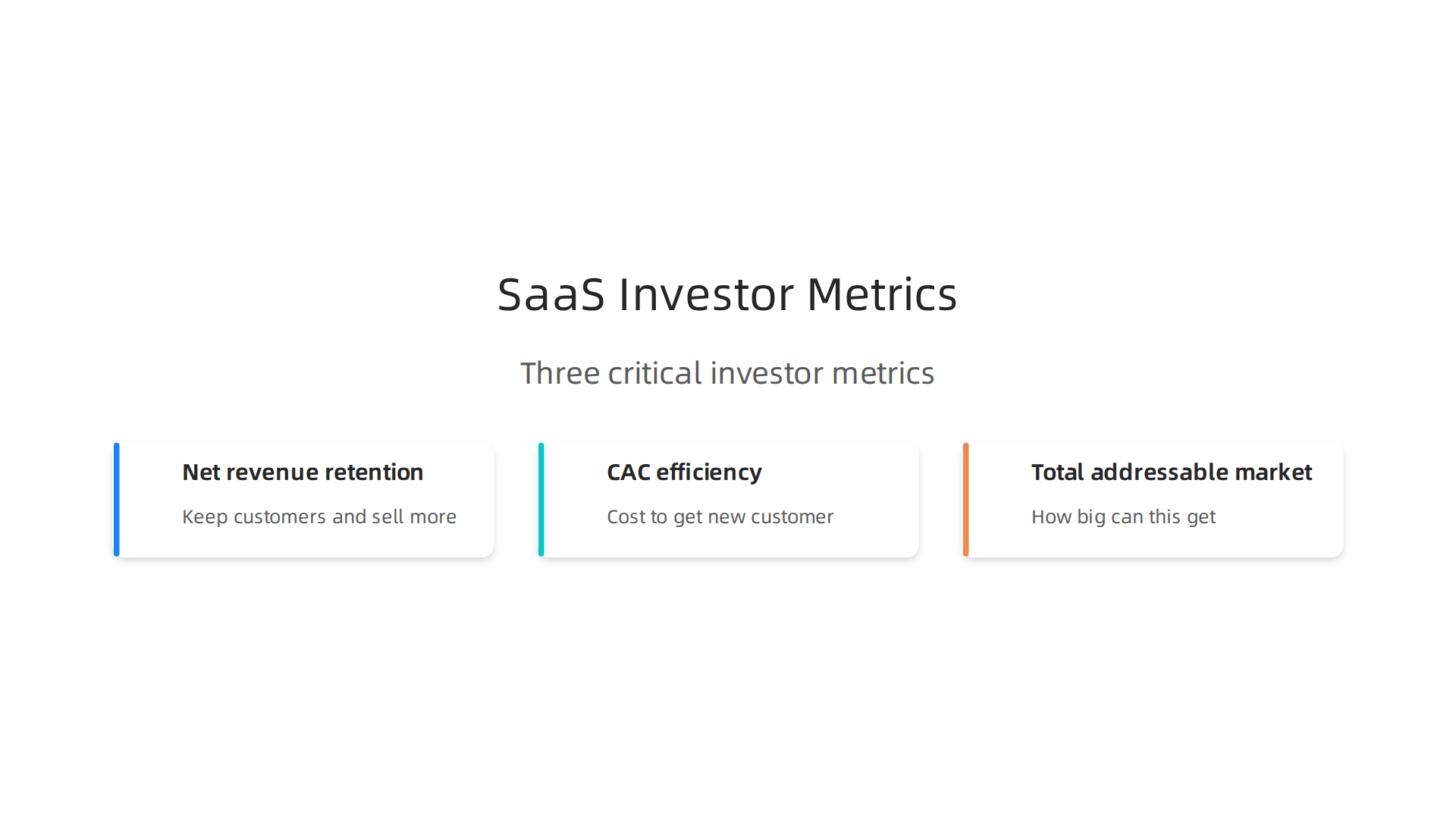
Net revenue retention. Can you keep your customers and sell them more over time? A healthy SaaS company keeps 120% or more of its recurring revenue year over year.
Customer acquisition cost efficiency. How much does it cost you to get a new customer? And how long does it take to earn that money back? Investors want to see a payback period under 12 months.
Total addressable market. How big can this get? Vertical SaaS often has smaller TAM than horizontal SaaS, but the unit economics can be much better.
If you are thinking about starting a cloud or SaaS company, or if you already have one and want to raise capital, you need to frame your business the right way. Getting your technology definition right helps investors understand exactly what you are building and why it matters.
For a complete breakdown of how to pitch these metrics and build a fundable SaaS business, check out our guide on seed and enterprise investment in 2026. It includes data-driven strategies for raising capital in this space.
The Semiconductor and Hardware Renaissance
If SaaS is the software layer that runs the world, semiconductors and hardware are the physical engine underneath. And in 2026, this engine is roaring back to life.
Why is this happening right now? Simple. The world needs more chips. AI models are getting bigger. Cars are getting smarter. Every single device is connecting to the internet. And geopolitical tensions have made it clear that countries cannot rely on a handful of foreign factories for the chips that power their security and economy.
This is where the CHIPS and Science Act comes in. Passed in 2022, it is actively reshaping the landscape in 2026. According to Camoin Associates, the act provides $52.7 billion in federal funding for semiconductor research and manufacturing. It also offers a 25% tax credit for US facilities that produce semiconductors or chipmaking equipment, as highlighted by Applied Energy Systems. PwC explains that the goal is to bring critical manufacturing back to the US while protecting national security. The result is a massive wave of government and private investment flowing into the sector.
What does this mean for computer companies? It means there is a massive opportunity, but it looks very different from the SaaS world we just discussed.
Hardware is capital intensive. It takes longer to get a product to market. But strategic investors understand this. Corporate venture arms, in particular, are very active in hardware right now. They have the patience and the deep pockets needed to support long development cycles. As Semiconductor Engineering reports, Q1 2026 saw significant funding rounds for chip startups focused on R&D and test chip development.
The key sub-categories to watch in 2026 are:
- AI Accelerators: Specialized chips that run AI tasks faster and use less power.
- Quantum Hardware: The race to build the first truly stable quantum computer.
- Edge AI Chips: Processors that let devices think for themselves without the cloud.
- Advanced Manufacturing: The tools and materials needed to build all of the above.
Companies like RB Tech, Gateway Tech, Davis Tech, and Lawrence Tech are all finding their spots here. Some focus on storage hardware for AI data centers. Others build specialized chips for industrial IoT. The key is picking a specific problem and owning it.
If you are building a hardware or semiconductor startup, you need to tell a different story to investors than a SaaS founder would. You need to show a clear path to manufacturing, strong supply chain relationships, and a deep technological moat.
You need to frame your business in a way that investors can understand quickly. Our guide on getting your technology definition right is a great place to start. It helps you explain what you are building in clear, investor-friendly language.
For a complete review of how to raise capital for a capital-intensive tech business, check out our seed and enterprise investment guide. It covers the specific metrics and strategies hardware founders need to succeed in 2026.
Cybersecurity and Data Privacy: A Growing Sector
Now let’s move from the physical chips that power our devices to the invisible shield that protects them. If hardware is the engine, cybersecurity is the lock on the door. And in 2026, everyone is rushing to buy better locks.
Why? Because the threats are growing just as fast as the technology. The World Economic Forum found that 87% of leaders now see AI-related vulnerabilities as the fastest-growing cyber risk. Every new AI tool creates a new entry point for attackers. At the same time, companies are moving more data to the cloud and trusting remote work setups more than ever. That creates a huge surface area to defend.
The numbers tell the story. Mordor Intelligence reports the global cybersecurity market will grow from $264.43 billion in 2026 to $471.88 billion by 2031. That is a compound annual growth rate of 12.28%. Other estimates are even higher. Cybersecurity Ventures predicts total global spending will exceed $520 billion annually by the end of this year. This is not a niche market anymore. It is one of the fastest-growing sectors in the entire tech economy.
What does this mean for computer companies and the founders building them? It means there are clear, high-demand sub-categories to focus on:
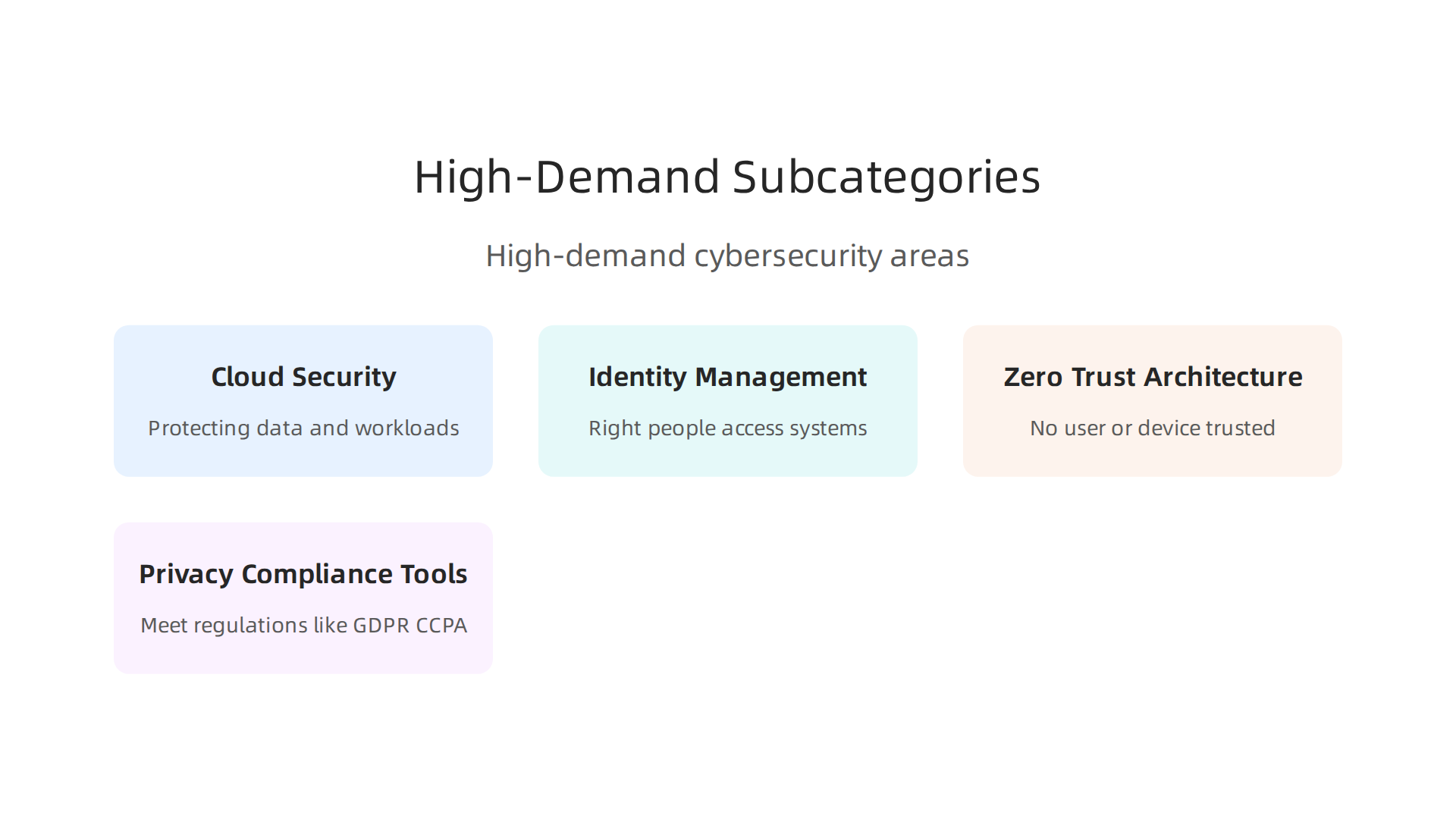
- Cloud Security: Protecting data and workloads that live outside traditional on-premise servers.
- Identity Management: Making sure the right people have access to the right systems.
- Zero Trust Architecture: A security model that assumes no user or device is trusted by default.
- Privacy Compliance Tools: Helping organizations meet regulations like GDPR, CCPA, and new state-level laws.
Investors love this space for a few reasons. First, the demand is not optional. Companies cannot delay cybersecurity spending the way they might delay a new marketing tool. Second, the business models tend to be sticky. Once a company adopts a security stack, switching costs are high. That means strong recurring revenue for the companies that execute well.
This is an area where focused players can win. A company like RB Tech might build specialized cloud security for healthcare. Gateway Tech could focus on zero trust for financial services. Davis Tech and Lawrence Tech can carve out niches in identity verification or compliance automation for mid-market firms. The key is finding a specific pain point and solving it better than anyone else.
If you are building in cybersecurity, investors will look for three things: technical differentiation, an experienced leadership team, and a clear path to recurring revenue. They also love regulatory tailwinds, and this sector has them in abundance. New privacy laws and security mandates mean companies have to buy your product.
Before you start pitching, make sure you can explain your technology in clear terms. Our guide on getting your technology definition right will help you build a strong foundation. And for a deeper look at how to structure a capital-efficient growth plan, check out our seed and enterprise investment guide.
Emerging Trends Shaping the Future of Tech Companies
The cybersecurity boom we just covered is a perfect example of a bigger story. The way we build and invest in tech is changing fast. Here are the three biggest trends shaping computer companies in 2026.

1. The Rise of the Hybrid Company
The old lines between hardware and software are disappearing. Look at AI. The best AI models need custom chips. Those chips need special cloud software. And all of it needs strong security built in from day one.
This creates a new kind of company. It is part semiconductor company, part cloud provider, and part security firm. Data from Dealroom shows that nearly 60% of deep tech funding goes to hardware-related startups. That is three times more than the rest of tech. The future is physical and digital together.
What does this mean for founders? You cannot just pitch yourself as a software company anymore. A startup like RB Tech might build a custom chip that runs a specific AI model in the cloud, while also offering a security layer. This hybrid model confuses old-school investors. They used to put hardware money in one bucket and software money in another.
You need a blended fundraising strategy. You also need to explain your technology clearly so investors understand your hybrid model. Our guide on getting your technology definition right will help you build a strong foundation.
2. Sustainability Is a Must-Have
Investors care deeply about ESG (Environmental, Social, Governance) in 2026. This is not a nice-to-have anymore.
If you build a cloud platform or a new chip, your energy usage matters. Capgemini lists sustainability as a top-three priority for tech leaders this year. Data centers for AI are using huge amounts of power. This creates a big opportunity.
Gateway Tech or Lawrence Tech could win by focusing on low-energy hardware or carbon-aware cloud software. Investors like Capital Group American Funds are actively looking for climate-forward tech investments. If you can show that your company uses less energy or helps others cut emissions, you will get attention.
3. Decentralized Tech Finds Its Groove
I know, Web3 had a rough patch. But in 2026, the technology is finding its place in the background. It is less about hype and more about utility.
We see it in supply chain tracking, secure computing, and digital identity. For a computer company, this means new ways to prove your hardware is genuine or to create secure, decentralized marketplaces for compute power.
Davis Tech could build a verification layer for chips using blockchain. It is a quieter market than AI, but it is steady and has deep pockets attached to it. To get the right investors interested, you need the right language. Our guide on technology synonyms can help you position yourself correctly in this space.
What This Means for You
These three trends convergence, sustainability, and decentralization create a new map for computer companies looking to raise capital in 2026. You cannot just build one thing. You have to build smart.
The good news? The market loves clarity. Founders who can clearly explain their hybrid model, their green credentials, or their decentralized architecture will stand out. If you want to see how other startups are navigating these trends, check out our trusted list of US startups to see what is working right now.
Summary
This article explains why correctly classifying your tech startup—hardware, software, AI, cloud/SaaS, or cybersecurity—matters for fundraising in 2026 and shows how investors view each lane differently. It covers capital intensity and timelines for hardware and semiconductors, the three things AI investors demand (proprietary data, strong technical teams, clear use cases), and the core SaaS metrics (NRR, CAC payback, TAM) that drive investor decisions. You’ll learn which investor types and funding strategies suit each category, how hybrid models blur old lines, and why sustainability and decentralization are becoming fundraising advantages. The piece also highlights regulatory and market trends shaping demand, and offers practical guidance on framing your pitch, targeting the right funds, and benchmarking expectations so you can raise capital more effectively.