
Introduction: The Cell Tech Revolution and What It Means for Investors
Cell technology is no longer just a buzzword in a lab. It is reshaping entire industries right now. From new cancer treatments to lab-grown meat, the science of working with cells is opening doors that seemed impossible just a few years ago.

For startup founders and investors, this shift creates a huge opportunity. The numbers tell the story. In 2026, the global cell therapy market is valued at over $3.1 billion and is expected to grow nearly 10% each year through 2033, according to the latest Cell Therapy Market Size and YoY Growth Rate, 2026-2033 report.
North America alone captured 67.9% of disclosed cell therapy funding, with deals like Orca Bio raising $250 million in a single round, as shown in the Cell Therapy Startup Funding 2025-2026 analysis.
But this is not just about healthcare. Cell tech is tech driven across biotech, agriculture, and materials. Understanding these trends is essential for anyone raising capital or spotting the next big bet. The smartest players are already paying close attention to what the science can do and where the money is flowing.
To stay ahead, you need clear, daily insights on how technology is shifting the investment landscape. That is why so many founders and VCs rely on The AI Newsletter Worth Reading to cut through the noise.

And for a deeper look at how to frame your own fundraising story, check out this guide on master framing tech for startup fundraising success.
The Surge in Cell Therapy Financing: Trends and Key Players
So who is actually getting funded right now, and what does it take to join their ranks? The short answer is that this market is not handing out cash to just anyone. Investors are being very strategic about where they place their bets.
The data from the last 12 months shows a clear pattern. Late stage cell therapy companies are taking home most of the money. CAR T cell therapies, which modify a patient’s own immune cells to fight cancer, led the way in deal count. According to the latest cell therapy financing trends beyond CAR-T report, the average round size landed around $77 million.

But here is the catch. The top 10 deals alone soaked up over 80% of all the capital. That means investors are backing winners they already know rather than spreading small bets across many early stage ideas.
This dynamic is driven by one main thing. Results. Regulatory approvals and strong clinical trial data act as rocket fuel for funding rounds. When the science clears a major hurdle, the capital follows fast. The Stem cell therapy market projections show this growth is expected to accelerate from $20.5 billion in 2026 to nearly $60 billion by 2035. Companies with advanced programs are the ones cashing in.
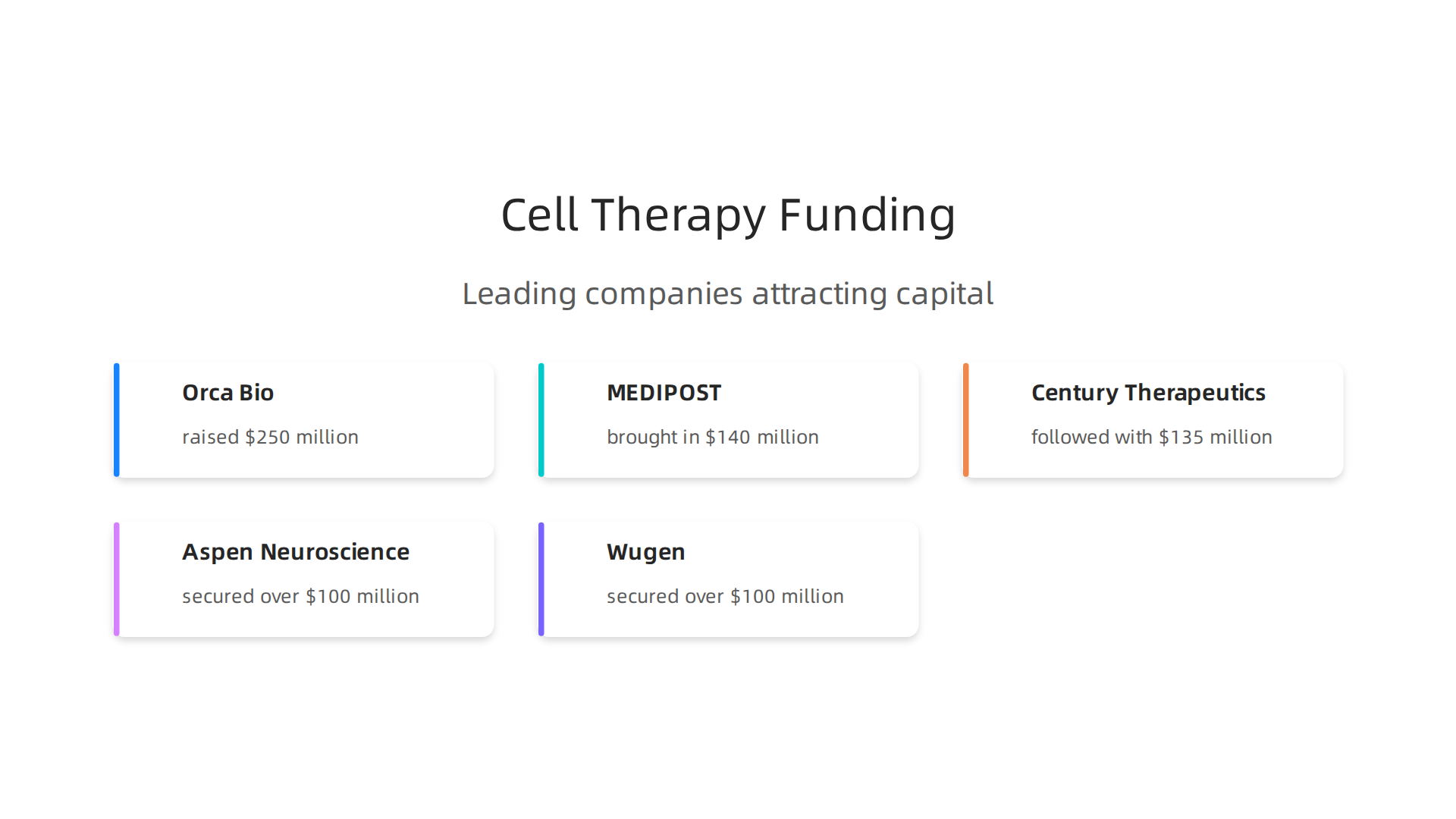
So who are the key players making moves in 2026? Orca Bio raised $250 million in a single round. MEDIPOST brought in $140 million. Century Therapeutics followed closely with $135 million. Aspen Neuroscience and Wugen both secured over $100 million each.
What do these companies have in common? They all have advanced clinical programs or clear regulatory pathways.
This surge is not just about curing cancer, though. The same tech driven energy is spilling over into neurology, fertility, and rare diseases. The infrastructure needed to make these therapies at scale is growing just as fast. The cell therapy manufacturing market expansion is on track to reach $6.2 billion in 2026, proving that building the factory is just as important as the science inside it.
For startup founders watching this space, the message is straightforward. Investors have capital, but they are picky. They want to see data that proves your cell tech platform works in humans. Whether you are working on gene editing, CAR T, or regenerative medicine, you need to frame your story around clinical and commercial milestones. Understanding how to position your company alongside broader breakthrough tech fundraising strategies can make a real difference when you sit down with VCs.
The lesson is simple. The surge in cell therapy financing is not slowing down, but it is becoming more focused. The companies that can show strong science plus a realistic path to market will be the ones winning the largest checks.
Cellular Agriculture – From Lab to Market: Funding Landscape
The same cell tech energy that is fueling cancer therapies is also making its way into your refrigerator. Cellular agriculture, the science of growing meat, dairy, and other animal products directly from cells, is attracting serious investor attention as more countries open the door to regulatory approvals. If cell therapy is about fixing the human body, cellular agriculture is about fixing the food system.

And the funding landscape tells a story that every founder and investor should understand.
The numbers show a sector that has been through a boom, a bust, and now a careful recalibration. Cellular agriculture startups raised a cumulative $3.1 billion by 2023, with investment peaking at $1.4 billion in 2021. Then reality hit. Scaling production and reaching cost parity turned out to be harder than anyone predicted. By 2023, the sector was raising about $177 million, and in 2025, cultivated meat companies across Europe managed just £28 million in the first three quarters. Investors wanted proof that the science could actually deliver affordable products at scale.
But here is where the story gets interesting. Despite the downturn, a handful of companies are breaking through. Upside Foods leads the pack with $580.8 million in total funding, followed by The EVERY Company at $246.8 million and Eat Just at over $220 million. These companies have not only raised big rounds but have also attracted strategic investors from traditional food and agribusiness. That signals a shift. The tech driven capital that dominated early stage bets is now being joined by deep pocketed industry players who understand supply chains and consumer markets.
What does that mean for you as a founder or early stage investor? It means the bar is higher, but the opportunity is real. The companies getting funded today are the ones showing real progress on cost reduction and regulatory clarity. Meatable raised a $35 million Series B in 2024 by proving it could make cultivated pork at 90% lower cost than earlier methods. Mosa Meat secured a €15 million extension in late 2025 by focusing on a clear path to market. The message is the same as in cell therapy: show the data, show the path.
Valuations in this space are becoming more grounded. Early stage rounds are still happening, but they are smaller and more targeted. The days of handing out unicorn valuations on a vision alone are over. Instead, investors want to see partnerships with food manufacturers, pilot production lines, and consumer taste test results. The 2025 AgTech Venture Capital Investment and Exit Round Up notes that agtech investors are making fewer but larger bets, favoring scaled leaders over early experimental projects.

This pattern applies directly to cellular agriculture.
For founders building in this space, understanding how to frame your company around real milestones is critical. Investors want to see a realistic timeline to commercial revenue, not just a breakthrough in the lab. A strong approach is to learn from how other deep tech founders position their stories. The guide on master framing tech for startup fundraising success offers practical ways to align your pitch with what investors actually care about.
The bottom line is that cellular agriculture is not going away. The global meat market is worth $700 billion, and the demand for sustainable protein is only growing. The companies that survive the current funding winter will be the ones that build the infrastructure to produce at scale and at price parity. That requires a combination of smart science, smart capital, and smart storytelling. And for founders and investors who want to stay on top of the broader tech driven shifts reshaping every industry, staying informed is a competitive advantage. The daily insights from The AI Newsletter Worth Reading can help you see how trends in cell tech, agtech, and beyond connect into a single market picture.
Cell-Based Diagnostics and Monitoring: Investment Hotspots
The same cell tech engine that is driving therapies and cultivated meat is also powering a quieter but equally exciting revolution in diagnostics. Cell-based diagnostics, especially liquid biopsies and single cell analysis platforms, are becoming major investment hotspots. The logic is simple: if you can catch a disease earlier or track how a patient responds to treatment in real time, you save lives and money.

And investors are paying close attention.
Diagnostic startups look very different from therapeutic companies from an investor’s perspective. A therapy company has to run expensive clinical trials for years before it can generate any revenue. A diagnostic company often has a faster path to market. Regulatory approvals for diagnostic tests can take less time, and the manufacturing scale up is usually simpler. That changes the risk profile and the valuation math. For a founder, that means you can build a valuable company with less capital and a shorter time horizon, provided you focus on the right clinical need.
The hottest areas right now are cancer monitoring, early detection, and companion diagnostics. These are not small markets. The global liquid biopsy market alone is expected to grow rapidly as more patients and doctors shift toward non invasive testing. Single cell analysis is also drawing serious funding because it allows researchers to understand disease at a granular level that was impossible just a few years ago.
The numbers back this up. Companies like Freenome have raised over $1.5 billion for their blood based cancer detection tests. The startup made the list of the most promising healthcare startups of 2025 for its ability to combine multiomic AI with a simple blood draw. That kind of funding tells you that investors believe early detection will fundamentally change how we treat cancer. And it is not just the big names. Diagnostic technology firms like Nuclidium raised a $99 million Series B in mid 2025 for their copper based radiotheranostic platform, which combines diagnostics and therapy in a single approach.
For founders and investors looking at this space, the key is to understand what makes diagnostic startups fundable. You need a clear clinical use case, strong data on accuracy, and a realistic plan for insurance reimbursement. Investors want to see that your test does not just work in a lab, but can be deployed in real clinics at a price that makes sense. That is a different kind of discipline than building a therapeutic, but it is just as important.
If you are building a diagnostic startup, it pays to study how other deep tech founders frame their technology for investors. A great resource is the guide on how to budget and fundraise for deep innovation, which walks through the specific milestones investors look for in capital intensive tech fields. The same principles apply whether you are growing cells for meat or analyzing them for cancer signals.
The bottom line is that cell based diagnostics are a sweet spot in the current funding environment. The risk reward ratio is attractive, the market need is huge, and the technology is finally mature enough to deliver real results. As the broader cell tech ecosystem matures, the companies that solve detection and monitoring challenges will be positioned to capture significant value. And for anyone watching the trends, the pattern is clear: when cell tech works at the diagnostic level, the investment dollars follow.
Valuation Benchmarks and Exit Strategies in Cell Tech
Understanding how much a cell tech company is worth and how investors eventually cash out is just as important as building great science. Valuation numbers give founders a target for their next round. Exit data shows what kind of returns are possible. And in a market where capital is flowing freely into tech driven biotech, knowing the benchmarks can make or break a fundraising campaign.
So what do the numbers actually look like for cell tech companies in 2026?
Cell Tech Valuations by Stage
The most useful benchmarks come from real funding data across the biotech landscape. According to the latest data from Carta, the median pre-money valuation for a Series A startup in 2025 was $49.3 million. Series B companies hit $119 million. Series C rounds ranged from $300 million to $400 million.
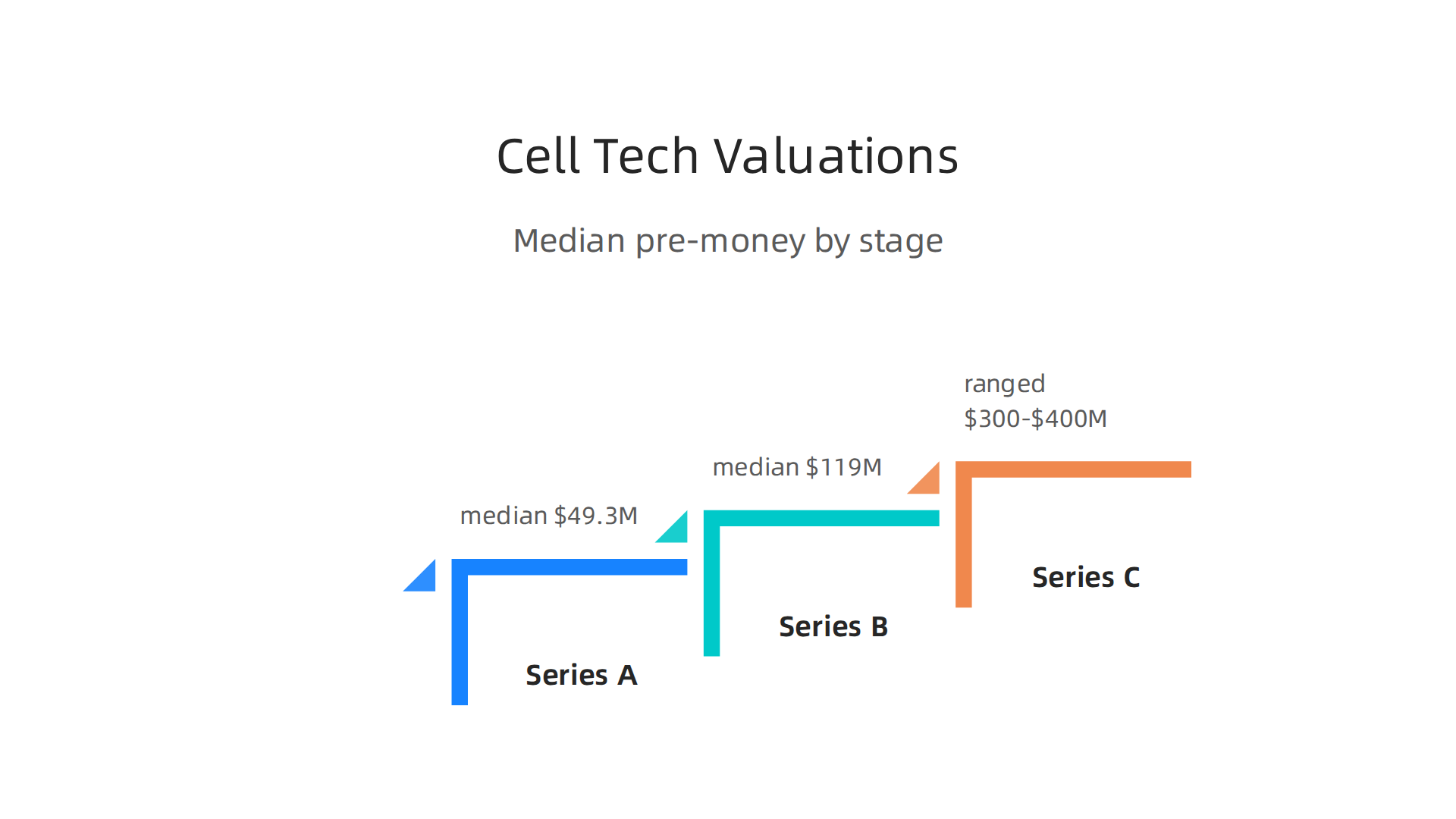
These figures come from the detailed analysis of startup valuation by funding round data for 2026.
But cell tech does not always follow the average. Sub-sectors like AI driven drug discovery and cell therapy platforms often command premium multiples. The data from Grant Thornton shows that life sciences VC valuations have grown steadily, even as stock prices for smaller companies have underperformed larger peers. That means investors are paying more for early-stage cell tech companies than the broad averages might suggest.
At the same time, the sheer size of rounds has increased. The median biotech venture round stayed near $100 million in early 2025, continuing a trend of more capital flowing into fewer, larger deals. This pattern is especially strong for cell therapy and diagnostic platforms, where building clinical proof costs real money.
Exit Strategies: IPOs and Acquisitions
The other side of the valuation coin is the exit. When a cell tech company goes public or gets bought, it sets a benchmark for everyone else in the space. Recent history shows that exits are happening, but the bar is high.
Take AI biotech companies as an example. Lila Sciences announced a $115 million extension to its Series A in October 2025, pushing the round total to $350 million and the company valuation to $1.3 billion. That is a massive valuation for a private company, and it signals that investors believe AI enabled cell tech can deliver blockbuster returns.
Acquisitions are also common in cell therapy and diagnostics. Large pharmaceutical companies regularly buy promising cell tech startups to fill their pipelines. These deals typically happen after the startup has shown strong preclinical or early clinical data. For founders, understanding what acquirers look for is essential. A guide on how founders can master framing tech for startup fundraising success is a great resource for learning how to position your technology for the right exit.
What This Means for Founders
Valuations are not random numbers. They are built on real drivers like intellectual property strength, clinical data quality, market size, and team experience. In cell tech, having a clear path to regulatory approval and a realistic reimbursement plan also matters a lot. That is why diagnostic companies often see different multiples than therapy companies, even at the same stage.
The good news is that with the right data and framing, founders can raise capital at attractive valuations. The key is to know the benchmarks, understand where your company fits, and build a story that resonates with investors. Whether you are planning a Series A next year or thinking about an IPO down the road, the data is there to guide you.
Cell tech is a high stakes game, but the valuation and exit data provides a clear map. Use it to price your rounds, pick your investors, and plan your long term future.
How VCs Are Evaluating Cell Tech Startups in 2026
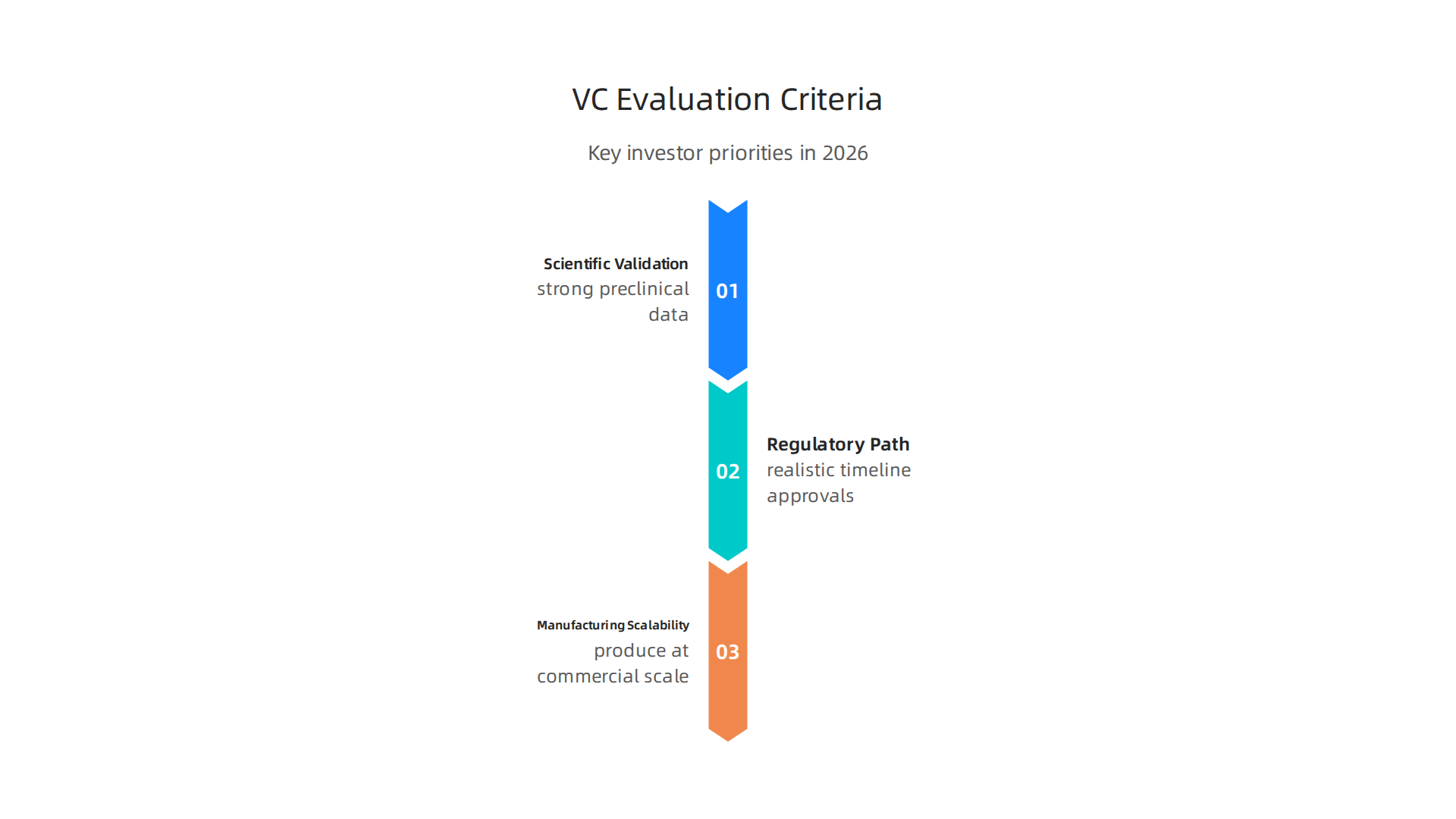
So you know the valuation benchmarks and exit numbers. But how do venture capitalists actually decide which cell tech companies to back? In 2026, their process is sharper and more data driven than ever. Three areas stand out: scientific validation, regulatory path, manufacturing scalability.
And on top of that, investors are leaning hard on new tools to reduce risk.
Scientific Validation Comes First
VCs in cell tech are not betting on hype. They want proof. That means strong preclinical data, a clear mechanism of action, and a team that has done this before. Investors dig deep into the science. They look for reproducible results and solid intellectual property. Without convincing data, no amount of market size will get you funded.
The regulatory path is the second big check. Cell therapies and diagnostics face strict FDA or EMA oversight. VCs want to see that you have a realistic timeline for approvals. They know the landscape well. For example, the latest data on biotechnology company formation shows that even Series A rounds now average over $105 million. That is a lot of money for a young company. So investors need confidence that your regulatory strategy is solid before they write that check.
Manufacturing Scalability Is Non-Negotiable
Making cells at lab scale is one thing. Producing them at commercial scale is another. VCs are hyper focused on whether your manufacturing process can scale without breaking quality or budget. They ask tough questions about bioreactor design, supply chain logistics, and cost per dose. If you cannot show a clear path to mass production, you will struggle to close a round.
To de-risk these deals, many VCs now co-invest with corporate venture arms. These strategic partners bring deep industry knowledge and often help with manufacturing and distribution. A growing number of deals include co-investment from big pharma or agtech players. This trend is reshaping how cell tech startups fundraise. If you want to understand how this works, read our analysis on corporate venture capital and how it is becoming a power broker in startup funding.
AI and Data Analytics Reshape Due Diligence
Here is something new. Investors are using AI and data analytics to evaluate technical risks and predict outcomes. They run models on your preclinical data to forecast clinical trial success. They use machine learning to compare your technology against hundreds of similar platforms. This gives them a more objective view of your chances.
AI in biotech is not just for drug discovery anymore. It is now a core part of how VCs decide where to put their money. The shift toward data driven evaluation means you need to be ready to share your data in machine readable formats. Companies that do this well often command higher valuations. For daily insights on how AI is changing biotech investing, The AI Newsletter Worth Reading is a great resource.
What Founders Should Do
Knowing what VCs look for is half the battle. The other half is building your story around these three pillars. Show strong science. Map out your regulatory timeline. Prove you can manufacture at scale.

And be ready for data driven diligence.
Cell tech is a tough space to raise money in 2026, but the rules are clear. Follow them, and you will stand out.
The Role of AI and Automation in Cell Tech Development
We have talked about how VCs use AI to evaluate deals. But AI is not just a tool for investors. It is also changing how cell tech products are actually built. In 2026, artificial intelligence and automation are reshaping every stage of development, from finding the right cell targets to manufacturing therapies at scale.
AI Speeds Up Target Discovery and Cell Line Design
Finding the right biological target is one of the hardest parts of cell tech. You need to identify which cells to modify and how. This used to take years of lab work. Now AI algorithms can analyze huge datasets from genomics, proteomics, and patient records to predict the best targets in weeks. Machine learning models also help optimize cell lines for faster growth and higher output. According to a recent market analysis, AI is actively transforming the cell therapy market by advancing research, development, and manufacturing processes. Companies using these tools can move from idea to preclinical data much faster than competitors who rely on older methods.
This tech driven approach is not just a small improvement. It is a fundamental shift. AI platforms can run thousands of virtual experiments before a single cell is grown in a dish. That saves time, money, and resources. It also means you can test more ideas and fail faster on the ones that do not work. For startups, that speed can be the difference between catching a wave of investor interest or missing it entirely.
AI-Native Startups Are Blending Software and Biology
A new wave of companies is emerging that combine software engineering with biology. These AI-native cell tech startups are built around machine learning from day one. They do not treat AI as an add on. It is central to how they discover, design, and test therapies. Several of these startups have raised significant rounds in 2026. Investors are excited because these companies have the potential to produce better data, reduce trial risk, and ultimately bring products to market faster.
The concept of tmc innovation (where technology, medicine, and computation meet) is driving this trend. If you are a founder looking to raise funds, having an AI first strategy can make your pitch much stronger. For more on how deep innovation companies budget and fundraise, check out our guide on breakthrough tech 2026.
Automation Cuts Costs and Speeds Clinical Translation
Building cell therapies at lab scale is one thing. Making them for thousands of patients is another. Automation is the key to solving that puzzle. Robotic systems can now handle cell culture, expansion, and quality control with far fewer errors than humans. Automated bioreactors and closed processing systems reduce contamination risks and improve consistency.
These systems do not just make manufacturing cheaper. They also make it faster. Faster production means clinical trials can start sooner. Faster trials mean data arrives earlier. And earlier data means you can make decisions about your therapy sooner. All of that translates into a faster path to market.
According to data from the cell and gene therapy manufacturing market, the sector is expected to reach USD 6.86 billion in 2026, driven in part by AI and automation adoption. This is not a small niche. It is a rapidly growing area that investors are watching closely.
Why Automation Is a Key Investment Theme
When VCs look at cell tech in 2026, automation is a major part of their checklist. They know that manual processes are slow, expensive, and hard to scale. Startups that invest in automated workflows and AI driven process control are more likely to secure funding because they have a clearer path to commercial success.
Automation also reduces human error. In cell therapy, a small mistake can ruin a batch worth hundreds of thousands of dollars. Automated systems monitor conditions in real time and make adjustments instantly. This kind of precision is essential for regulatory approval and for building trust with investors.
The bottom line is simple. AI and automation are no longer optional in cell tech development. They are core to how the most promising companies operate. If you are building in this space, making these technologies central to your strategy will help you raise capital and bring therapies to patients faster.
Summary
This article surveys the 2026 investment landscape for cell technology, explaining where capital is flowing and what founders must prove to win funding. It covers major trends in cell therapy (with CAR‑T and late‑stage companies taking the largest rounds), the recalibration of cellular agriculture toward cost and regulatory proof points, and the rising opportunity in cell‑based diagnostics with faster commercialization paths. You’ll learn valuation benchmarks by stage, common exit routes, and how VCs now weigh scientific validation, regulatory strategy, and manufacturing scalability. The piece also outlines how AI and automation accelerate target discovery, optimize cell lines, and de‑risk manufacturing—making startups with data‑ready workflows more fundable. Practical guidance shows founders how to position milestones, build partnerships, and use new investor tools to shorten diligence. After reading, founders and investors will have a clear roadmap for fundraising, product prioritization, and what metrics matter most in cell tech.