

Introduction
Finding the right capital partner in 2026 is harder than it sounds. The venture capital market is bigger than ever. Global VC investment hit a record $330.9 billion in Q1 2026 alone, according to the latest Global VC investment surged to a record $330.9 billion report from KPMG. That is a lot of money flying around. But for startup founders, more money also means more noise. Hundreds of firms are competing for the best deals. And every one of them promises to be the perfect partner for your company.
So how do you find the firm that actually fits what you are building?

That is where understanding firms like Covenant Venture Capital becomes useful. Covenant Venture Capital is not just another name in a crowded field. The firm has built a reputation for backing founders with more than just a check. They bring deep industry knowledge, strategic connections, and a clear point of view on what makes startups win. Alongside other respected players like Spark Capital, Ridgemont Equity Partners, and Stone Point Capital, Covenant occupies a unique space in the venture ecosystem.
This profile is designed to give you the real story. Not the marketing version. The practical details that help you decide if Covenant Venture Capital belongs on your fundraising shortlist. You will learn about their investment focus, their track record, and what they actually look for in a founder. And you will walk away with actionable insights you can use in your next pitch meeting.
The fundraising landscape moves fast in 2026. Having the right partner matters more than ever. If you want to stay ahead of the curve, start by getting clear daily AI and tech updates from The AI Newsletter Worth Reading. It helps founders like you spot trends before they go mainstream.
Next, we will walk through the investment thesis that drives Covenant Venture Capital and what it means for your fundraising strategy.
The Venture Capital Landscape in 2026
The venture capital world in 2026 is massive and still growing fast. The total market size is now estimated at $436.59 billion, with projections to reach over $900 billion by 2030, according to the Venture Capital Investment Market Report 2026. That kind of money attracts a lot of players. The number of institutional VC funds has grown five times over the past decade, climbing from about 2,100 to more than 11,000 globally, as shown in the PDF report on the future of venture capital by the World Economic Forum.
So where is all that capital going? Three sectors dominate the conversation in 2026.
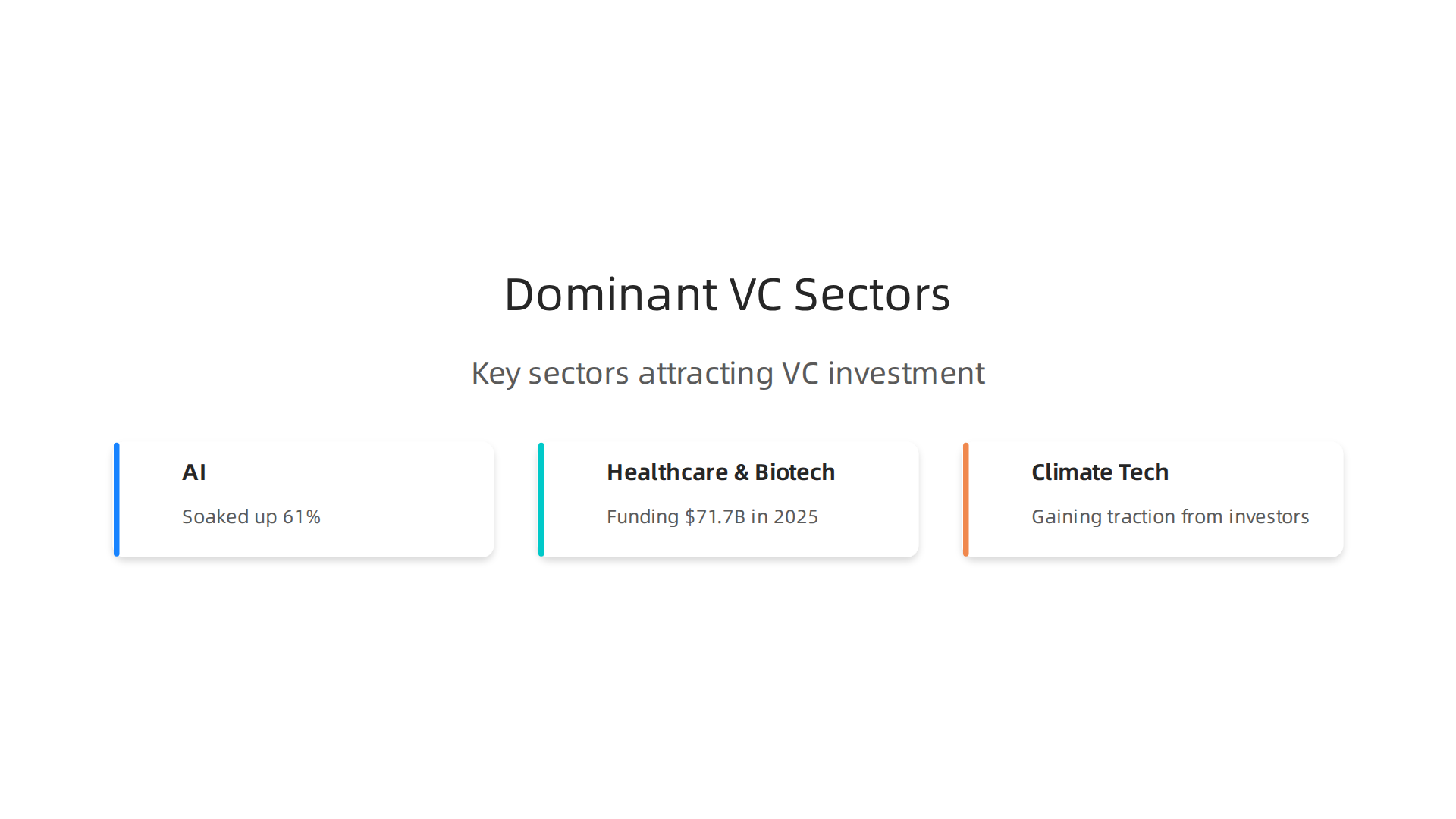
AI remains the king. It soaked up 61% of all VC investments in 2025, according to the Top VC Fundraising Trends of 2026 report from HubSpot. That is nearly $260 billion flowing into artificial intelligence alone. The biggest rounds went to names like OpenAI, Anthropic, and xAI, but the real story is how AI is spreading into every industry.
Healthcare and biotech are the second biggest sector. Funding reached $71.7 billion in 2025, and early 2026 numbers suggest another strong year. Climate tech is also gaining serious traction, with investors backing everything from carbon capture to sustainable energy.
Geography matters too. The United States still leads by a wide margin, accounting for $267.2 billion in Q1 2026 alone. That is more than double its previous record high. Asia pulled in $31.8 billion, while Europe reached $25.7 billion, hitting multi-year highs for both regions.
What does this mean for founders? The market is bigger than ever, but it is also more concentrated. A handful of mega-deals swallow most of the capital. To stand out, you need to target the right sectors and know which firms operate in your space. Understanding the differences between VC and other funding types helps too. Check out this guide on venture capital private equity the critical difference for startup fundraising to sharpen your approach.
Next, we will dive into the specific investment thesis that drives Covenant Venture Capital and how it fits into this landscape.
Covenant Venture Capital: Investment Thesis and Track Record
Not every firm chases early-stage bets. Covenant Venture Capital takes a different route. Founded in 2020 and based in New York, this firm focuses on private credit and growth-stage equity investing. Its thesis is simple: find companies with real traction, strong leadership, and scalable models. Then back them with discipline.
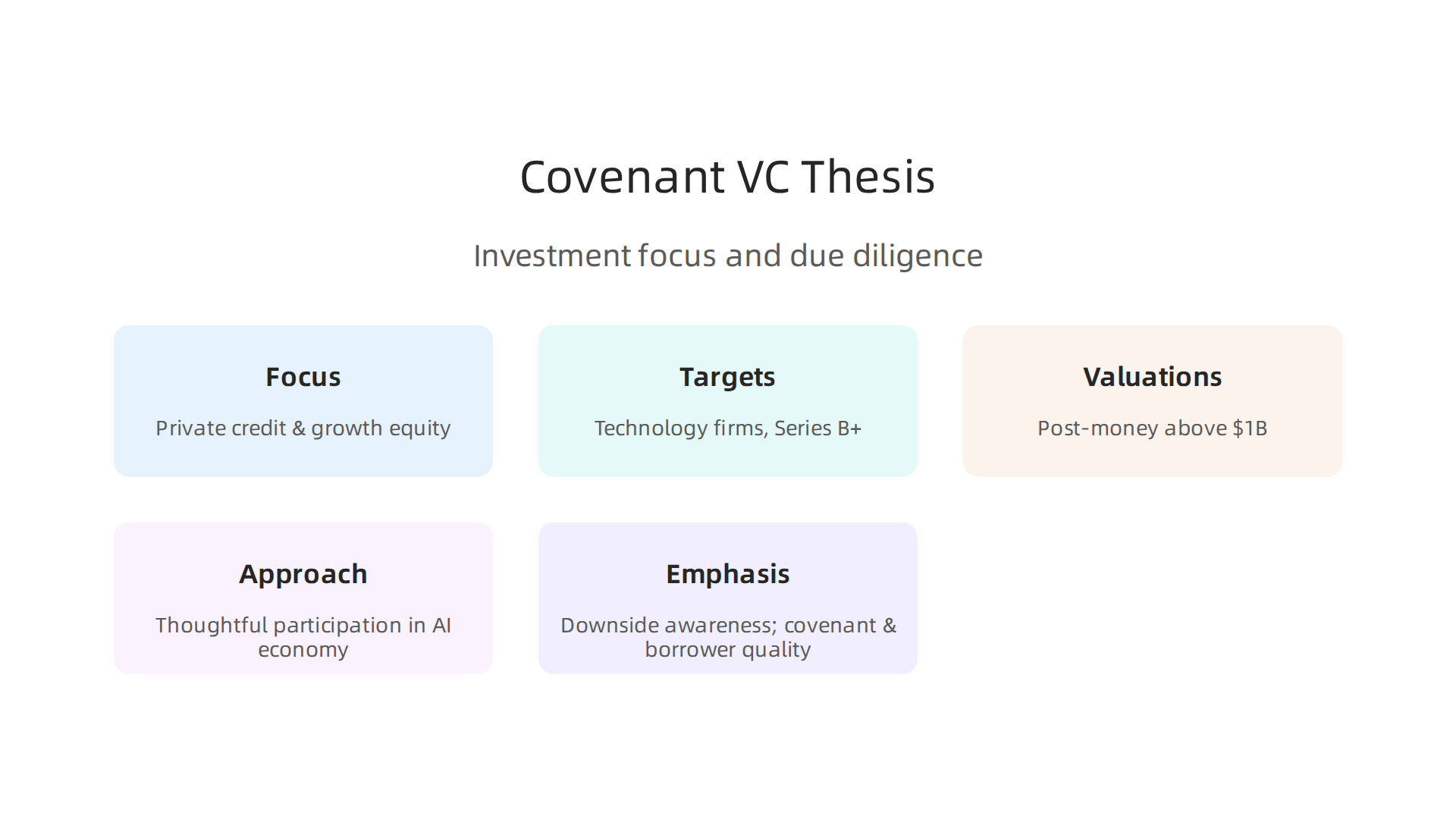
Covenant targets technology companies that have already completed Series B or later rounds. Many come with post-money valuations above $1 billion. That is the growth-stage sweet spot, where the risk of early failure is lower but the upside remains significant. On the credit side, Covenant builds hyper-diversified portfolios of short-term loans to businesses with solid credit profiles.
The firm describes its approach as "thoughtful participation in the evolving AI economy through carefully selected opportunities designed to balance growth and risk." You can read more about this investment philosophy on their Demo About Page. The emphasis is on downside awareness, covenant structure, and borrower quality. This is not a firm that chases hype. It picks its spots carefully.
Who invests with Covenant? The firm serves high-net-worth individuals, family offices, and institutional investors. One notable partner is the State of New Jersey, which has committed capital to the firm’s strategies. On the deal side, Covenant completed a strategic investment in Hill Research alongside the New Jersey Economic Development Authority. That deal signals the firm’s ability to partner with institutional players, as detailed in their announcement about the Hill Research investment.
The team is lean with 11 to 50 employees and operates across venture capital, private credit, and AI. For founders evaluating potential partners, understanding a firm’s track record matters. Read this guide on how to choose private equity investment companies for your startup for a broader perspective on evaluating firms like Covenant.
As the AI economy continues to reshape venture capital, staying informed on daily developments is essential. If you want to keep a pulse on the latest AI trends and funding moves, check out The AI Newsletter Worth Reading. It delivers clear daily updates straight to your inbox.
How Covenant Venture Capital Compares to Peer Firms
When you look at the venture capital landscape in 2026, certain names come up again and again. a16z, Sequoia, Index Ventures. These firms are giants. They chase massive deals, lead enormous rounds, and cover every stage from seed to late. Covenant Venture Capital does not try to compete with them on size or brand recognition. Instead, it competes on focus and discipline.
Here is the big difference. Firms like a16z and Sequoia run broad, multi-stage funds. They write checks across dozens of sectors, from crypto to healthcare to enterprise software. Covenant picks a much narrower lane. It specializes in private credit and growth-stage equity, with a strong emphasis on the AI economy. The firm avoids early-stage bets where product risk is highest. It targets companies that have already reached Series B or later, with valuations above $1 billion. That is a very different risk profile than what Sequoia takes on when it backs a seed-stage startup.
Sector specialization is another key differentiator. While Index Ventures has deep expertise in software and consumer tech, Covenant concentrates almost entirely on companies positioned to benefit from long-term shifts in the AI economy. The firm describes its approach as focused on structural advantages and durable business models, not hype cycles. You can read more about this philosophy on the Covenant Venture Capital main site.
What about performance benchmarks? Covenant does not publish its returns publicly. But its strategy of backing later-stage, cash-flow-positive companies with strong credit profiles generally leads to more predictable outcomes. The firm prioritizes downside protection over moonshot returns. That contrasts with the aggressive growth targets at firms like a16z, where hitting 100x returns on early bets is part of the culture. Covenant plays for singles and doubles, not home runs.
For founders trying to understand where a firm like Covenant fits, it helps to know the bigger picture of how different investment models work. Check out this guide on the venture capital versus private equity difference to see how stage focus shapes a firm’s entire approach.
The bottom line is simple. If you are a founder with a mature, cash-generating business in the AI space, Covenant is a natural partner. If you are a seed-stage startup, you are better off talking to Sequoia or Index. Knowing which firm matches your stage is half the battle.
Decoding Due Diligence: What Covenant and Peers Evaluate
Due diligence is where the real work happens.

After the initial meetings, investors dig into your business to see if everything checks out. Covenant Venture Capital follows a structured process, but its focus areas reveal what matters most.
Most VCs evaluate four buckets: team, market, product, and traction. A comprehensive due diligence checklist for 2026 from Predict Ventures breaks down over 50 questions investors ask. Covenant applies the same framework with a specific lens.
For Covenant, team evaluation is critical but different from seed-stage firms.
At Series B and beyond, Covenant expects a proven leadership team with a track record in AI. The firm looks for deep domain expertise. Market velocity matters more than total addressable market. Is the problem getting more urgent?
Product defensibility is huge for Covenant. The firm looks for technical moats, proprietary data, and strong IP. Given its AI focus, Covenant checks whether a company has a genuine data advantage. You can review the complete 2026 venture capital due diligence framework from SignalX to see how investors approach technical evaluation.
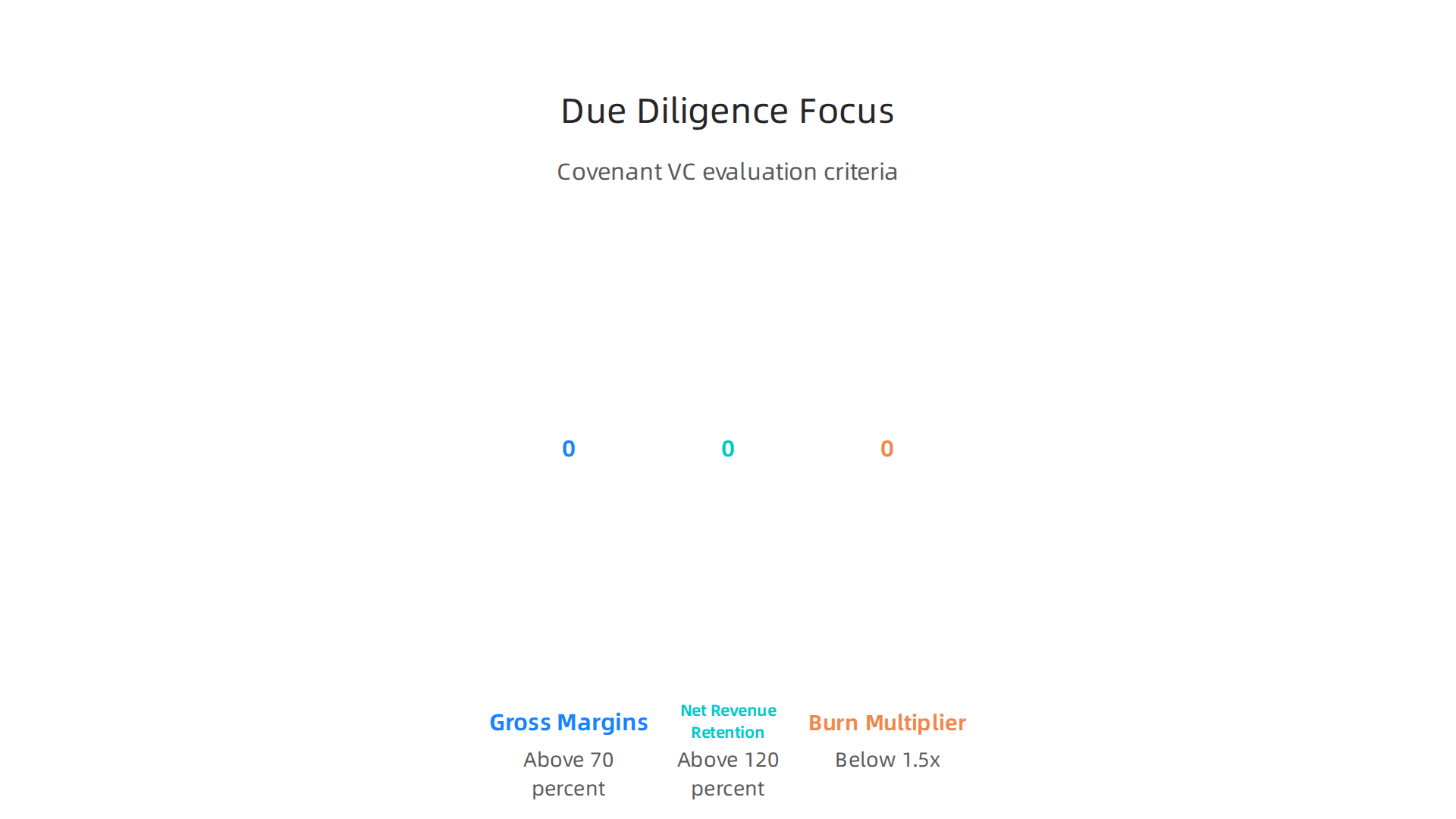
Traction is where Covenant stands out most. The firm prioritizes cash-flow-positive businesses with strong unit economics. Gross margins above 70 percent, net revenue retention above 120 percent, and a burn multiplier below 1.5x catch Covenant’s attention.
How do you prepare? Build a data room with financial statements, cap table, customer contracts, and IP assignments. A detailed guide on how to prepare for due diligence from Pitchwise walks through every document you need. Organization speeds up the entire process.
Understanding what investors look for is only half the picture. You also need to know how to evaluate them in return. This guide on how to choose private equity investment companies for your startup can help you assess fit from both sides.
If Covenant is on your list and you want to stay ahead of AI trends, consider The AI Newsletter Worth Reading for daily updates on what matters to AI-focused investors.
The Growing Role of AI and Data in VC Decision-Making
Venture capital is becoming more data-driven every year. In 2026, AI is not just a sector to invest in. It is also a tool that investors use to make smarter decisions. According to a report from insights4vc, AI captured about 80% of global venture funding in Q1 2026. That is a record. But beyond where the money goes, AI is changing how VCs find and pick startups.
So how do firms use AI for deal sourcing and evaluation? Many VCs now rely on AI-powered platforms to scan thousands of startups. These tools analyze online signals, founder backgrounds, market trends, and even social media activity. The goal is to spot high-potential companies before anyone else sees them. Some firms use natural language processing to review pitch decks and predict success rates. Others use machine learning models to track traction and growth patterns.
Take Spark Capital as an example. They have integrated AI screening into their deal flow. Ridgemont Equity Partners also uses data analytics to validate investment theses. Even traditional players like Stone Point Capital now lean on AI for due diligence. The shift is industry-wide.
Covenant Venture Capital takes a data-driven approach that matches its AI focus. The firm uses proprietary models to assess technical moats and data advantages. This fits their thesis that AI startups with defensible data hold the most upside. Covenant’s data tools also track market velocity, adoption rates, and unit economics in real time. This helps them spot trends early and act fast.
The key takeaway is that data and AI are becoming essential in VC decision-making. Founders who understand this can better prepare their own data rooms and pitch materials. If you want to learn more about the tools that help startups attract investors, check out this guide on tech tools for startups 2026 that attract investors and accelerate fundraising. Knowing how VCs use data gives you an edge in your fundraising journey.
Building Strategic Relationships with Capital Firms
You already know how firms like Covenant Venture Capital use data and AI to find winners. The next step is getting on their radar. Building a real relationship takes effort, but it pays off.

Here is how to do it in 2026.
Start with your existing network. Do you know a founder in Covenant’s portfolio? A mutual connection is your best path. Ask advisors, angel investors, or fellow founders for a warm introduction. When you ask, be specific. Say something like, "Our AI platform aligns with Covenant’s focus on defensible data moats. Could you introduce me to the team?"
Attend events where partners from firms like Covenant, Spark Capital, or Stone Point Capital speak. Demo days, AI conferences, and startup webinars are great places to listen and ask thoughtful questions. After the event, follow up with a short email. Reference something the partner said. That shows you pay attention.
When you land a meeting, focus on alignment and open communication. Show that you understand the firm’s investment thesis. For Covenant, that means talking about your technical moat, data advantages, and market velocity. Be honest about challenges too. Investors respect transparency.
Building the relationship early also prepares you for formal evaluation. You will already have shared context. To get ready for the deep dive, review this VC Due Diligence Checklist for Investors and Founders. It covers the financial, team, and legal documents firms will request.
Understanding how venture capital differs from private equity also helps you target the right firms. Read about the critical difference between venture capital and private equity to sharpen your approach.
Finally, stay current on AI trends that matter to investors like Covenant. The AI Newsletter Worth Reading delivers daily updates so you can speak their language with confidence.
Case Studies: Successful Partnerships with Covenant Venture Capital
So what does a real partnership with Covenant Venture Capital look like? The best way to understand is to look at how they work with portfolio companies. These examples show the kind of support founders can expect.
Growth-Stage Equity Partnerships
Covenant focuses on growth-stage companies that have completed Series B or later rounds. Their equity strategy targets companies with proven traction and strong institutional backing. According to their own materials, Covenant uses a proprietary 3-Trigger strategy. This approach captures venture-level upside while keeping a private equity style risk profile.
The firm looks for companies nearing scale. They partner with management teams directly. They also target structured secondary opportunities between institutional financings. This gives founders more flexibility when they need liquidity for employees or early investors.
Private Credit and Covenant Monitoring
Another area where Covenant adds real value is private credit. The firm helps portfolio companies manage borrowing effectively. Tools like percentile-based benchmarking from partners such as Allvue Systems make this easier. Instead of asking whether a borrower exceeds a fixed limit, this method compares performance to peers over time. It flags problems earlier and more accurately.
For founders, this means Covenant does not just write a check. They bring sophisticated monitoring tools that help companies stay healthy during the growth phase.
Fund Partnerships for Broader Access
Covenant also partners with platforms like Chateau to offer fund access. Through offerings like the schUSD fund, accredited investors and family offices get exposure to private credit and growth equity. This creates a bigger pool of capital that Covenant can deploy into promising companies.
Key Takeaways for Founders
What can you learn from these examples?
First, Covenant values data-driven approaches. When you pitch them, bring clear metrics and benchmarks. Second, they care about alignment. They want management teams who communicate openly and understand the firm’s investment thesis. Third, they look for companies at the later growth stage with proven traction. If you are still pre-revenue, you may not be the right fit.
To find the best investor match for your stage, check out this guide on how to choose private equity investment companies for your startup.
And remember, speaking the language of venture investors means staying current on AI and tech trends. The AI Newsletter Worth Reading delivers daily updates so you can walk into any meeting informed and confident.
Future Trends in Venture Capital and Startup Funding
The venture landscape in 2026 looks very different than it did just a few years ago. If you are a founder trying to raise money, knowing where the market is headed matters just as much as understanding your own pitch deck.
AI Is Reshaping Everything
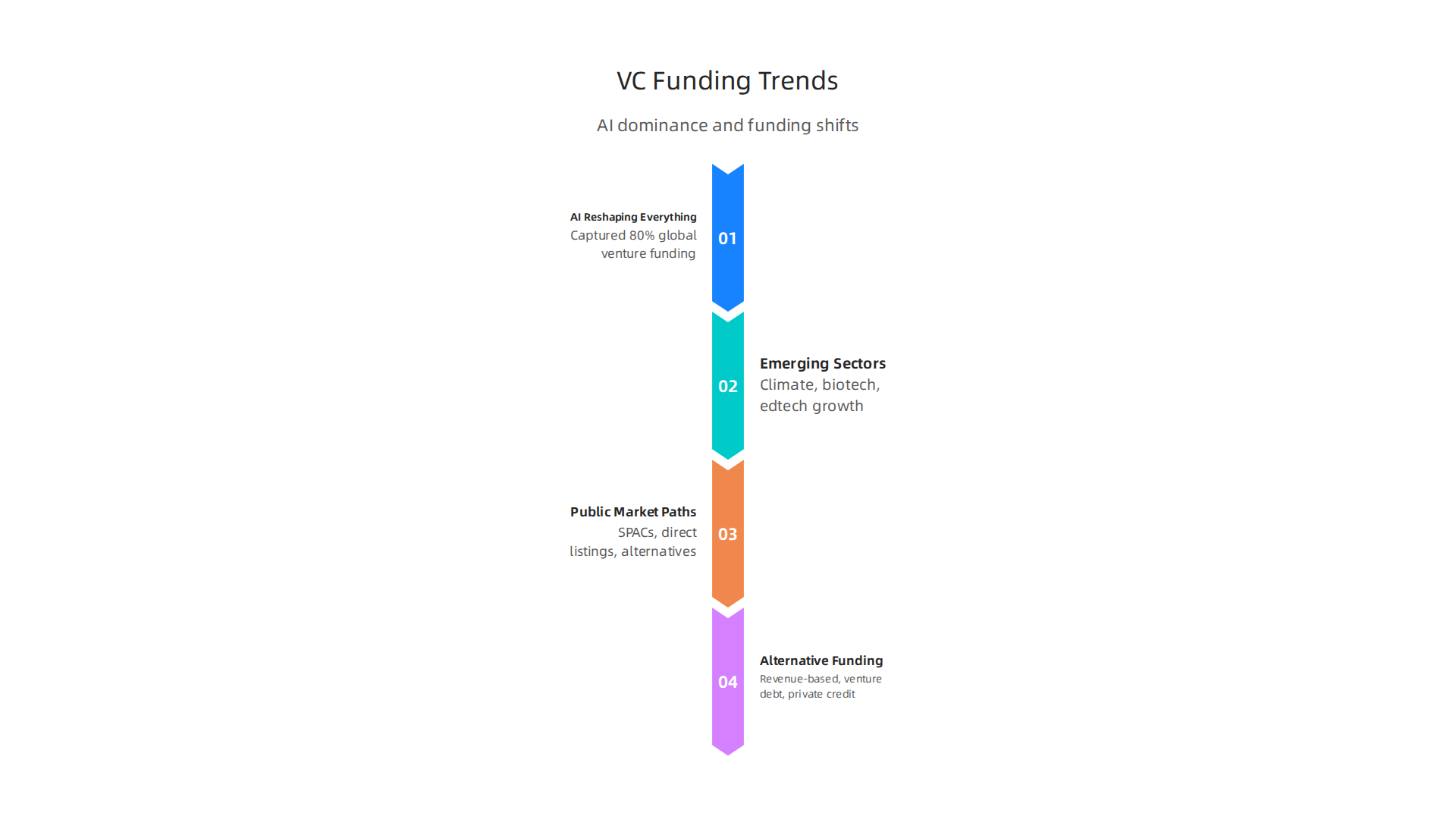
The biggest trend is impossible to miss. AI captured 80% of global venture funding in Q1 2026 according to Crunchbase data.
That is roughly $242 billion out of $300 billion total. For context, that is an all-time quarterly high for startup investment worldwide.
What does this mean for you? Even if your startup is not an AI company, every investor including covenant venture capital will want to know how AI affects your space. The firms that answer that question well get the meetings.
Emerging Sectors Gaining Steam
AI gets the headlines, but other sectors are growing fast too.
Climate tech is drawing serious money as governments push for cleaner energy. Biotech is surging, especially where AI tools speed up drug discovery. Edtech is making a comeback with personalized learning platforms.
Different firms are placing bets across these spaces. Spark Capital has backed climate-focused startups. Ridgemont Equity Partners targets healthcare and tech-enabled services. Stone Point Capital focuses on financial services and insurance. Each firm has its own thesis, but the common thread is clear. Investors want companies solving real problems in large markets.
New Paths to Public Markets
The way startups go public has changed. SPACs and direct listings are now standard options. These alternatives give founders more control over timing and avoid some costs of a traditional IPO.
Alternative funding is also growing fast. Revenue-based financing, venture debt, and private credit now fill gaps that equity alone used to cover. That is where covenant venture capital stands out. Their focus on private credit with data-driven monitoring tools gives portfolio companies flexible options without giving up too much equity.
Where Covenant Could Go Next
Looking ahead five years, covenant seems well positioned. More companies are staying private longer. They need sophisticated financing that blends equity and debt. Covenant’s 3-Trigger strategy and percentile-based benchmarking tools fit this trend perfectly.
For a deeper look at how these shifts affect your fundraising plans, check out this breakdown of venture capital trends for 2026. The firms that adapt fastest will win the best deals.
Summary
This profile explains how Covenant Venture Capital fits into the much-larger 2026 VC market and what founders should know before targeting them. Covenant specializes in private credit and growth-stage equity, typically investing in Series B+ technology companies—many tied to the AI economy—and prefers cash-generating businesses with strong unit economics and defensible data advantages. The article covers the firm’s track record, investment thesis, typical deal structures (including private credit tools), and how it differs from multi-stage giants like a16z or Sequoia. It also breaks down the due diligence priorities (team, product defensibility, traction metrics), shows practical ways to get on Covenant’s radar, and illustrates real partnership examples. Finally, it places Covenant within broader 2026 trends—AI-dominant funding, new credit solutions, and evolving exit paths—so founders can decide whether the firm matches their stage and fundraising goals.