

Introduction
Finding the right growth capital for your startup can feel overwhelming.

You have heard about private equity investment companies, but understanding how they work and which ones might be the right fit takes time and effort.
Private equity investment companies are a powerful source of growth capital for scaling startups and established businesses. In 2026, the industry is sitting on over $1.1 trillion in dry powder, according to the Private Equity Report 2025 Trends and 2026 Outlook. That is a huge pool of money waiting for the right opportunities.
But here is the thing. The partnership journey is complex. Founders often struggle with information overload, lack of transparency, and the pressure of market volatility when evaluating potential PE partners. How do you know which firms on the list of private equity firms are the real deal? What makes a firm like sentinel capital partners or ks capital different from the rest? And what are investment companies really looking for when they decide to back a business?
These are not easy questions to answer alone.
That is why this guide exists. We created a structured, evidence-based roadmap to help you navigate the PE landscape. From due diligence to post-investment growth, we cover the practical steps you need to find and secure the right partner.
Understanding what private equity investment companies expect can save you months of wasted effort. It can also help you avoid partnerships that do not serve your long-term vision.
Let us start by breaking down what these firms actually do and how they think.
The AI Newsletter Worth Reading delivers clear daily updates on tech and market shifts that affect your fundraising strategy.
For a deeper look at how PE firms operate, check out this guide on private equity funds for startup founders.
Understanding the Private Equity Landscape: Key Players and Market Dynamics
Not all private equity investment companies are the same. Walk into a room with a dozen PE firms, and you will find completely different strategies, risk appetites, and expectations. Some want to buy your whole company. Others just want a minority stake. Some look for fast growth. Others want steady cash flow.
If you are a founder, this matters a lot. Targeting the wrong type of firm wastes months of your time. So let us break down the main players you will meet.
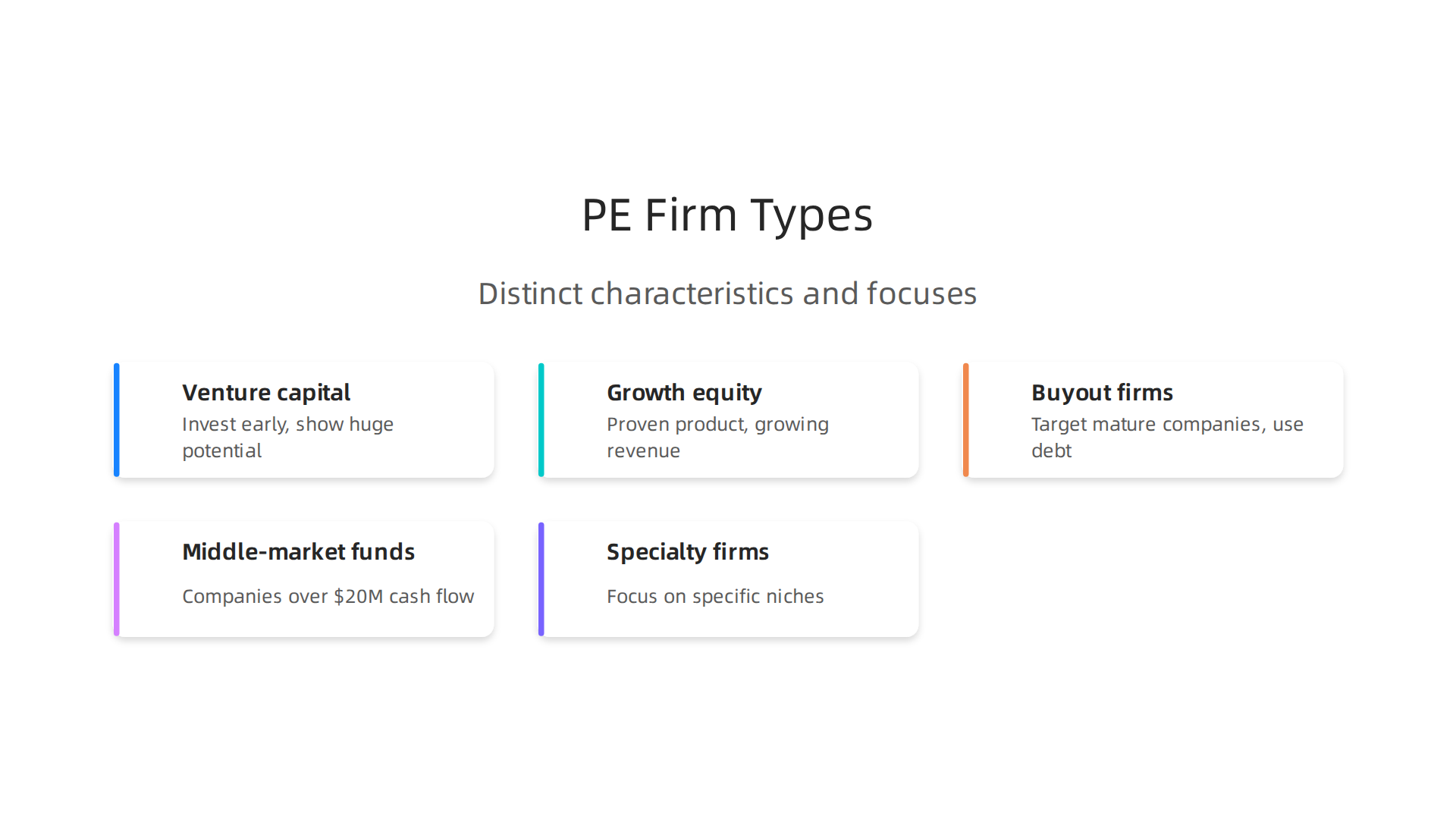
Venture capital firms invest early. They back startups that may not have revenue yet but show huge potential. They usually take a minority stake and expect high returns from a few big winners.
Growth equity firms step in later. Your company has a proven product, steady customers, and growing revenue. These investors take a minority or sometimes majority stake without using much debt. They want to fuel your next big push.
Buyout firms target mature companies. They use debt to buy a controlling stake, then work to improve operations and cash flow. These include mega funds like Blackstone and KKR as well as middle-market specialists.
Middle-market funds are the largest category by deal volume. They focus on companies with over $20 million in cash flow. Firms like Audax Private Equity use a buy-and-build model, rolling up smaller companies to create bigger, more valuable platforms.
Specialty firms focus on specific niches. For example, Sentinel Capital Partners targets smaller businesses in sectors like restaurant and healthcare. KS Capital backs lower-middle-market companies needing operational support.
So how is the market looking in 2026?
The industry is sitting on massive capital. According to the 2026 Private Equity Industry Predictions, deal activity is expected to keep rising. Firms are competing hard for top-tier assets, especially in technology, healthcare, and energy infrastructure. Valuation gaps are narrowing, and borrowing costs are coming down.
Founders should pay attention to these trends. When capital is abundant and competition is high, you have more leverage. The right firm will offer not just money but real operational help.
The takeaway is simple. Know which type of player fits your stage and goals before you start reaching out. It saves time and gets you better offers. For a deeper look at how a leading middle-market firm operates, read this analysis of Audax Private Equity and the buy-and-build model.
Criteria for Selecting the Right Private Equity Investment Companies
You now know the different types of private equity players walking around. But knowing the types is only half the battle. The real question is: how do you pick the right one for your company?
Here is the hard truth. Many founders jump at the first offer that lands on their desk. That is a mistake. Not all private equity investment companies bring the same value. Some will be a perfect match. Others will make your life miserable.
Think of it like hiring a business partner. You would not hire someone just because they showed up first. You would check their background, their style, and whether you can stand working with them for five to seven years. The same logic applies here.
So what should you actually look for?
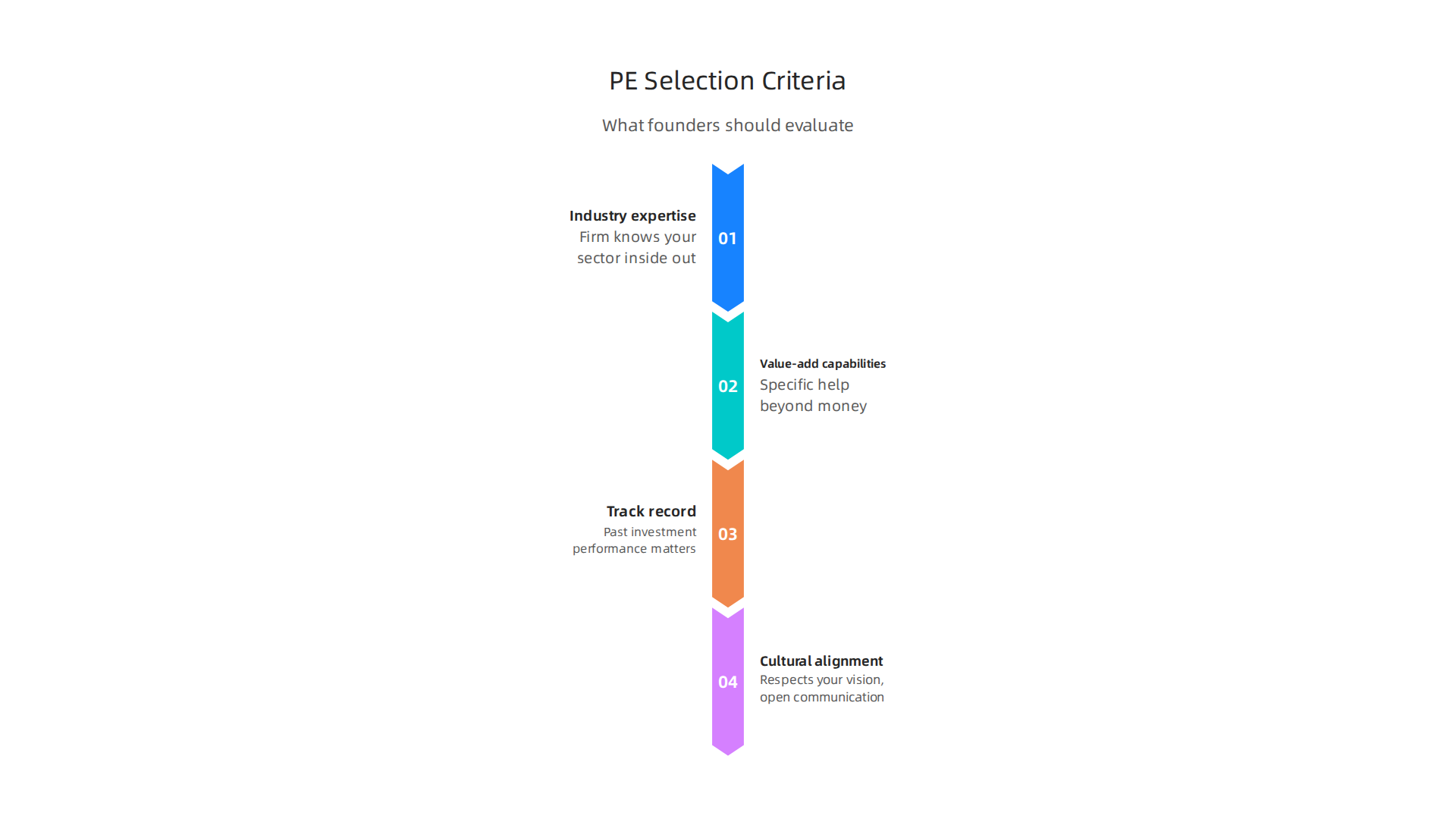
Industry expertise comes first. A PE firm that knows your sector inside out is worth ten times more than one that only brings cash. They understand your customers, your competitors, and your challenges. They can open doors you cannot open yourself. According to the detailed guide on criteria to evaluate private equity investors, firms with a specialized focus tend to offer better strategic support and more useful networks than generalists.
Value-add capabilities matter more than the check size. Some firms bring operational experts who can help you improve your supply chain. Others have marketing teams that can double your pipeline. A few even have in-house tech teams. Ask yourself: what specific help does this firm offer beyond money? The answer will tell you a lot.
Track record is not just about returns. Sure, past investment performance matters. But dig deeper. Have they worked with companies at your stage? Have they helped founders through tough transitions like replacing a CFO or entering a new market? Have they exited companies successfully without destroying the relationship? Look for patterns, not just numbers.
Cultural alignment is the one everyone skips. This is huge. Do they communicate openly or do they disappear for months? Do they respect your vision or do they want to change everything on day one? Do they treat founders as partners or as employees? You will spend years working with these people. Make sure you actually like them.
Here is a simple framework to build your shortlist. Start by writing down your top three needs. Maybe you need operational support. Maybe you need help making acquisitions. Maybe you just want a hands-off partner who sends a board member once a quarter. Match those needs against what each firm actually delivers.
Then do your homework. Talk to CEOs of their current and past portfolio companies. Ask about the hard stuff. When things went wrong, how did the firm react? Were they supportive or did they start pointing fingers?
Finally, be honest about your own strengths and gaps. A firm that expects a CEO who thrives on fast growth will clash with a founder who likes steady, careful progress. Knowing yourself helps you find the right match.
The goal is not to find the biggest name on the list. The goal is to find the firm that fits your business, your team, and your future plans.

For a deeper look at how to build that shortlist, check out this guide on how to evaluate top VC and PE firms.
The Due Diligence Process: What PE Firms Evaluate
So you have built your shortlist of firms. You know what you want from a partner. Now comes the part that makes many founders sweat. The tables turn, and suddenly your company is the one being examined under a microscope.
Private equity due diligence is not a casual look at your financials. It is a deep, thorough investigation that covers every corner of your business. The best private equity investment companies leave no stone unturned. They want to know everything before they write a check.
Here is what they are actually looking at.
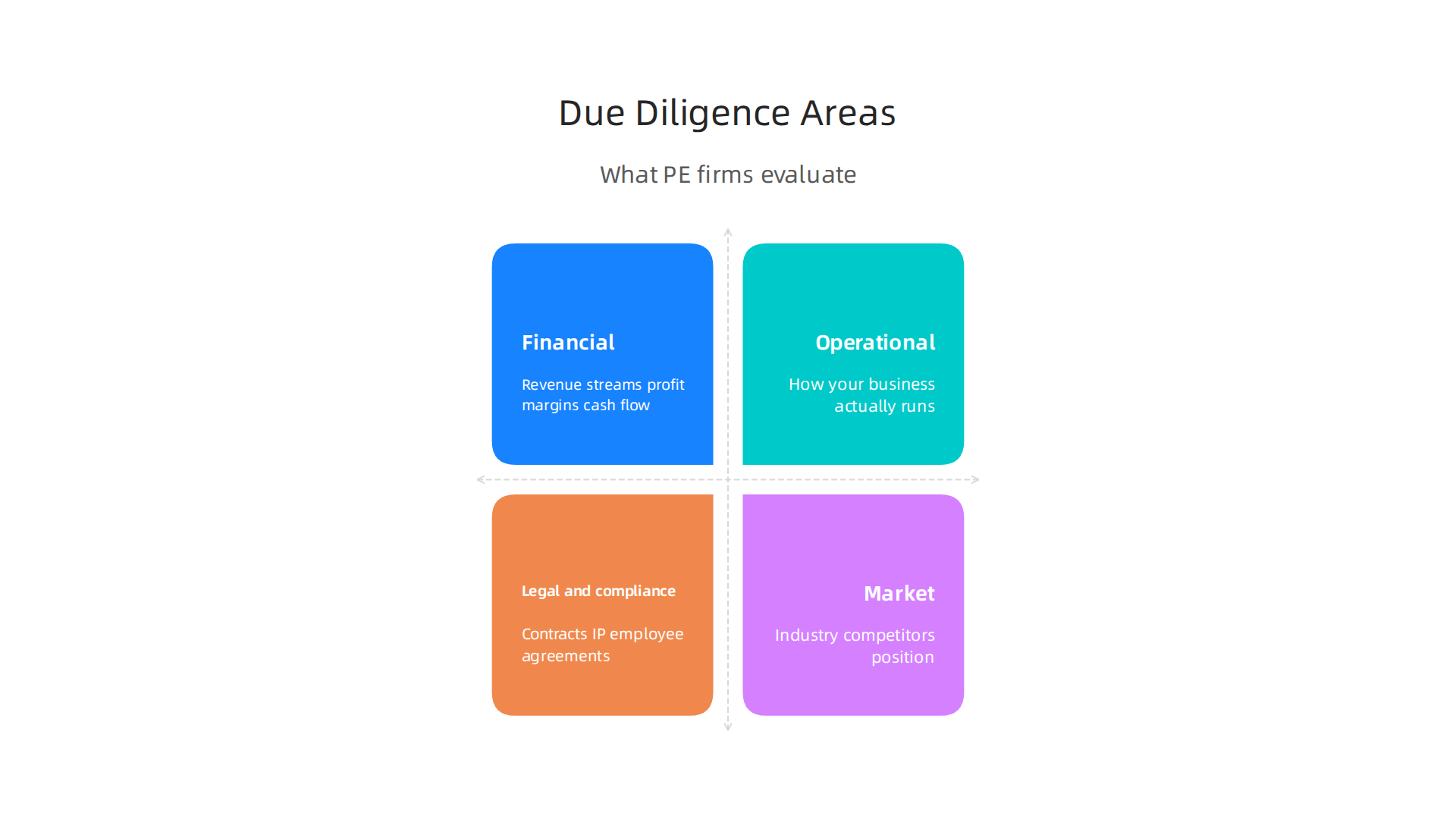
Financial due diligence is the obvious starting point. PE firms will dig through your revenue streams, profit margins, cash flow patterns, and historical growth rates. They want to see clean numbers with no surprises. They will check your customer concentration. If one client makes up 40 percent of your revenue, that is a red flag. They will verify your recurring revenue and look for signs of trouble like shrinking margins or rising churn.
Operational due diligence goes deeper. This is where the list of private equity firms separates the pros from the amateurs. Strong firms send operational experts to tour your facilities, interview your managers, and review your systems. They want to understand how your business actually runs day to day. What is your supply chain like? How reliable are your key suppliers? Do you have the right team in place to scale? According to the detailed breakdown of lower middle-market private equity investment criteria, firms look for sustainable competitive advantages and multiple ways to grow. They are not just buying your past performance. They are buying your future potential.
Legal and compliance checks are non-negotiable. The PE firm will review your contracts, intellectual property, employee agreements, and regulatory filings. They will look for lawsuits, compliance gaps, or anything that could become a liability down the road. If you have messy contracts with customers or employees, now is the time to clean them up.
Market due diligence tests your moat. The firm will study your industry, your competitors, and your position in the market. They want to know if your business can survive disruption. Are you in a growing market or a shrinking one? Do you have pricing power? Can competitors easily copy what you do?
Here is the thing many founders miss. The quality of your data and your transparency during this process directly affect your valuation. Hiding problems or having messy records can kill the deal or reduce your price. Smart founders get ahead of this. They prepare their data room before the first meeting. They fix known issues. They are honest about weaknesses.
If you want to understand how top PE firms approach the full investment cycle, this guide on private equity funds for startup founders breaks down the entire process from sourcing to exit.
The due diligence process can feel intense. But remember, a thorough PE firm is a good sign. It means they are serious about making the partnership work. Your job is to make their job easier by being prepared, transparent, and proactive.
Post-Investment Partnership: Maximizing Growth with Your PE Partner
You just closed the deal. The paperwork is signed, the funds are in the bank, and you feel a huge sense of relief. But here is the truth most people do not talk about: the real work starts now.
The moment after closing is when the partnership actually begins. For many founders, this is the most exciting and the most challenging phase. The real value of working with private equity investment companies does not come from the check they wrote. It comes from everything that happens next.
What Active Ownership Looks Like
Top PE firms do not just sit back and wait for quarterly reports. They roll up their sleeves. They help you build a structured plan to grow faster, fix operational leaks, and reach new customers.
According to McKinsey, the most successful PE partners create something called a postclose value creation plan. This plan turns the original investment idea into a practical roadmap with clear priorities, timelines, and accountability. Think of it as a shared GPS for the next three to five years.
These value creation levers usually include operational improvements, digital upgrades, strategic acquisitions, and sometimes changes in leadership. The goal is not just to cut costs. The goal is to build a stronger, more valuable company.
Aligning Expectations Early
One of the biggest sources of friction between founders and their PE partners is misaligned expectations. You might want to move fast and experiment. Your partner might want steady, predictable growth. Both can work, but you need to agree on the rules of the game upfront.
Set clear expectations around:
- How often you report financials and key metrics
- What decisions require board approval
- What growth milestones matter most in the first year
- How you will communicate problems before they become crises
A good PE partner will ask tough questions. They will push you. But they should also bring resources like industry experts, technology tools, and strategic connections that you could not afford on your own.
Trust and Transparency Go Both Ways
The strongest post-investment relationships are built on honest communication.

When you share bad news early, your partner can help fix it. When you are transparent about challenges with cash flow, team culture, or customer churn, a great PE firm treats those as problems to solve together, not reasons to panic.
Firms like Sentinel Capital Partners and KS Capital are known for taking a hands-on, partnership approach. They understand that founders know their businesses better than anyone. Their job is to add fuel to the fire you already built.
If you want to understand how different private equity investment companies approach post-deal partnerships, reading a detailed private equity funds guide for startup founders can help you prepare for what comes after the handshake.
The bottom line? A PE partnership is not the finish line. It is the starting point for your company’s next chapter. Get the relationship right, and you will build something far bigger than you could on your own.
Future Trends in Private Equity (2026 and Beyond)
The world of private equity investment companies is shifting fast in 2026. If you want to attract top PE partners in the coming years, you need to know what is coming next.
The landscape is not the same as it was five years ago, and the firms that win will be the ones that adapt early.
AI Is Reshaping Everything
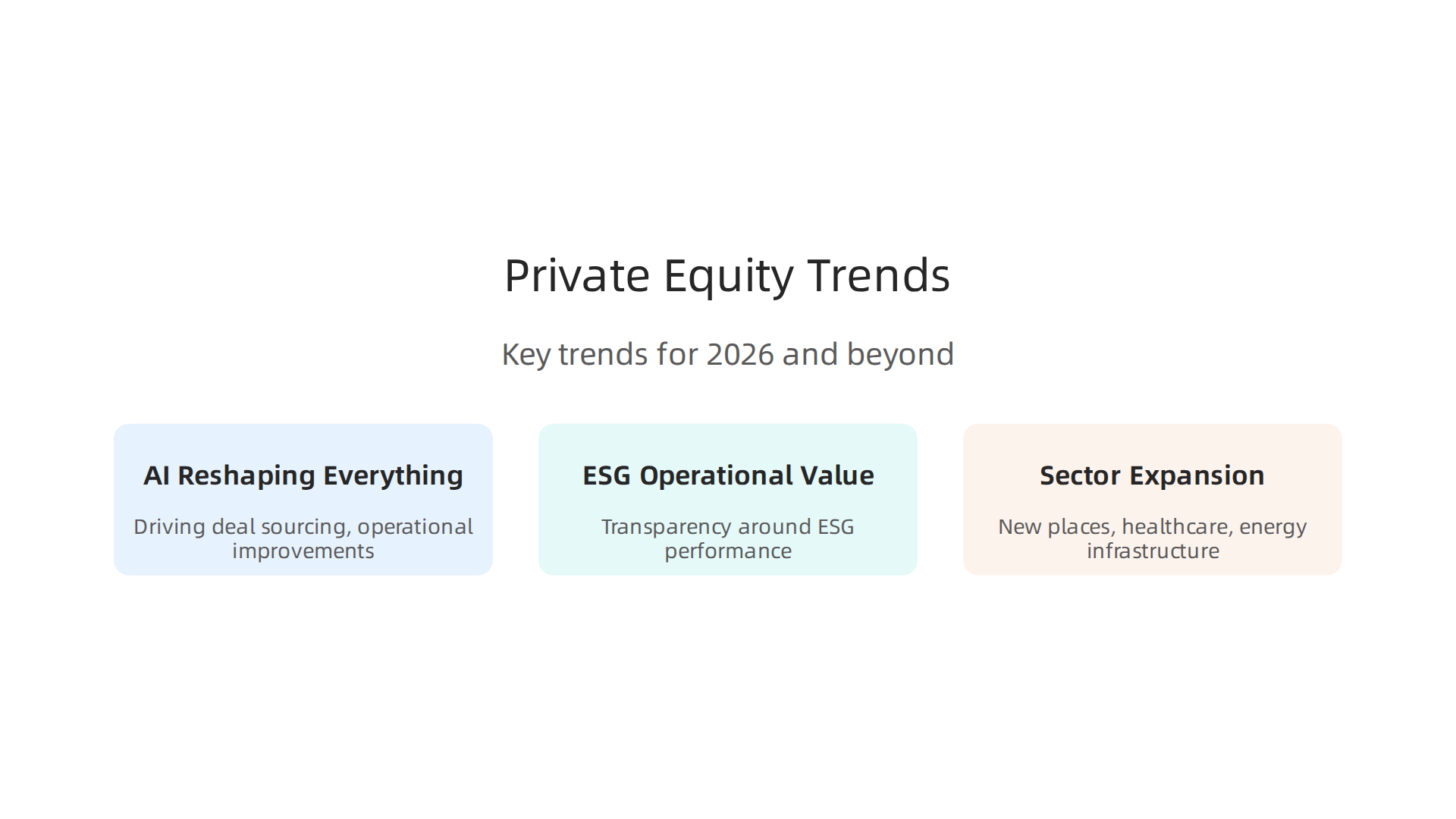
Artificial intelligence is no longer a side project in private equity. It has become the central force driving deal sourcing, operational improvements, and exit planning. According to the 2026 Private Equity AI Radar by FTI Consulting, 95% of funds report that their AI initiatives are meeting or exceeding original business case criteria. That is a huge number.
Most PE firms are now embedding AI across the entire investment lifecycle. They use it to find better deals, improve how portfolio companies run, and prepare for successful exits. For founders, this means one thing: if you want to attract forward-thinking PE investors, your company needs to show clear AI capabilities.
ESG and Operational Value Creation
Environmental, social, and governance factors are also becoming standard expectations. LPs, the investors who put money into PE funds, are demanding more transparency around ESG performance. This is not just a nice to have anymore. It is a requirement.
At the same time, PE firms are moving away from relying on financial leverage alone. They are focusing on real operational improvements. They bring in experts, upgrade technology, and push for productivity gains inside their portfolio companies. The Cherry Bekaert private equity report notes that firms with deep operational expertise are gaining a clear competitive edge.
Geographic and Sector Expansion
Private equity is also expanding into new places. European PE activity is expected to catch up with the US market in 2026, as interest rates stabilize and exit markets open up. Sectors like healthcare, energy infrastructure, and financial services are attracting more capital.
For startup founders, this is good news. It means more potential partners with different areas of focus. To position your company well, study the list of private equity firms that specialize in your industry. Look for firms like Sentinel Capital Partners and KS Capital that have strong track records in your space.
If you want to dig deeper into how top firms are approaching the market, check out our detailed piece on private equity and venture capital trends for 2026. It covers what successful funds are doing differently this year.
Stay Ahead of the Curve
The best way to prepare for a future PE partnership is to understand where the market is headed. AI, operational excellence, and ESG are not passing fads. They are the new foundation of value creation. Build your company with these trends in mind, and you will stand out when it comes time to raise capital.
Want to stay informed on how AI is changing business and fundraising? Get clear daily AI updates from The Deep View Newsletter.

It will help you keep your finger on the pulse of the technology that is reshaping private equity.
Your Path to a Successful Private Equity Partnership
With that big picture view of the market in mind, let’s get practical. Finding the right private equity investment companies to work with takes more than a good pitch deck. It takes strategy, careful preparation, and honest conversations.
Start by studying the list of private equity firms that operate in your industry. Each firm has a unique focus. Some target fast growing tech companies. Others prefer stable cash flow businesses in healthcare or manufacturing. For example, firms like Sentinel Capital Partners and KS Capital have specific investment criteria that match certain stages and sectors. Knowing what are investment companies really looking for helps you target the right partners from the start.
Once you have a shortlist, the real work begins. PE firms dig deep during due diligence. They will study your financials, your team, and your market position. They also start building their value creation plan or VCP. This is a detailed roadmap for how they plan to grow your company after the deal. You can explore a full breakdown of how this process works in the Private Equity Value Creation: 2026 Playbook and Examples by Dealroom. Understanding this process helps you go into term sheet negotiations with confidence.
The relationship does not end when you sign the deal. The best partnerships are built on active collaboration. Your PE partners will bring operational expertise and strategic guidance. Your job is to stay aligned on goals and communicate openly. For a closer look at how top firms handle these long term relationships, check out this guide to private equity funds for founders.
By focusing on shared goals from day one, you create a partnership that drives real growth for years to come.
Summary
This guide explains how private equity investment companies operate and how founders should approach them to secure growth capital. It breaks down the different PE players—from venture and growth equity to buyout and middle-market funds—and shows which firm types fit different company stages and goals. You’ll learn practical criteria for selecting partners, including industry expertise, value‑add capabilities, track records, and cultural fit, plus a simple framework to build a targeted shortlist. The article walks through the due diligence process (financial, operational, legal, and market checks) and explains how to prepare clean data and transparent answers to speed deals. It also covers post‑investment work: building a value creation plan, aligning expectations, and maintaining trust with active PE partners. Finally, it highlights 2026 trends—AI, ESG, and geographic/sector shifts—that will shape which firms invest and how they create value. After reading, founders will know how to target the right firms, navigate diligence, negotiate wisely, and manage a productive PE partnership.