

You’ve probably heard "private equity" in financial news, but what are private equity funds exactly, and why should startup founders care? Private markets are a massive but often mysterious part of the global economy. Private equity funds alone manage trillions of dollars in assets, pooling money from big investors like pension funds and endowments to buy and grow companies not listed on public stock exchanges. For a closer look at how these funds operate, check out this private equity overview from KKR.

If you’re building a startup, understanding private equity meaning is important.

It helps you evaluate growth capital options later in your journey. You might sell your company to a PE firm or take growth equity from one. Plus, knowing the difference between private equity and venture capital can shape your fundraising strategy. For a deeper dive, read about the critical difference between venture capital and private equity.
In this article, we’ll demystify what private equity funds are. We’ll explain their structure, how they differ from venture capital, and the trends shaping the landscape in 2026. To stay ahead of the tech and AI shifts that affect fundraising, get clear daily AI updates from The Deep View Newsletter.

The LP-GP Model and Fee Structures
Now let’s get into the nuts and bolts of how private equity funds are actually built. Every private equity fund has two main groups: the limited partners (LPs) and the general partner (GP).
LPs are the big investors, like pension funds, university endowments, and insurance companies. They put up most of the money but stay out of the daily decisions. The GP is the private equity firm that runs the fund. It finds the companies to buy, works to grow them, and eventually sells them for a profit.
The way the GP gets paid is famous in finance. It’s called the "2 and 20" model. That means a 2% annual management fee on the total money in the fund, plus 20% of any profits the fund makes. That profit share is known as carried interest or carry. As one expert resource explains, this 2/20 structure is the standard profit model for fund managers.
But things are changing in 2026. LPs are pushing for better deals. Many funds now charge lower management fees, sometimes closer to 1.5%. And hurdle rates are getting higher. A hurdle rate is the minimum profit the fund must earn before the GP can take its 20% carry. According to a detailed breakdown of private equity fund structures, the hurdle rate often falls between 5% and 8% per year. Some newer funds even set it at 8% or 9%.
For founders, understanding this model matters. If you ever sell your company to a PE firm, you’ll be dealing with a GP that has strong incentives to grow your company fast. The fee structure drives their behavior. To see how one major general partner executes its strategy, read about how KKR private equity became one of the most powerful names in finance. Knowing how GPs make money helps you negotiate better and align interests.
Fund Lifecycle: From Inception to Exit
Now let’s walk through the full journey of a private equity fund from start to finish. A typical PE fund spans 7 to 10 years, though some run longer. The lifecycle has four main phases: fundraising, investment, value creation, and exit.
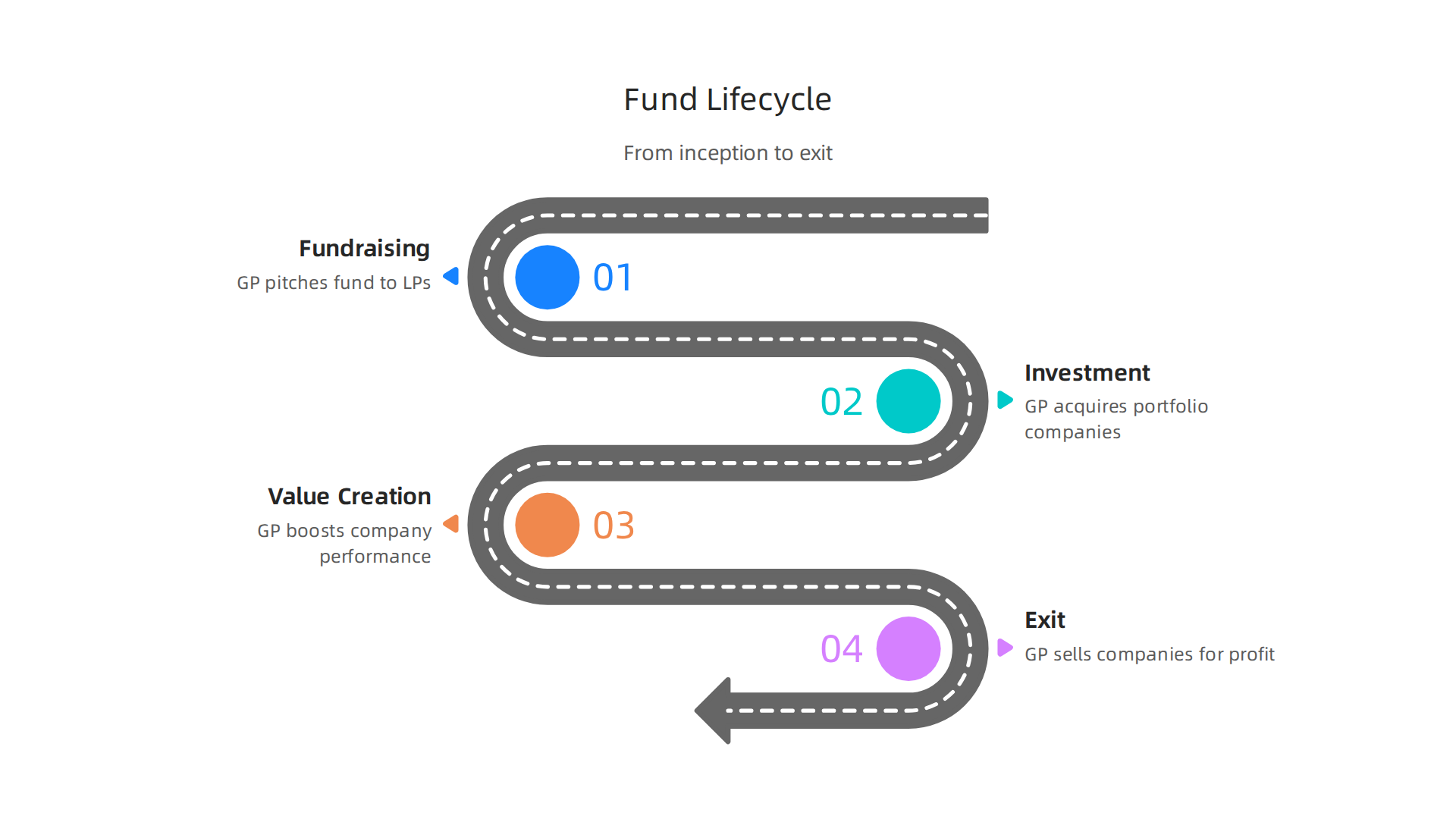
Fundraising kicks things off. The GP spends 1 to 2 years pitching the fund to LPs like pension funds and endowments. Once enough capital is committed, the fund closes. But LPs don’t wire all the money at once. Instead, the GP sends capital calls when it finds a deal. This way, cash is drawn down gradually.
Next comes the investment period, usually 2 to 5 years. The GP sources companies, performs due diligence, and closes acquisitions. This is where the fund puts its strategy to work.
After buying companies, the value creation phase begins. The GP actively manages each portfolio company to boost performance through operational improvements, cost reductions, or add-on acquisitions. This hold period typically lasts 3 to 7 years. As one detailed resource on the private equity fund life cycle explains, once a team makes an investment, it needs to work quickly to build a record of exceptional results.
Finally, exit. The GP sells each company through a trade sale to a strategic buyer, an IPO on the stock market, or a secondary sale to another PE firm. Profits are then shared between LPs and the GP based on the distribution waterfall, which determines how returns flow back.
Knowing this lifecycle helps you anticipate a PE buyer’s timeline and motivations. To see how this differs from other funding paths, explore the difference between venture capital and private equity for startup fundraising.
If you want to keep up with the trends shaping private markets and technology, get clear daily AI updates from The AI Newsletter Worth Reading. It’s a simple way to stay informed.
Investment Strategies and Risk Profiles
Not all private equity funds invest the same way. In fact, the strategies and risk levels vary a lot depending on what type of companies the fund targets. Understanding these differences is a big part of answering the question "what are private equity funds" and how they compare to other investment vehicles.
Most traditional PE funds buy mature, cash-flow-positive companies. They often use borrowed money, called leverage, to buy these businesses. This is known as a leveraged buyout (LBO). The idea is to use the company’s own cash flow to pay down the debt while the PE firm improves operations. For a solid foundation on this model, check out what you need to know about private equity from KKR.
Now, compare that to venture capital. VC firms target early-stage startups with high growth potential but little to no revenue. That makes VC much riskier. If the startup fails, investors could lose everything. PE bets on more established companies, so the risk is lower. Still, PE investments are illiquid — you cannot cash out quickly.
Hedge funds are another different animal. They focus on liquid assets like stocks and bonds, using short-term strategies to generate returns. Their goal is often market-neutral or absolute returns, meaning they try to make money in both up and down markets.
So, here is the risk profile breakdown:
- Private equity: Moderate risk, long-term, illiquid.
- Venture capital: High risk, very long-term, illiquid.
- Hedge funds: Lower risk (depending on strategy), short-term, liquid.
If you want to see how a top firm applies these strategies, read about how KKR private equity became one of the most powerful names in finance. Knowing these differences helps you spot which kind of fund fits a particular company or investment goal.
Return Expectations and Liquidity
So, you understand the risk profile. But what about the actual returns? When someone asks "what are private equity funds" they usually want to know how much money they could make and when they can get it back. That is where return expectations and liquidity come in.
Private equity funds typically aim for net IRRs in the mid-to-high teens, around 15% to 20%. They hold investments for 4 to 7 years. During that time, they work to improve the company’s operations and cash flow. A good benchmark to remember is that top-quartile buyout funds clear a 2.3x multiple of invested capital according to 2026 data from Cambridge Associates.
You can check out those private equity return benchmarks for more detail.
Now, venture capital targets much higher potential returns, often 25% or more net IRR. But here is the catch. Many startups fail. So those high returns come with a much higher chance of losing your whole investment. That is a key part of the difference between venture capital and private equity.
Hedge funds are different again. They target lower, more consistent returns, usually in the single digits to low teens. They use strategies that work in both up and down markets. So the risk is lower, but so is the potential upside.
Liquidity is another big difference. PE and VC are highly illiquid. Your money is locked up for many years. You cannot cash out early. Hedge funds often offer periodic redemption windows, like every quarter or year. That makes them much more liquid.
If you want to stay ahead of these market trends and investment strategies, you should check out The Deep View Newsletter. It delivers clear daily AI and tech updates that help you make smarter decisions.
The Fundraising Process for Private Equity
To fully answer what are private equity funds, you need to know how they raise money. The general partner (GP) cannot just start buying companies. First, they must secure capital from limited partners (LPs). These LPs are big institutions like pension funds, endowments, insurance companies, and family offices. They commit money to the fund.
The fundraising process is structured and can take 12 to 18 months.
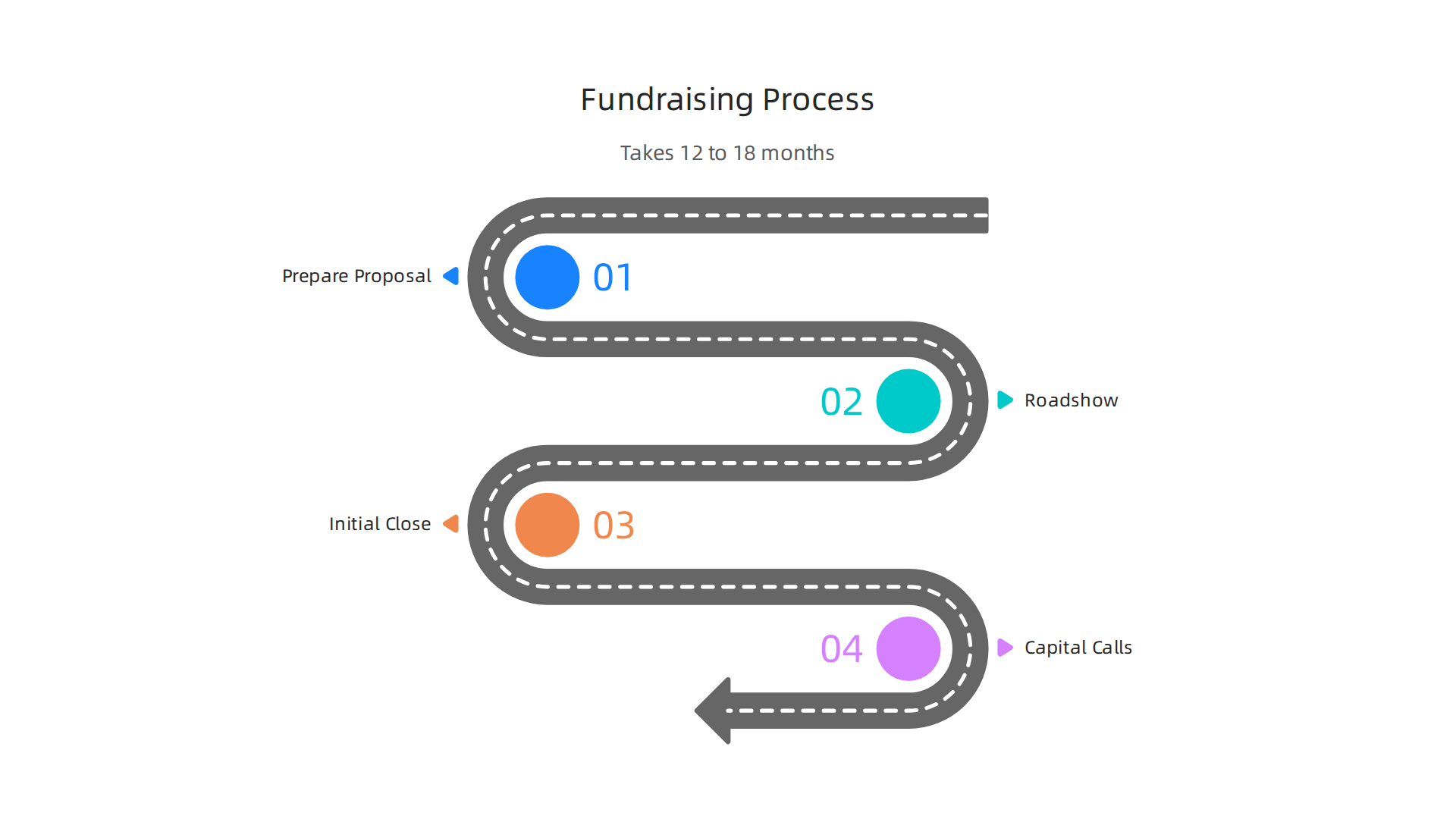
During that time, the GP prepares a detailed fund proposal. This includes the investment strategy, the team’s track record, fee structures, and the target fund size. The key document is the private placement memorandum (PPM). It explains the fund’s rules and risks. You can explore a complete private equity fundraising checklist to see what this entails.
Next comes the roadshow. The GP meets with potential LPs to pitch the fund. LPs ask tough questions about the strategy and history. This phase builds trust. Once enough LPs agree to commit, the fund holds an initial close. This means the fund is officially launched. More investors can join in later closings.
After the final close, the GP issues capital calls. A capital call requests a portion of the committed capital from LPs. The GP uses this money to invest in portfolio companies. LPs must send the money when asked. This is a key difference between private equity and other investments. You cannot choose your timing.
To see how this compares to venture capital fundraising, read about the critical difference between venture capital and private equity.
This process is why PE funds are long-term commitments. The GP needs time to find good deals and improve them.
The Role of Private Equity in the Startup Ecosystem
If you are a startup founder, you might wonder when private equity firms get involved. The answer is that private equity usually steps in during the later stages of a company’s life. This happens in two main ways: growth equity investments and buyouts.
Growth equity is when a PE firm buys a minority or majority stake in a company that already has a proven product and steady revenue. This is different from venture capital, which often invests in early-stage startups with high risk and no profits. PE firms look for companies with predictable cash flows and a clear path to growth. They then provide capital to expand into new markets, hire more staff, or acquire competitors.
The other path is a buyout. A PE firm might acquire a maturing startup entirely. For the founders and early investors, this is a common exit strategy. Instead of going public or selling to another company, they sell to a PE firm. The PE firm then takes over operations and works to improve the business.
When PE buys a startup, they bring more than just money. They bring operational expertise, management talent, and strong governance.

They often restructure the company to make it more profitable. This can help the startup scale much faster than it could on its own.
As a founder, understanding when to approach PE versus VC is crucial. PE wants a business model that is already working. If your startup has recurring revenue, loyal customers, and a clear financial track record, PE might be the right partner. If you are still building the product and have no sales, stick with venture capital.
To dive deeper into these differences, read more about the critical difference between venture capital and private equity.
PE firms that invest in late-stage startups often target strong returns. Top quartile funds can achieve multiples above 2.3x according to recent benchmarks. That kind of performance is what makes PE an attractive partner for founders who want to sell or scale.
Staying informed about the latest trends in tech and fundraising is key. Get clear daily AI updates from The Deep View Newsletter to help you make smarter decisions.
Key Metrics: IRR, MOIC, and Distribution Waterfall
When you first learn about private equity, the numbers can feel confusing. But the key metrics are simple once you break them down. To truly understand what are private equity funds, you need to know how they measure success.
Internal Rate of Return (IRR) shows the annualized yield of an investment. It accounts for the timing of cash flows. A high IRR means the investment grew fast. Multiple on Invested Capital (MOIC) shows the total return multiple. It tells you how many times your money was multiplied. For example, a 2.0x MOIC means you doubled your money. You can learn more about the MOIC in Private Equity: 2026 Benchmarks + Formula from Waveup.
The distribution waterfall is how profits are split between the fund managers (general partners) and the investors (limited partners). Typically, LPs receive 100 percent of distributions until they get back their initial capital plus a preferred return. After that, profits are shared. This structure aligns everyone’s interests. For a deeper look, see the Multiple on Invested Capital (MOIC) | Formula + Calculator from Wall Street Prep.
Net IRR and net MOIC are the most commonly reported numbers because they subtract fees. If you hear a fund boasts a 15 percent net IRR, that’s after all costs. Understanding these metrics helps you evaluate any private equity opportunity.
For founders, knowing these metrics can help you negotiate better terms when selling to a PE firm. If you want to see how top firms operate, read about how KKR private equity became one of the most powerful names in finance.
Now you have a clearer picture of the numbers behind PE. This knowledge is part of the private equity meaning — it is not just about buying companies, but about measuring returns.
Benchmarking Against Peers
Knowing IRR and MOIC is one thing. But how do you know if a fund’s returns are actually strong? Limited partners (LPs) do not guess. They compare fund performance against benchmarks from organizations like Preqin, Cambridge Associates, and PitchBook. These databases track thousands of funds and give LPs a clear picture of what "good" looks like.
Performance is often shown in quartiles. A top-quartile fund sits in the top 25 percent of all funds. In 2026 buyout deals, a MOIC above 3x is considered a very good return in private equity. A fund in the bottom quartile might struggle to raise money again. The difference between top and median funds can be several percentage points of IRR.
But benchmarks are not perfect. Survivorship bias means only successful funds are still reporting. Failed funds drop out of the data. That makes average performance look better than it really is. Also, data vintage effects matter. A fund started in 2020, during a boom, might look worse than one started in 2009, right after a crash. You have to compare funds from the same vintage year.
Understanding these details helps you evaluate any private equity opportunity. If you want to learn more about how private equity compares to other fundraising paths, check out this guide on the private equity vs venture capital difference.
And because market trends shift fast, staying informed about broader technology and investment news is important. That is why many readers subscribe to The Deep View Newsletter for daily AI and tech updates.
Technological Disruption in Private Equity
Beyond benchmarking, another big shift is changing what are private equity funds and how they work. Technology is no longer just a tool for portfolio companies. It is now reshaping the funds themselves.
AI and data analytics are transforming three key areas: deal sourcing, due diligence, and portfolio management.

Instead of relying only on personal networks, fund managers now use algorithms to scan thousands of companies and find hidden opportunities. Machine learning can also speed up due diligence by reviewing legal documents, financial records, and market data in hours instead of weeks. Once a deal is done, AI tools help track performance and spot risks early.
Digital platforms are also making fundraising and reporting smoother. A structured private equity fundraising process now often includes online data rooms and automated investor updates. Limited partners expect real time access to fund performance, not just quarterly PDFs. That is why many GPs are investing in secure LP portals.
Firms that embrace technology may gain a real edge. As the private equity meaning expands to include tech savvy operations, the difference between traditional and modern fund managers grows. For founders and investors, understanding these tools matters. If you are raising capital, learning how to use the latest tech tools for startups in 2026 can help you stand out to tech forward GPs.
Regulatory and ESG Trends
Regulation and ESG are two forces quietly reshaping the private equity landscape in 2026. If you are trying to understand what are private equity funds today, you need to look at how rules and environmental goals are changing the game.
On the regulatory side, the SEC has been busy. In April 2026, the SEC and CFTC jointly proposed a SEC and CFTC joint proposal to reduce private fund reporting burdens for smaller advisers. This would raise the filing threshold from $150 million to $1 billion in private fund assets. That means fewer paperwork headaches for many fund managers. At the same time, enforcement is still sharp. The SEC continues to focus on conflicts of interest, fee disclosures, and valuation practices as shown in recent SEC enforcement trends for private funds 2025-2026.
ESG is another big piece of the puzzle. Even though the SEC has pulled back on pushing specific ESG rules, limited partners (LPs) haven’t lost interest. Many LPs now require their fund managers to show how they handle environmental, social, and governance factors.

This is not just a nice-to-have. It can directly affect fundraising success and the value of portfolio companies. Funds that build ESG into their strategy often see higher valuation multiples.
What does this all mean for the private equity meaning? It means the definition keeps expanding. A modern private equity fund must navigate complex rules while meeting LP demands for responsible investing. For startup founders pitching to these funds, showing you understand compliance and ESG can set you apart.
Before committing, you should know the critical difference between venture capital and private equity because the regulatory expectations vary significantly between them.
To stay sharp on how technology and regulation are converging, consider getting The AI Newsletter Worth Reading. It delivers clear daily updates that help you connect the dots between AI, investing, and the rules that shape both.
Summary
This article demystifies private equity funds for startup founders, explaining how they are structured, how they differ from venture capital, and why those differences matter for fundraising and exits. It covers the LP‑GP model, common fees like the