

Introduction: Two Paths to Growth Capital
Is venture capital private equity? It is one of the most common questions we hear from founders and investors in 2026. And honestly, mixing up these two types of funding can be a costly mistake.

Here is the simple truth. Venture capital firms place high-risk bets on young startups with huge potential. They look for the next big idea. The most successful venture capital firms often make many investments, hoping just one becomes a massive winner. Private equity funds, on the other hand, buy stable, mature companies to make them more profitable. The largest private equity firms use leverage and operational changes to grow their investments. They want safe, steady returns.
So, technically, are they the same? Both are considered "private funds" under SEC rules, according to the SEC glossary. But they operate in completely different worlds. A venture capital firm invests in early-stage innovation and high growth. A private equity firm invests in established cash flow. If you are a founder building a tech startup, you need to understand this difference from day one. It shapes who you pitch to and what kind of partner you get. For example, in 2026, knowing your tech company categories is essential for attracting the right investor.
This guide gives you an evidence-based comparison to choose the right capital partner for your stage. We cover everything from regulatory definitions to real-world strategy. And to keep your finger on the pulse of the tech trends driving this market, The Deep View Newsletter delivers clear daily AI and tech insights straight to your inbox. Let us clear up the confusion once and for all.
What Is Venture Capital?
Let us dig into the details. To really answer the question is venture capital private equity, you first need to know exactly what venture capital is.
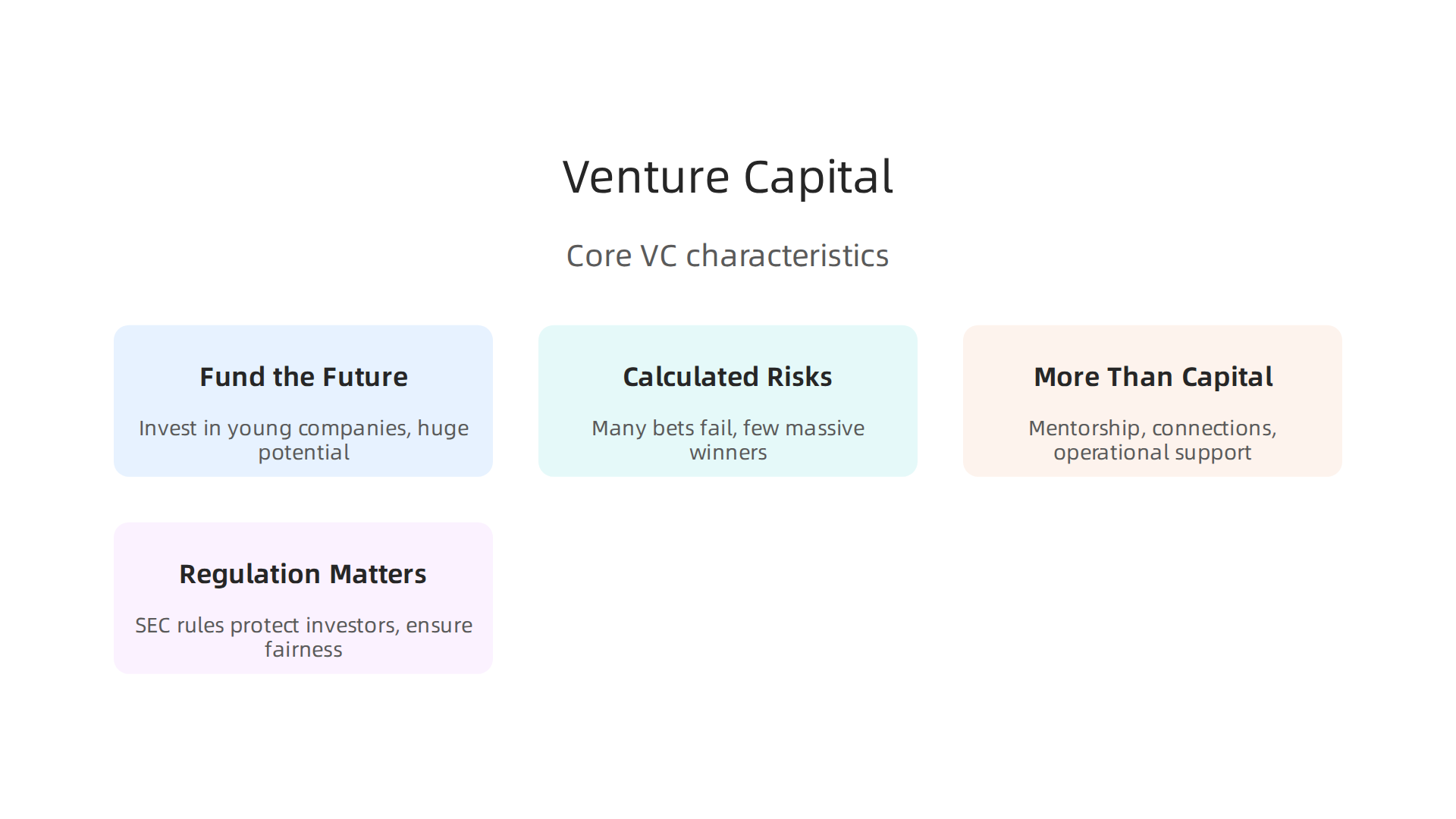
Venture capital is a specific type of private equity. The SEC glossary explains that both are considered "private funds." They pool money from outside investors to invest in companies. But VC is the branch focused on early-stage innovation and high growth.
They fund the future. Venture capital firms invest in young companies with huge potential.

These startups often have a new technology or a disruptive business model. According to the official rules, a venture capital fund must tell investors that it actively pursues a venture capital strategy 17 CFR § 275.203(l)-1.
They take calculated risks. The most successful venture capital firms know that many of their bets will fail. And they are okay with that. They only need one or two massive winners to make the entire fund profitable. This is the opposite of how the largest private equity firms work. PE funds buy stable, mature companies and use leverage to boost returns.
They provide more than just capital. When a VC fund invests in your startup, you get mentorship, industry connections, and operational support.

They help you hire key people and refine your strategy. Founders also raise money in stages. You start with a seed round, then move to Series A, Series B, and so on. This staged approach helps you grow without giving away too much control too soon. If you want to see how different company categories attract different types of capital, check out this guide on tech company categories in 2026.
Regulation matters. The SEC has strict rules for these funds. For example, a "qualifying venture capital fund" cannot have more than $10 million in total capital contributions SEC Proposes Update. These rules exist to protect the investors and keep the system fair.
So, yes, venture capital is a form of private equity. But it is a very unique form. It focuses on high-risk, high-reward startups. It is patient with losses and hungry for moonshots.
To keep up with the innovative trends that venture capital firms are chasing, you need a reliable news source. The The Deep View Newsletter delivers clear daily AI and tech updates straight to your inbox. It helps you understand the landscape that top investors are betting on.
What Is Private Equity?
Now you know what venture capital looks like. You can see why so many people ask, is venture capital private equity? The answer gets clearer once you understand the full private equity picture.
Private equity is the bigger category. It includes venture capital, but it covers much more. The Harvard Business School library puts it simply: private equity is ownership of an entity that is not publicly traded. You buy shares in a company that does not have its stock on a public exchange.
They buy mature companies. Unlike venture capital firms that back risky startups, private equity funds typically invest in businesses that are already stable. These are established companies with steady revenue and proven products. Think of a manufacturer, a retail chain, or a software company that has been around for years.
They take control. The largest private equity firms often buy a majority stake in a company. They may use a strategy called a leveraged buyout, or LBO. That means they borrow money to fund the purchase. The target company’s own assets and cash flow help pay back that debt later. This is a huge difference from VC, where you usually buy a small minority stake.
They focus on operations. A private equity fund does not just hand over cash and hope for the best. They install new management teams. They cut costs. They find synergies between companies.

Their whole goal is to improve the business and then sell it for a profit, either to another company or through an IPO. The SEC glossary confirms that both private equity and venture capital are "private funds," but the strategies are night and day.
Let us put it side by side.
| Characteristic | Venture Capital | Private Equity |
|---|---|---|
| Company stage | Early, high growth | Mature, established |
| Risk level | Very high | Moderate |
| Typical stake | Minority ownership | Majority or full ownership |
| Funding method | Equity investments | Equity plus debt (LBOs) |
| Focus area | Innovation and disruption | Operational efficiency |
Think of it this way. A VC firm bets on a startup that could fail. A private equity firm buys a company that already works and makes it work better. To see how one of the most powerful names in finance operates, check out this breakdown of how KKR private equity became a dominant force.
The bottom line is clear. Private equity is the parent category. Venture capital is a specific child inside it. They both pool money from investors and buy private companies. But the way they do it, and the companies they choose, could not be more different.
If you want to stay ahead of the trends that drive both VC and PE, you need reliable information. The The Deep View Newsletter delivers clear daily AI and tech updates straight to your inbox. It helps you understand the market forces that shape every investment decision.
Key Differences Between Venture Capital and Private Equity
The last section gave you the big picture. Now let us get into the details that actually matter. If you are trying to figure out is venture capital private equity in a practical sense, you need to look at three specific areas. These areas change how investors act and what they expect from you.
1. The Companies They Buy (Investment Stage)
This is the biggest difference. It changes everything else.
Venture capital firms look for startups. They want young companies that are growing fast. Many of these companies have no profit. Some have no revenue. The potential is huge. But so is the chance of failure. The most successful venture capital firms know how to spot potential in a founder who has nothing but a strong idea.
Private equity funds look for grown up companies. They buy businesses that are already stable. These companies have cash flow. They have customers. They have a track record. The largest private equity firms come in to make things run better, not to invent something new from scratch.
If you are a founder, knowing where your company fits is crucial. Different investors look for very different things. You can read more about tech company categories 2026 how founders can attract the right investors to see where you stand.
2. The Size of the Bet (Risk Profile)
The risk in VC is enormous. Most startups fail. Investors in VC funds know this. They expect most of their investments to go to zero. But they hope the one or two winners will pay for all the losses and more. It is a high risk, high reward game.
The risk in PE is much lower. The company already makes money. The biggest risk comes from the debt used in the buyout. If the company cannot make its debt payments, the deal goes bad. But because the company is stable, the chances of that happening are far lower. The ILPA glossary lists both VC and PE as alternative assets. But the risk level inside those two buckets is completely different.
3. The Time It Takes (Fund Structure)
VC funds have a long life. They usually last ten years. In the first few years, the fund looks bad on paper. The startups are spending money, not making it. This is called the J curve. It takes years for the winners to emerge. Investors need a lot of patience.
PE funds move faster. They often hold a company for three to seven years. Because the company is profitable, the fund can start making money right away. They use operational improvements and debt repayment to boost value. Then they sell the company for a profit.
Staying on top of these market dynamics is hard work. Technology and AI are changing both VC and PE every single day. The The Deep View Newsletter delivers clear daily AI and tech updates straight to your inbox. It helps you understand the market forces that shape every investment decision.
How VC and PE Funds Are Structured
Now we get into the nuts and bolts. If you want to know is venture capital private equity at the structural level, the answer is yes. Both use the same basic setup. A general partner (GP) manages the fund. Limited partners (LPs) provide the money. But the fees and rules are very different.
Here is how both types of funds actually make money and how those costs flow to you as a founder.
The Fee Model
Most venture capital firms follow the "two and twenty" model. They charge a 2% management fee and take 20% of the profits as carried interest. But many top VC funds charge more. Some charge 2.5% fees and 30% carry. This is because the risk is high. The most successful venture capital firms can demand higher pay. As Qubit Capital explains, this fee structure is standard across VC and hedge funds. It works because LPs expect most startups to fail.
Private equity funds work differently. They manage much larger pools of money. So their management fees are lower. Usually 1.5% to 2% of assets under management. Their carried interest is often 20%. But here is the twist. PE funds almost always have a hurdle rate. That means LPs get a guaranteed return before the GP earns any carry. A common hurdle is 8%. Only after the fund beats that benchmark does the GP start sharing profits. That protects LPs from paying out big bonuses for average results.
The Waterfall
The "waterfall" is the order of money distribution. In VC, the waterfall is simpler. Profits go back to LPs first until they get their money back. Then the GP gets carried interest. In PE, the waterfall often has layers. LPs get their capital back plus the hurdle return. Then the GP catches up. Then the remaining profits are split.
These differences matter. When you pitch a venture capital firms, they care about potential. When you pitch largest private equity firms, they care about cash flow and debt repayment. Understanding the fee structure helps you know what each investor expects.
To stay sharp on these market shifts, get daily AI and tech updates from The Deep View Newsletter. It keeps you ahead of the changes that shape every fund’s strategy.
Investment Strategies: Early-Stage vs. Buyout
So you know how the money flows. Now let’s talk about where it goes. The answer to is venture capital private equity really shows up in the bets they make.
Venture capital firms play the long game on potential. They invest in early-stage companies that don’t have revenue yet. Seed rounds. Series A. Growth equity. The focus is on technology, innovation, and network effects. If a startup can disrupt a big market, most successful venture capital firms want in. They accept that many bets will fail. As Qubit Capital explains, the two and twenty fee model works because LPs expect most startups to fail. That risk tolerance shapes everything. VC firms source deals by meeting founders at accelerators, demo days, and through warm introductions from other startups. They bet on the team and the idea.
Private equity funds play a different game. They invest in mature companies that already have cash flow. The main strategy is the leveraged buyout (LBO). The PE fund borrows money to buy a company, then works to improve its operations, cut costs, and boost profits. Growth buyouts and distressed investing are also common. The largest private equity firms care about operational improvement and multiples. They want to double a company’s earnings, not wait for a moonshot. PE sourcing is more secretive. They use proprietary deal flow, bankers, and auction processes. You won’t find them at a startup pitch night.
Here is the simple difference. VC invests in potential. PE invests in proven operations. Both search for returns, but the path looks completely different.
To stay sharp on these market shifts, get daily AI and tech updates from The Deep View Newsletter. It keeps you ahead of the changes that shape every fund’s strategy.
Risk, Return, and Performance Benchmarks
Now that you see how the money flows and where it gets placed, let’s talk about what comes back. The answer to is venture capital private equity becomes even clearer when you compare the risk and the returns. The numbers tell a very different story for each.
Venture capital firms live in a world of high risk and high reward. The returns are all over the place. The 25-year average net return for US VC sits around 12 to 15 percent, according to industry data from PipelineRoad. But the top quartile of most successful venture capital firms can see net returns above 20 to 30 percent. That is the upside. The downside? Many VC funds fail completely. The math works because a few big wins cover a pile of losses. That is why VC targets a multiple on invested capital (MOIC) of 3x or more. You need those home runs.
Private equity funds are a different animal. Returns are much more consistent. The typical target is 2 to 2.5x MOIC. Because PE uses borrowed money to buy companies, the leverage boosts the internal rate of return (IRR). The American Investment Council shows that private equity indexes often beat public markets like the Russell 3000 over time. The largest private equity firms aim for steady, repeatable gains. They do not swing for the fences.
How do you compare them fairly? That is where benchmark indices come in. Cambridge Associates publishes separate US Private Equity and Venture Capital indexes. In the first half of 2025, the PE index earned 3.9 percent while the VC index earned 6.4 percent. Short term numbers can flip, but over decades the pattern holds. VC has higher peaks and deeper valleys. PE is smoother.
Another tool is the Public Market Equivalent (PME), explained by Preqin. PME lets you compare a private fund’s IRR directly to a public stock market return. It is an apples to apples view.
For founders, understanding these benchmarks matters. It shows you what investors expect. If you want to improve your own fundraising game, start with the right tools. Check out our guide on tech tools for startups in 2026 that attract investors and accelerate fundraising.
To stay on top of the data and trends that shape every fund’s performance, get daily AI and tech updates from The Deep View Newsletter. It helps you see the market shifts before they happen.
Current Trends in Venture Capital and Private Equity (2026)
These return dynamics are shaping the biggest shifts in 2026. The question is venture capital private equity. But the two worlds are colliding in new ways. Here is what is happening right now.
Artificial intelligence is driving a boom in specialized funds. AI focused venture capital firms are popping up everywhere. They only bet on machine learning, generative AI, and automation. At the same time, the largest private equity firms are not sitting still. They are buying stakes in AI companies too. Blackstone, KKR, and others have all made big tech deals. The line between VC and PE is fading. Founders building AI startups need to understand both groups. That means using the right tools to get noticed. Check out this guide on tech tools for startups in 2026 that attract investors and accelerate fundraising to learn more.
Higher interest rates are changing the math for everyone. When rates go up, leveraged buyouts get more expensive. Private equity funds that rely on debt see their returns squeezed. According to PipelineRoad, VC returns have also been hit. Valuations drop because future cash flows are worth less today. Many startups had to take down rounds or flat rounds in 2025 and 2026. But the best venture capital firms use this as a chance to buy low. They invest smaller amounts for larger ownership stakes.
Regulators are paying closer attention to private markets. Governments around the world are asking for more transparency. The SEC in the US has proposed new rules for private fund reporting. As a result, limited partners are demanding co investment rights. They want to invest directly alongside funds without paying high fees. Special purpose vehicles (SPVs) are also growing fast. SPVs let smaller investors pool money for a single deal. The Preqin academy notes that these structures are becoming common.
What does this mean for founders? You need to know who is writing the check. A VC fund might love your AI pitch. A PE fund might want your recurring revenue. Both are active right now.
To stay ahead of every trend that moves the market, get clear daily AI updates from The Deep View Newsletter. Subscribe here. It helps you spot opportunities before the crowd does.
Which Path Is Right for Your Startup? A Decision Framework
So you are building a company and need money. The question is venture capital private equity. Which one fits you? The answer comes down to three things: your stage, how much you need, and who stays in control.
Let’s walk through the framework.
1. Founder stage and maturity matter most.
If you are pre-revenue or just getting started, you probably need a venture capital firm. These investors are used to risk. They bet on ideas and teams. Most successful venture capital firms have deep experience with early stage chaos. For example, many founders start by learning the ropes through a structured process, just like the one outlined in this guide on how to raise startup capital in 2026.
On the other hand, if you already have steady revenue and profits, you might attract private equity funds. They want businesses that are proven. They look for predictable cash flow.
2. How much capital do you actually need?
Venture capital firms usually invest smaller amounts first. Think hundreds of thousands to a few million dollars. They grow with you. Private equity funds can drop big money fast. They write checks in the tens or hundreds of millions. That works if you want to buy out a competitor or scale hard. For a deeper look at how PE operates, check out this article on how KKR private equity became so powerful.
3. Control and timeline are totally different.
Here is a big difference. A venture capital firm typically takes a minority stake. They want to see you grow over five to ten years. They give you room to build. But a private equity firm often wants control. They buy a majority of the company. And they expect a faster exit, usually within three to five years. That matters a lot for how you run your business day to day.
Think about what you actually want. Do you want a long term partner who lets you lead? Go with VC. Do you want a big cash injection now and are okay with giving up control? PE might be your match.
No matter which path you take, you need to stay on top of market shifts. That is why so many founders rely on daily updates. Get clear AI and tech trends delivered straight to your inbox. Subscribe to The Deep View Newsletter here and spot opportunities before the crowd does.
Conclusion: Mastering the Capital Options Landscape
So here is the real takeaway. The question is venture capital private equity is not just a test of definitions. It is a test of your strategy. Venture capital firms and private equity funds are two distinct pillars of the private capital world. Knowing the difference is the foundation of smart fundraising.
Why does this matter so much? Because the capital source you choose shapes your company’s future. As researchers at Columbia Business School note in their guide on breaking into venture capital, the best founders understand that the choice of capital source is as important as the product itself. A mismatch can kill your momentum. The right fit makes you unstoppable. The most successful venture capital firms look for specific traits like massive market potential and founder grit. The largest private equity firms look for cash flow and stability. Both are valid. You just need to know which game you are playing.
Here is the thing. The market rewards founders who do their homework. Whether you are targeting early stage VC or a growth stage PE fund, you need a clear thesis. You need to know your stage, your numbers, and your ideal exit timeline. If you are still early in your journey, getting the basics right matters most. For a deeper look at how to position your startup at the earliest stage, check out our data-driven strategies on seed and enterprise investment in 2026.
Your next step is simple. Stay sharp. Stay informed. The capital landscape shifts fast, and the best opportunities go to those who see them first. Do not let information overload slow you down. Get clear, daily insights on the trends that drive funding decisions. Subscribe to The Deep View Newsletter here and keep your strategy ahead of the curve.
Summary
This article answers the common question