
In 2026, the world of technology changes faster than ever. Every day brings new breakthroughs, updates, and innovations. For founders, operators, and investors, this constant rush of information can feel like trying to drink from a firehose. How do you know which technologies actually matter? Which ones will attract investors? And which ones are just noise?
This is where a good tech radar comes in. Think of a tech radar as your special map for the tech world. It helps you cut through all the extra information to see what is truly important. Instead of feeling lost, you get a clear view of the technologies that are making big waves and catching the eye of smart investors. This focused approach reduces information overload and helps you spot the signals that can boost your fundraising efforts.
Many reports show that technology adoption is at an all-time high. For example, in 2026, many organizations are already using or planning to use technologies like Cyber AI, AI language models, and AI-based coding tools, according to the Tech trends 2026 report. Understanding these trends is key.
When you know which emerging technologies are gaining traction, you can connect your startup’s vision to what investors are already looking for. A well-built tech radar helps you show how your product or service fits into the future, making your pitch much stronger. It highlights how your innovations are not just new, but also relevant and poised for growth. This connection between emerging technology trends and fundraising opportunities for startups is crucial. Investors want to put their money into companies that understand where the market is going and are ready to lead the way.
Staying updated on tech news is more important than ever. While many platforms offer general tech news, a specific tech radar helps you filter that information through a fundraising lens. It is about spotting the tech that creates value, not just headlines. This insight can help founders understand how to best position their innovations and attract capital. For a deeper dive into making sense of the broader tech landscape, consider exploring resources on global tech intelligence for startup fundraising success. For keeping up with the latest in AI and technology, consider subscribing to The AI Newsletter Worth Reading for clear daily updates.
In the coming sections, we will give you easy-to-use frameworks and clear steps. These will help founders, operators, and investors build their own effective tech radars and use them to make smart choices today. You will learn how to identify technologies that excite investors, how to track their progress, and how to use this knowledge to secure the funding you need.
1. Trend Overview: What the 2026 Tech Landscape Looks Like
The technology world in 2026 is buzzing with exciting changes. Big shifts are happening across key areas like Artificial Intelligence (AI), cloud computing, cybersecurity, and tools for developers. Knowing about these major trends is like having a compass in a new land. It helps founders, operators, and investors see where the biggest opportunities are.

Let’s look at the main areas that are really standing out this year:
- Artificial Intelligence (AI): AI is everywhere. From smart helpers that write code to powerful tools that understand language, AI is changing how we work and live. Reports from 2026 show that almost nine out of ten organizations are either using or quickly adopting new technologies, especially in AI. This includes things like AI-powered analytics, with 83% of organizations already using it to make sense of their data. Even small businesses are jumping in, with many using at least one AI tool. This widespread use makes AI a key area investors are watching closely.
- Cloud Computing: Cloud technology continues to be the backbone for many new services. It lets companies grow fast without needing lots of expensive computer hardware. Almost every new startup relies on the cloud in some way.
- Cybersecurity: As more things move online, keeping them safe is super important. New threats mean new ways to protect data. Technologies like Cyber AI are becoming very important for keeping our digital world secure. Investors see the growing need for strong security solutions and are putting money into companies that can solve these challenges.
- Developer Tools: The people who build software need great tools. New tools that help developers create programs faster and better are always in demand. Things like AI-based coding helpers are making development quicker and easier.
Prioritizing Signals for Fundraising
With so much happening, how do you know which tech signals truly matter for getting investors excited and boosting your company’s value? It’s about looking for patterns that show real growth and impact, not just hype. A good tech radar helps you do this.
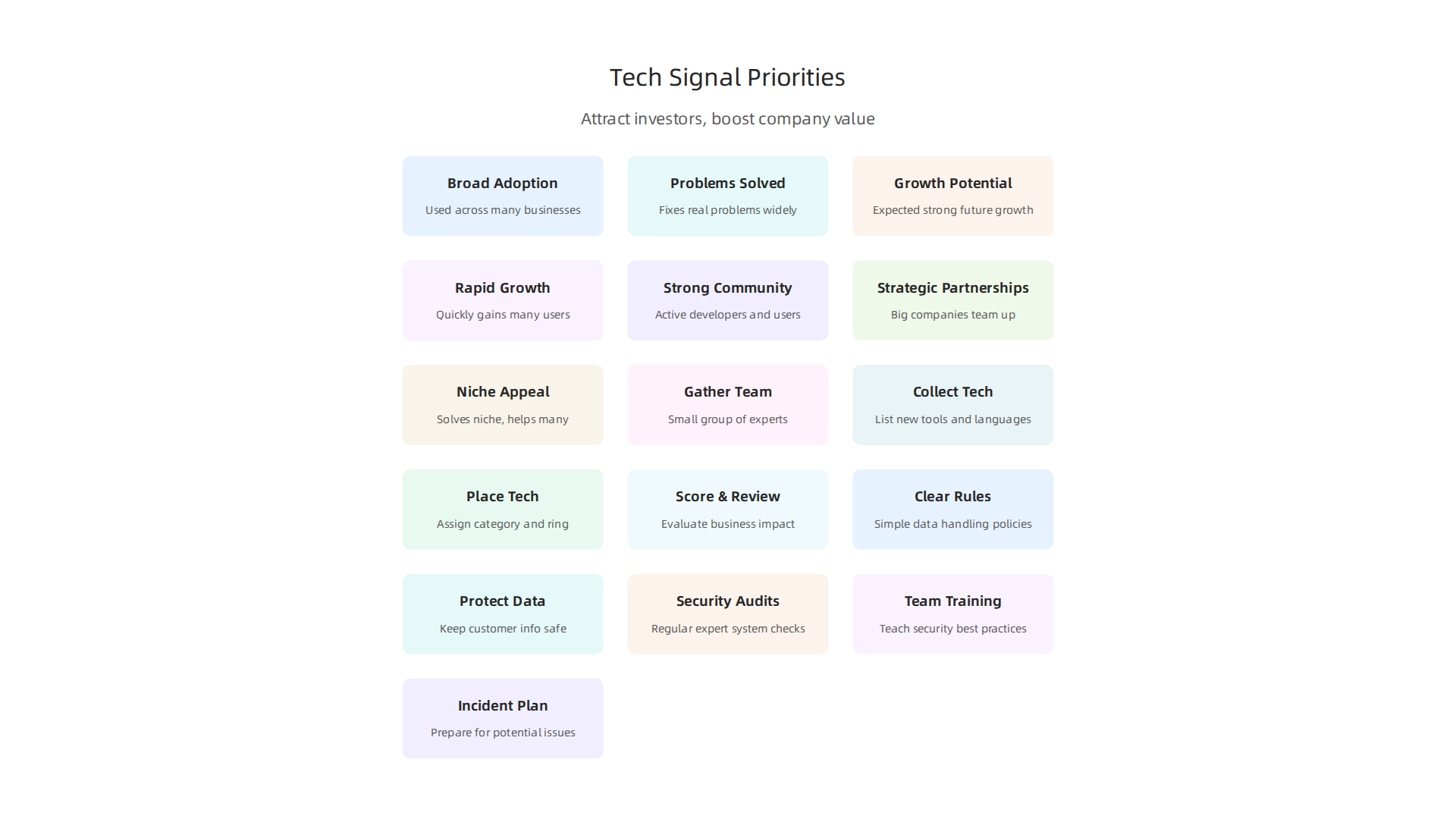
- Look for broad adoption: If many different kinds of businesses are starting to use a technology, that’s a strong sign. For example, if both large companies and small businesses are embracing AI tools, it shows wide market acceptance.
- Seek problems being solved: Investors love technologies that fix real problems for many people or businesses. A technology that makes complex tasks simple or keeps data extra safe will attract more interest.
- Find strong growth potential: Technologies that are not just used today but also expected to grow a lot in the future are very appealing. Think about how a new tool could change an entire industry.
Early Signs That Catch Investor Attention
Investors are always looking for the next big thing. They want to see early clues that a technology or a startup is on the right path. Here are some things that grab their attention:
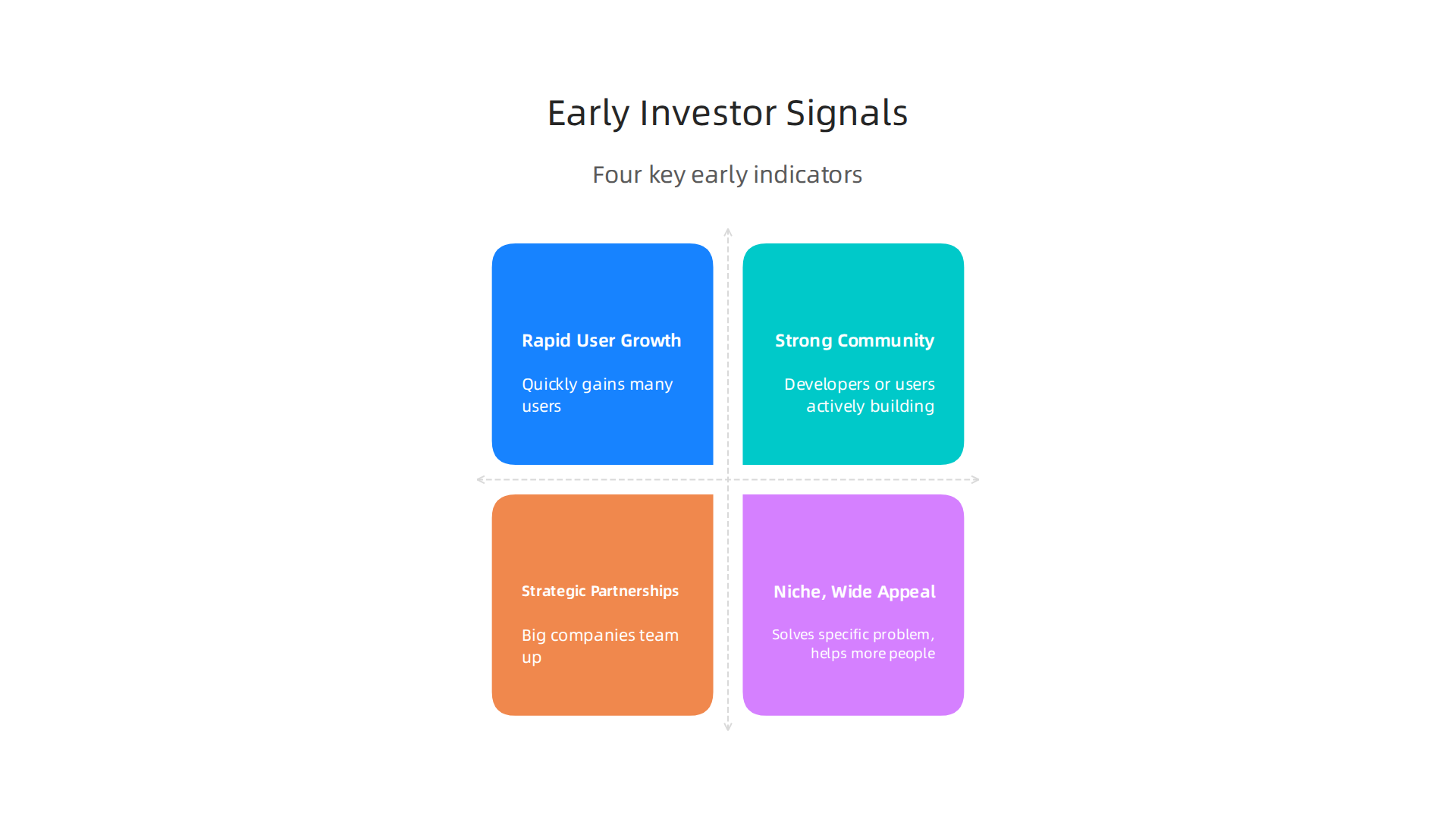
- Rapid User Growth: When a new product or tool quickly gains many users, it shows people find it valuable.
- Strong Community: If developers or users are actively talking about and building on a new technology, it signals a strong foundation and future potential.
- Strategic Partnerships: When big companies team up with smaller ones using a new technology, it proves the technology’s importance and usefulness.
- Solving a Niche Problem with Broad Appeal: Sometimes a technology starts by solving a very specific problem but then shows it can help many more people. This kind of flexibility is a good sign.
Understanding these trends and signals is key to crafting a compelling story for potential funders. It helps you find and fund high potential tech startup ideas in 2026 by showing how your company fits into the bigger picture of what’s coming next. It also helps you grasp the tech company categories 2026 where investors are actively seeking opportunities. Keeping an eye on these indicators helps you make sure your startup is not just innovative, but also investable.
A tech radar is like your company’s special map of what’s happening in the technology world. It helps you keep track of new tools, ideas, and changes that matter for your business. Think of it as a living document that guides your choices, especially when you’re talking to investors.
What is a Tech Radar?
Imagine a big circle divided into four parts. Each part is a category like "techniques," "tools," "platforms," or "languages." Inside these parts, there are rings. These rings show how much you should trust or use a technology. They often are:
- Hold: Don’t use this right now.
- Assess: Look into this more.
- Trial: Try this out with a small project.
- Adopt: Use this often.
This idea comes from companies like Thoughtworks, who publish their own Technology Radar to show important trends. Building your own helps you make smart choices.
How to Build Your Own Tech Radar
Creating a useful tech radar for your startup involves a few key steps:
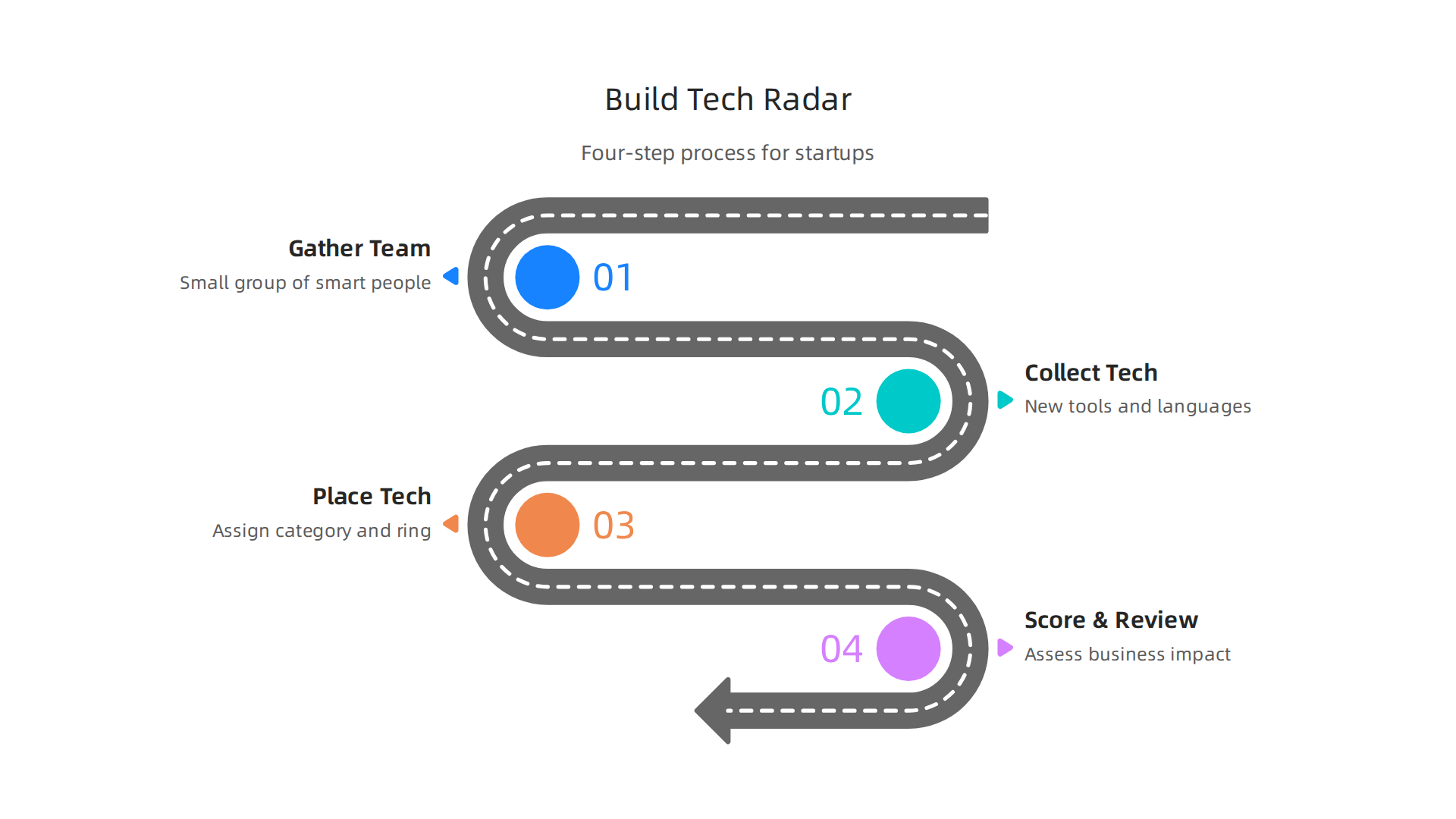
- Gather Your Team: Pick a small group of smart people in your company. These should be people who know a lot about different tech areas, like engineers or product managers. They will help choose and rate the technologies. Websites like EM Tools and ITONICS Innovation offer guidance on how to build one for engineering teams.
- Collect Technologies: Ask your team what new tools, programming languages, or ways of working they are seeing. Look at what your competitors are using or what’s talked about in tech news. You can also look at reports like the Thoughtworks Technology Radar PDF for ideas.
- Place Technologies on the Radar: This is where you put each idea into a category (like "tools") and a ring (like "trial"). You discuss as a team why each technology belongs where it does. For example, a new AI tool might go into "tools" and "trial" if you’re just starting to test it. There are many tips for building your own Tech Radar, including how to define categories and assessment cycles.
- Score and Review: Think about how each technology helps your business. Does it solve a big problem? Is it easy to use? Does it have a lot of users already? This helps you decide its placement. A good approach includes collecting data, running experiments, and holding evaluation meetings to decide where each technology belongs on the radar. DevSecOps Notes explains how to get started Building a Technology Radar in 5 Steps.
Using Your Tech Radar for Fundraising
Once your tech radar is ready, it becomes a powerful tool for talking to investors:
- Show You’re Ahead: You can use your tech radar to show investors you understand where the tech world is going. You can point to technologies you’re "assessing" or "trialing" to show you’re always looking for new ways to improve.
- Answer Investor Questions: Investors will ask about your tech choices. Your radar gives you clear answers. For example, if an investor asks about your AI strategy, you can show them how you’re tracking and adopting specific AI tools on your radar. This helps you explain your information systems vs information technology choices confidently.
- Strengthen Your Pitch: A tech radar proves you’re thoughtful about your technology stack. It shows you’re not just picking tools at random but have a plan. This helps you master framing tech for startup fundraising success and present a clear picture of your company’s future.
Keeping Your Tech Radar Current
Technology changes super fast, so your tech radar needs regular updates.
- Update Cadence: Plan to review and update your tech radar every three to six months. This makes sure it stays fresh and useful. Many experts recommend assembling a technology advisory group to do this, as highlighted in "Tech Radar for Engineering Teams: How to Build One".
- Team Roles: The team that built the radar should be the ones to keep it updated. They should discuss new technologies, move items between rings, and remove old ones.
By actively using a tech radar, you can show investors that your startup is smart, forward-thinking, and ready for what’s next. It’s a great way to present a strong case for your funding needs and to create your winning funding package for startup success.
Staying on top of rapidly evolving tech trends, especially in AI, is crucial. If you want to keep getting simple and clear daily updates on AI and other tech, there’s a great resource.
Get clear daily AI updates from The AI Newsletter Worth Reading.
To really keep your finger on the pulse of tech trends, especially with fast-moving things like AI, you need the right tools and a clear way of working. It’s not just about knowing what’s new, but also how to use that information to make smart choices for your startup.
Tools and Workflows: From Feeds to Decision Dashboards
Building and maintaining your tech radar becomes much easier with the right support. Here are some tools and a simple way to use them:
- Information Feeds: This is where you first learn about new technologies. Think of it like a stream of useful news coming to you. You can get these from:
- Tech News Podcasts: Listening to experts talk about new ideas.
- Specialized Newsletters: For example, getting regular updates on "jetbrains news" or broad insights from respected figures like those who follow "bill gates recent news" can keep you informed.
- RSS Feeds: These bring news headlines from your favorite tech blogs directly to you.
Using platforms that help you gather and analyze this kind of information can optimize fundraising with top tech news and analysis platforms.
- Decision Dashboards: Once you’ve collected information, you need a place to see it all clearly. A dashboard is like a visual report of your tech radar. It shows which technologies are in the "adopt" ring and which are still in "assess." This helps everyone on your team understand the current tech landscape at a glance. You can use simple tools like spreadsheets or specialized software for this.
- Annotation Tools: When your team is discussing a technology, it’s helpful to write down notes, pros, and cons right next to the item. Annotation tools allow you to add comments, link to research, or even upload experiment results. This keeps all the important thoughts and reasons for placing a technology in a certain ring in one spot.
A Simple Workflow for Small Teams
You don’t need fancy tools to start. Small teams can set up an effective tech radar workflow quickly:
- Collect Ideas: Everyone on the team looks for new technologies from their usual sources like tech news podcasts or industry blogs. They might use a shared document, like a Google Sheet, to list potential technologies. This step is about gathering all the raw ideas. Some experts suggest starting with a survey to find out what technologies your teams already use or are interested in researching further to create your Tech Radar.
- Discuss and Rate: Meet regularly, maybe once a month. Talk about each new technology. Where does it fit in the four quadrants (tools, techniques, etc.)? And which ring (hold, assess, trial, adopt) makes the most sense? Write down why you decided on that placement. A good way to do this is to gather candidate technologies and existing standards for evaluation, as explained by DevOpsSchool about the steps for a Tech Radar.
- Update Your Radar: After your discussion, update your visual tech radar. This could be as simple as moving virtual sticky notes on a shared digital whiteboard or updating rows in a spreadsheet. This makes sure your tech radar always shows your latest decisions.
- Share and Act: Make sure everyone in your company, especially your engineering and product teams, can easily see the updated tech radar. This way, they can use it to guide their work and make consistent tech choices.
By using these simple tools and following a clear workflow, even a small startup can keep its tech radar up to date. This shows everyone, including potential investors, that you’re smart about your tech choices and always looking ahead.
After setting up your tech radar to keep an eye on new tools, let’s dive into one of the biggest areas getting attention right now: Artificial Intelligence (AI) and Machine Learning (ML). In 2026, investors are really watching what happens in these fields.
3. AI & ML Spotlight: What Investors Are Watching in 2026
For any startup, knowing where money is flowing in AI and ML is key. A good tech radar helps you keep track of these movements. Investors are especially keen on a few key areas within AI. One is called "foundation models." These are very big AI models that can be used for many different tasks, like writing text or creating images. They are like a strong base for many other AI tools.
Another hot area is "vertical AI." This means AI tools made for a very specific industry, like AI for healthcare, finance, or education. For example, the field of Artificial Intelligence in Education, 2026 is seeing much growth and investor interest this year. Many companies are adopting AI in their daily operations, which signals a clear direction for where the market is going, as shown in the Key Takeaways from the 2026 State of AI in the Cloud Report.
How do investors know where to put their money? They look for signs on the ground. One sign is "talent flow." This means where smart people who work with AI are moving to. If many top AI experts are joining certain companies or working on particular problems, it shows that area is promising.
Another sign is "open-source activity." This is when computer code for AI tools is shared freely for everyone to use and improve. A lot of activity in open-source AI projects often means new ideas are booming. Also, how quickly new tools for building and managing AI are growing tells a story. The 2026 State of AI Infrastructure Report shows this growth is a good sign for the health of the AI market overall.
For startups, understanding these trends is super important. If your startup is working on foundation models or a specific vertical AI solution, you’ll want to clearly say that in your pitch. This helps you stand out to investors who are looking for exactly those kinds of ideas.
Your "fundraising narrative" is the story you tell about your company. In 2026, a strong story for AI startups includes showing how your solution fits into these big trends. It’s not just about having a cool AI tool, but about showing how it’s part of the bigger picture investors care about. Knowing what investors are interested in helps you position your startup better to secure capital how to find private and RIA investors for your startup and understand how to get venture capital funding. This helps you keep your tech radar focused on what really matters to investors right now and allows you to master startup investing and fundraising 2026 strategies.
To stay on top of these fast-changing AI trends, consider subscribing to The AI Newsletter Worth Reading for clear daily updates.
The story of AI doesn’t stop with the smart models themselves. It also includes the powerful systems that run them. In 2026, understanding the nuts and bolts of cloud and infrastructure is just as important as knowing about the latest AI breakthroughs. This is another area your tech radar should be tracking closely.
4. Infrastructure & Cloud: Cost, Latency, and Architecture Signals
Think of it this way: even the smartest brain needs a strong body. For AI, that body is its infrastructure. Changes in how much cloud services cost, how fast data travels (latency), and how these systems are built (architecture) directly affect what your startup can do and how much money you’ll need. These factors truly impact your product roadmap.
One big change is in cloud economics. Running advanced AI models can be very expensive. So, companies are always looking for ways to save money. This might mean choosing certain cloud providers, or even bringing some computing power in-house instead of relying fully on the cloud. According to a 2026 analysis, organizations could save a lot by using their own systems for AI at a large scale, sometimes 60-70% compared to cloud costs, as discussed in a Cloud vs On-Prem AI: Complete TCO Analysis 2026 report. Investors pay close attention to how smartly a startup manages these costs.
Another trend is "edge computing." This is about moving data processing closer to where the data is actually collected. Imagine self-driving cars or smart factories. They need quick decisions, so sending all the data to a far-off cloud and waiting for a response takes too long. Edge computing helps reduce this delay, or latency. This shift means new kinds of hardware and software are needed, creating fresh opportunities for startups. Experts highlight these shifts in Tech trends 2026 as critical for latency-sensitive applications.
"Managed services" are also changing how startups build their tech. These are services where a third party handles the setup and running of your servers, databases, or AI tools. This lets startups focus more on their main product and less on complex infrastructure tasks. It helps them move faster and often leads to more robust and scalable systems. The 2026 Infrastructure Identity Survey: State of AI Adoption shows that how companies adopt AI and its underlying infrastructure is a key focus this year.
For startups, your infrastructure choices can be a big competitive advantage. If you can show investors you have a cost-effective, fast, and reliable way to run your services, it makes your company much more attractive. On the flip side, poor choices can be a risk, making investors worry about future costs or performance problems. Understanding this balance is key to creating your winning funding package for startup success.
How do you know these infrastructure trends are becoming normal and not just experiments? Look for a few signs:
- More companies of all sizes are using these methods.
- More tools are available to help manage these systems easily.
- Big tech companies are investing heavily in these areas.
- New regulations or industry standards start to appear, helping to guide how these technologies should be used, as shown in the Publication: Cloud and Data Center Regulation.
When these signs are clear, it means the trend has moved from just an idea to something that many businesses rely on. Knowing this helps you build a solid case for your startup to potential investors. If you want to dive deeper into how technology drives investment decisions, learn more about information systems vs information technology your founders guide to investor confidence.
Just as a strong body needs protection, your startup’s tech structure needs to be safe and secure. Thinking about security and privacy signals is crucial for your tech radar. Investors pay very close attention to how well you handle these areas.
5. Security & Privacy: Regulatory and Risk Signals Investors Care About
In 2026, rules about how companies keep data safe and private are always changing. These new rules, or regulations, create a list of items that investors check carefully. For example, if your company handles personal information, there are strict laws you must follow. If you don’t, your startup could face big fines or lose customer trust. Investors see these risks and think about how they might affect your company’s future value. They want to know you’re not just building something cool, but something safe too.
Your approach to privacy and security can greatly impact how investors see your company. A startup with weak security looks risky, which can make investors less likely to put money in, or they might offer less money. On the other hand, a startup with strong security measures and clear privacy rules shows it’s well-managed and reliable. This can make your company much more appealing and might even lead to a higher company value. Poor security can even be one of the Data Room Mistakes That Kill 80% of Term Sheets according to experts. Showing that you care about protecting data builds trust.
So, what can founders do to show they take security seriously and reduce worries for investors? Here’s a quick checklist:
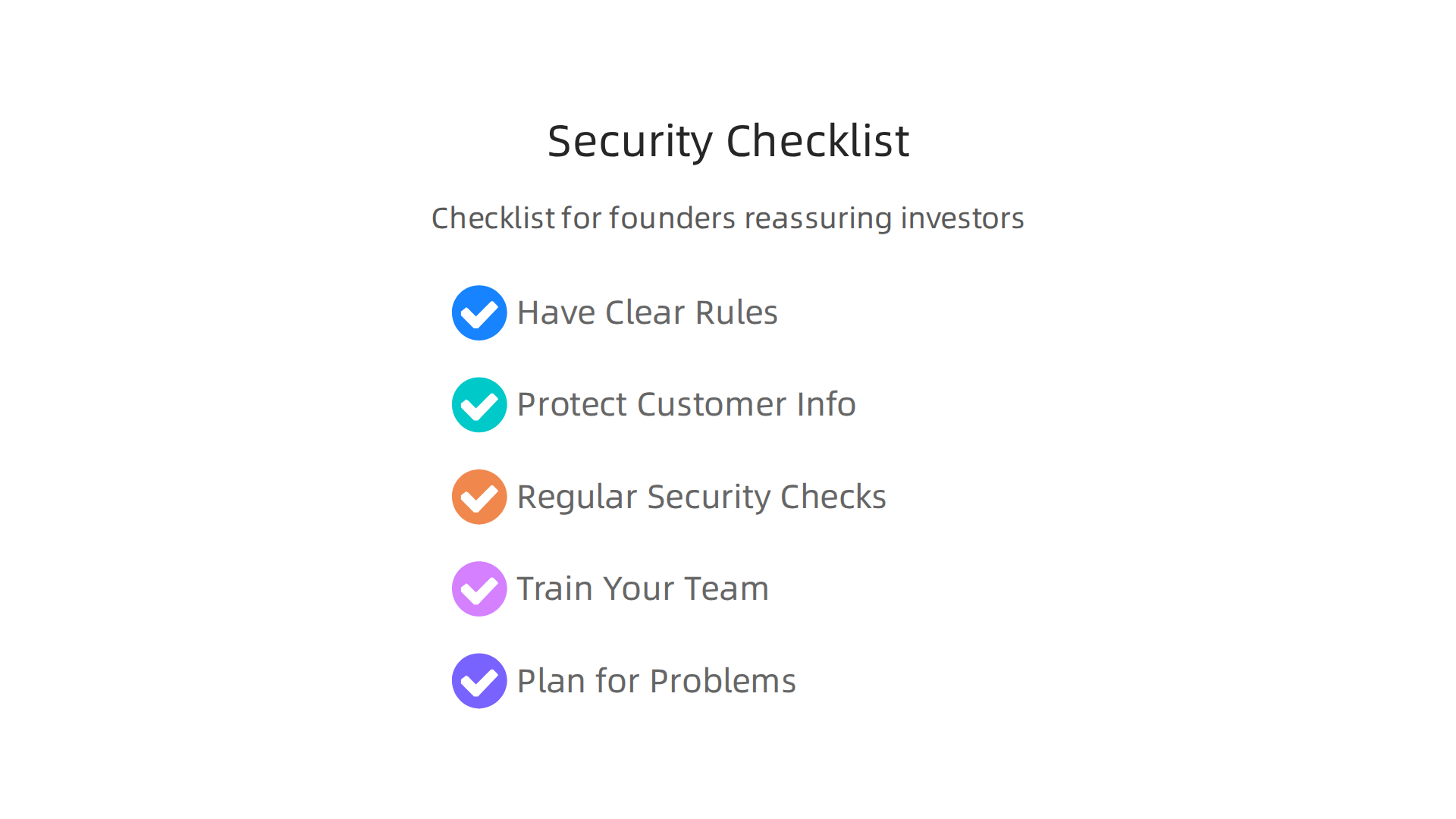
- Have Clear Rules: Make sure your company has simple, easy-to-understand rules for how you handle and protect all data.
- Protect Customer Information: Always keep customer data as safe as possible. Think about who can see it and how it’s stored.
- Regular Security Checks: Have experts check your systems often for any weak spots. Fix problems quickly.
- Train Your Team: Make sure everyone on your team knows about security best practices.
- Plan for Problems: Know what you will do if a security issue happens. Having a plan shows you’re ready for anything.
Following these steps shows potential investors that you are responsible. This can help you get better funding deals and increase your startup’s chance of success. In fact, Founders Who Understand Computer Systems Technology Attract More Investors. Investors want to see that your business model is not only innovative but also stable and secure for the long run.
Understanding these investor signals, especially in fast-moving areas like security, is part of mastering your overall strategy. To learn more about how to attract top funding, check out strategies for Master Startup Investing and Fundraising 2026 Strategies for Unrivaled Success.
Staying updated on the latest tech news, including security trends, is vital.
The tech world moves quickly. To keep up with everything from new AI rules to the latest security threats, you need reliable information. Get clear daily AI updates from The AI Newsletter Worth Reading.
The tech world moves quickly. To keep up with everything from new AI rules to the latest security threats, you need reliable information.
6. Investing Signals: From KPIs to Term Sheet Preferences
Keeping an eye on the bigger tech picture also means understanding what makes investors excited about a startup. This is about more than just your good idea. It’s about knowing the specific numbers and rules that grab their attention.

These are often called investing signals.
Key Performance Indicators (KPIs) That Catch Investor Eyes
Investors really look at how well your company is doing through its numbers. These important numbers are called Key Performance Indicators, or KPIs. They show how healthy your business is. For example, a good startup tracks things like:
- How much money comes in each month or year (Revenue Growth): Is it growing fast?
- How many customers you keep (Retention Rate): Do people stick around?
- How much it costs to get a new customer (Customer Acquisition Cost, or CAC): Is it a good deal?
- How much money you expect to make from a customer over time (Customer Lifetime Value, or LTV): Are customers valuable?
Showing a clear dashboard with strong, steady growth in these areas is very appealing. For example, a startup looking for Series A funding in 2026 is often judged on having annual recurring revenue (ARR) between $2 million and $5 million, and consistent year-over-year growth of 100% to 200% or more. Your ability to present these metrics clearly can make all the difference when you’re learning how to get venture capital funding a founders guide for 2026. These details help investors see your business isn’t just a good idea, but a working machine ready to grow.
Shifts in Term Sheet Language and Investor Priorities
A "term sheet" is like an early agreement that spells out the main points of an investment deal. It’s signed before all the complex legal papers. What’s written in these term sheets can tell you a lot about what investors care about in 2026.
Recently, for larger companies in Series C and beyond, the value of these startups has gone up. Plus, investors have been offering terms that are more helpful to founders. This means old terms like "participating preferences," which sometimes made it harder for founders to get their fair share, are becoming less common. According to the Venture Capital Term Sheet Guide 2026, there’s been a clear increase in activity for Series B and C+ deals.
Also, new reports show that deeptech companies, especially those using AI, are getting more favorable terms from investors. This is because these companies are seen as very valuable and future-proof. You can learn more about securing fair deals for your startup in the current funding landscape. Overall, staying on top of venture capital trends in 2026 is critical, as conditions in the market are always changing. Understanding these shifts helps founders know what kind of deal to expect and how to ask for it.
Mapping Radar Findings to Investor Conversations
Think of your company’s tech radar as a map showing you where to go. When you understand these investing signals, you can map your company’s progress to what investors are looking for. This helps you have much better conversations with them.
For example, if you know investors are prioritizing strong revenue growth and founder-friendly term sheets, you can highlight those points in your pitch. You can show how your product or service fits into bigger market trends. Keeping up with the latest tech news podcast or even specific industry updates like jetbrains news can give you talking points. This shows investors you are aware of the world outside your company, not just inside it. By preparing a solid funding package, you can show you understand what investors value. This helps you create your winning funding package for startup success.
Using this tech radar approach helps you tell a strong story. It proves you know your numbers, understand the market, and are ready for a smart investment. To make sure you’re always ahead, it’s wise to optimize fundraising with top tech news and analysis platforms. This helps you keep a pulse on what’s happening and adjust your strategy as needed.
Continuing from the idea of using a tech radar to tell a strong story, let’s look at real companies that have used this approach to get funded. These are examples of how founders turned smart market watching into actual investment deals.
Case Studies: How Startups Turned Radar Signals into Funded Stories
Many startups have found success by really paying attention to what investors want and what the market is doing. They use their tech radar to spot important signals and then make their pitch fit these signals.
-
Startup Alpha: The Data Powerhouse
This company focused on proving its growth with solid data. They showed investors a clear picture of how fast they were getting new customers and how many customers stayed loyal. By highlighting these strong numbers, they made investors feel safe about putting money into their business. This focus on data is a key factor in improving investor confidence, as seen in many tech startup funding challenges case studies. -
Startup Beta: The AI Innovator
Startup Beta developed a smart AI solution. They knew that deeptech and AI companies were hot right now. So, they made sure their pitch showed not just what their AI could do, but also how it fit into bigger market trends. This helped them secure favorable terms because investors saw the huge future value in their idea. Learning from case studies of startups using AI to secure investor funding can show you how to do this.
Key Takeaways and Tactics:
What can founders learn from these stories?
- Know Your Numbers: Always track your Key Performance Indicators (KPIs). Be ready to show clear, positive growth.
- Understand the Market: Use your
tech radarto know what types of companies and technologies investors are excited about right now. This includes keeping up with important trends. - Tailor Your Story: Adjust your pitch to match what investors are looking for. Show how your company solves a current problem and fits into future trends.
By adopting these tactics, you can make your startup more appealing to investors. Staying informed on the latest developments in AI is especially helpful. To get clear daily AI updates, consider signing up for The AI Newsletter Worth Reading. This helps you understand the bigger tech picture, whether you’re following a tech news podcast or looking for insights into specific areas like jetbrains news. To really put these lessons into action and stand out, you might also want to explore Master Startup Investing and Fundraising 2026 Strategies for Unrivaled Success.
Summary
This article explains how founders, operators, and investors can use a tech radar as a practical, investor-focused map of the fast-changing 2026 technology landscape. It outlines the key trends—AI, cloud, cybersecurity, developer tools—and describes the signals investors watch, such as adoption, user growth, community activity, partnerships, and talent flow. You’ll get a clear, step‑by‑step method to build and maintain a tech radar (team setup, collection, scoring, and review cadence), plus simple workflows and tools for small teams. The guide also dives into critical areas that affect fundraising: AI/ML hotspots, infrastructure cost and latency decisions, and security/privacy rules investors care about. It shows how to translate radar findings into stronger pitch narratives, KPI dashboards, and better term‑sheet conversations. Real startup case studies illustrate how the approach helped companies win funding. After reading, you’ll know how to create a living tech radar, keep it current, and use it to position your startup for investor interest.