
Introduction: The Fundraising Maze in 2026
Raising money for your startup in 2026 is tougher than it sounds. Traditional venture capital is still there, but it is no longer the only game in town. More founders are turning to alternative options, and the numbers prove it. The Alternative Financing Market report for 2026 shows that the global market hit $1.42 trillion this year and is expected to grow fast through 2031. That is a lot of options and a lot of noise.
The problem is that most founders feel lost. There is too much information, not enough transparency, and real skill gaps when it comes to picking the right path. Do you go with revenue-based financing? Crowdfunding? Venture debt? And what about newer models like interval funding or cluely funding? The choices can feel overwhelming, and one wrong move can cost you time, equity, or both.

This article is here to clear things up. We will take a close look at specialized funding solutions from revenue-based financing to interval funding and give you actionable frameworks to choose the right path for your startup. Whether you are exploring apex funding or just trying to understand how to start funding a startup, you will leave with a clear plan.
Staying on top of these fast-changing funding trends is a full-time job. That is why many founders and investors rely on The AI Newsletter Worth Reading for clear daily updates on AI and technology that shape the market. But first, let us dive into the funding options you need to know in 2026.
What Are Specialized Funding Solutions and Why They Matter
Let us step back for a moment. When people think about funding a startup, they usually picture giving away equity in exchange for cash. That is the classic venture capital model. But in 2026, that is only one piece of the puzzle.
Specialized funding solutions are any source of capital that goes beyond plain equity. They give founders more ways to raise money without giving up as much ownership. Think of options like revenue-based financing, venture debt, convertible notes, grants, and structured milestone-based investments.
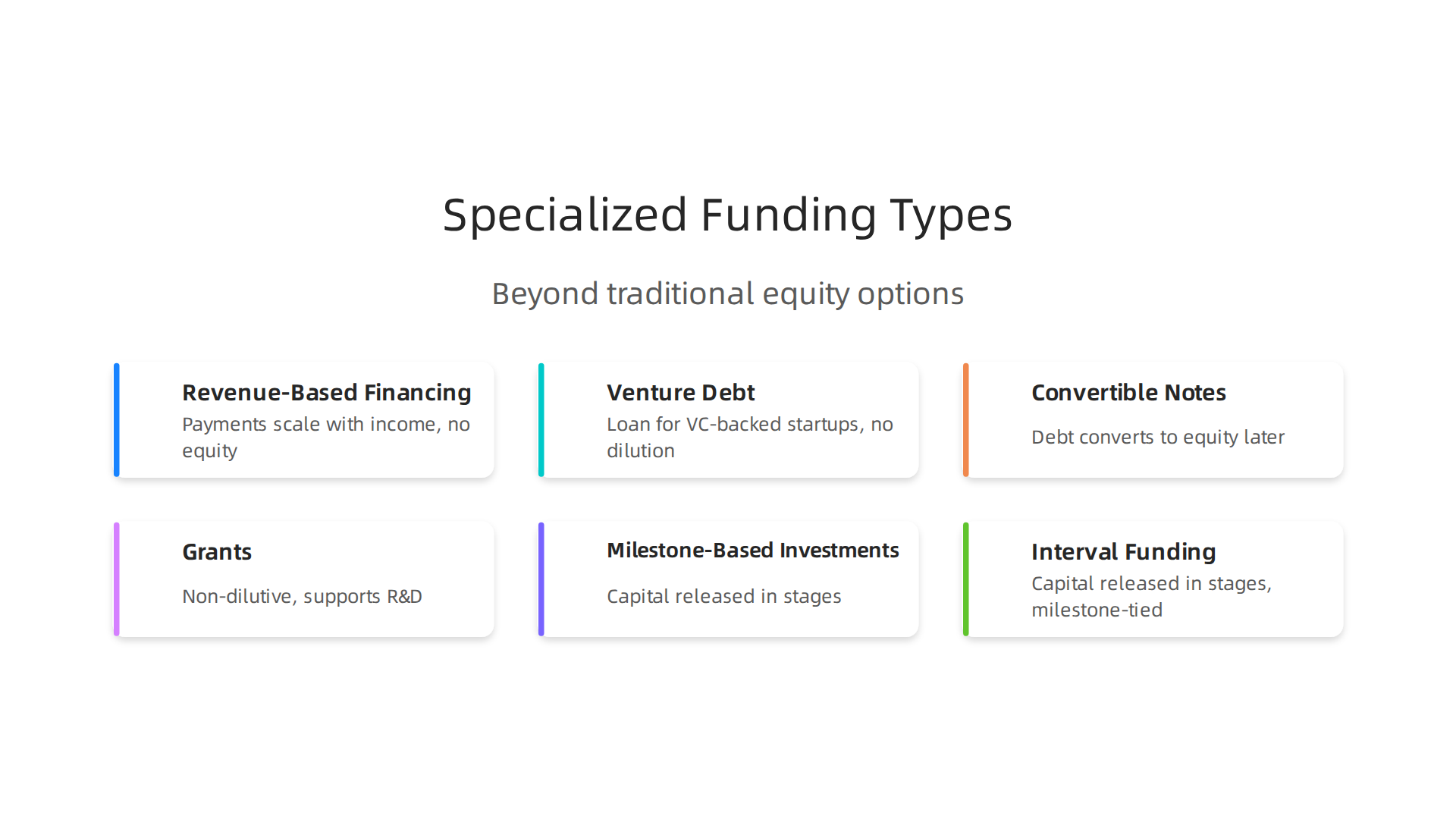
Even newer models like interval funding and cluely funding fall into this category. Each one works differently and fits different business models.
Why do these alternatives matter so much right now? For starters, they offer flexibility. A SaaS company with predictable monthly revenue might prefer revenue-based financing because payments scale with income. A hardware startup with expensive equipment might lean toward venture debt. A deep-tech company working on a long timeline might look at grants or milestone-based investments. The point is, you do not have to force your business into the equity mold.
Less dilution is another big reason. Every time you sell equity, you shrink your ownership. Specialized funding often preserves more of your company for you and your early team. That can make a huge difference down the road.
The market for these solutions is growing fast. According to the Alternative Financing Market report for 2026, the global alternative financing market was valued at $585.8 billion in 2026 and is projected to reach $1,690.66 billion by 2034. That is a compound annual growth rate of 14.20%. More and more founders are catching on.
Smart founders today do not just pick one funding type. They blend multiple specialized solutions to build a capital stack that fits their specific needs.

For example, you might combine a grant with a small venture debt facility and top it off with a convertible note. That hybrid approach minimizes dilution and keeps your options open.
If you want to see one powerful example of how specialized funding is reshaping the landscape, check out this guide on corporate venture capital as a new power broker in startup funding. Corporate VCs bring more than money; they often offer strategic partnerships and customer access.
Understanding these specialized solutions is the first step toward building a smarter fundraising strategy. In the next section, we will break down each major type and give you a clear framework to decide which one is right for your startup.
Revenue-Based Financing: Aligning Growth with Capital Costs
Revenue-based financing (RBF) is one of the most popular specialized funding solutions in 2026. Here is how it works. An investor gives you upfront capital. In return, you pay a fixed percentage of your monthly revenue, usually between 5% and 15%. You keep paying until you hit a pre-agreed cap, typically 1.5x to 3x the original amount.
The beauty of RBF is flexibility. When your revenue drops, your payment drops too. When revenue rises, you pay off faster. This makes RBF ideal for businesses with predictable recurring revenue. SaaS companies and subscription services are perfect candidates. You get growth capital without giving up board seats or ownership.
Before signing, understand four key terms: the revenue share percentage, the cap multiple, the repayment period (usually 6 to 48 months), and whether a personal guarantee is required. According to the Revenue-Based Financing terms and cost guide for 2026, these three core building blocks shape every RBF deal: funding amount, revenue share rate, and repayment cap.
RBF works well alongside other tools like grants or convertible notes. You can pair it with data-driven seed enterprise investment strategies to build your complete capital stack.
No matter your funding path, market intelligence matters. The AI Newsletter Worth Reading delivers daily updates on AI and tech to help you spot opportunities and make smarter decisions.
How Revenue-Based Financing Works: A Step-by-Step Example
Let’s walk through a concrete example. A B2B SaaS startup with $50,000 in monthly recurring revenue (MRR) secures $500,000 in RBF. The terms include a 5% monthly revenue share and a 1.5x cap. This means the startup repays a total of $750,000.
Step 1: Evaluation & Negotiation. The lender reviews MRR, margins, and churn. Both sides define "revenue" clearly. According to the founder’s guide to revenue-based financing by Capchase, defining gross versus net revenue upfront prevents disputes.
Step 2: Drawdown. The $500,000 lands in the bank.
Step 3: Monthly Payments. The startup pays 5% of MRR each month. At $50,000 MRR, that is $2,500.
Step 4: Settlement. Payments stop at the $750,000 cap.
A common pitfall is failing to model revenue dips. Always test lower numbers. Another is a vague revenue definition.
Compare RBF to private equity fund strategies for startups when exploring nterval funding options like apex funding or cluely funding.
Pros and Cons of Revenue-Based Financing for SaaS Startups
Revenue-based financing offers real advantages for SaaS startups. You keep full ownership with no board seats and no dilution.
Payments flex with your monthly revenue, so you pay less in slower months. The process often closes faster than equity rounds.
But RBF has downsides too. The effective APR can land between 15% and 40% according to the 2026 equity vs debt vs RBF decision guide, especially if you grow fast and repay quickly. During downturns, the revenue share still eats into cash flow. And if you haven’t launched yet, you won’t qualify.
For founders exploring nterval funding options like cluely funding or apex funding, weigh these trade-offs carefully. If you want to learn more about how RBF compares to traditional venture capital, check out this venture capital vs private equity guide for founders. And for daily market intelligence that helps you make smarter funding decisions, subscribe to The AI Newsletter Worth Reading.
Venture Debt: A Strategic Lever for Capital Efficiency
Venture debt is a loan designed for startups that already have venture capital investors. It works as a supplement to your equity rounds. You keep full ownership because there is no dilution. The money can extend your runway, buy equipment, or help you reach the next funding milestone without giving away more of the company.

In 2025, venture debt reached a record $68.8 billion in the U.S., according to the Venture Debt Review 2025-2026. That shows how many founders are using it as a capital efficiency tool.
What does venture debt actually cost? Interest rates usually fall between 7% and 15%, climbing above 20% for higher-risk startups. You also pay upfront fees, end-of-term fees, and warrants that give lenders the option to buy shares. Loan sizes typically equal 20% to 40% of your last equity round. The Key Features to Watch for in Venture Debt guide walks through covenants and repayment terms in plain language.
Unlike nterval funding options such as cluely funding or apex funding, venture debt comes from specialized lenders like tech banks and requires a recent equity round. You typically need at least 12 months of cash runway and strong revenue growth to qualify.
If you want to see how broader tech shifts are influencing the funding a startup climate, check out this overview of cell tech investment trends reshaping startup funding in 2026. It connects directly to the larger fundraising landscape you are navigating.
When to Use Venture Debt vs. Equity
Pick venture debt when your startup has predictable revenue, strong margins, and a clear use for the funds.
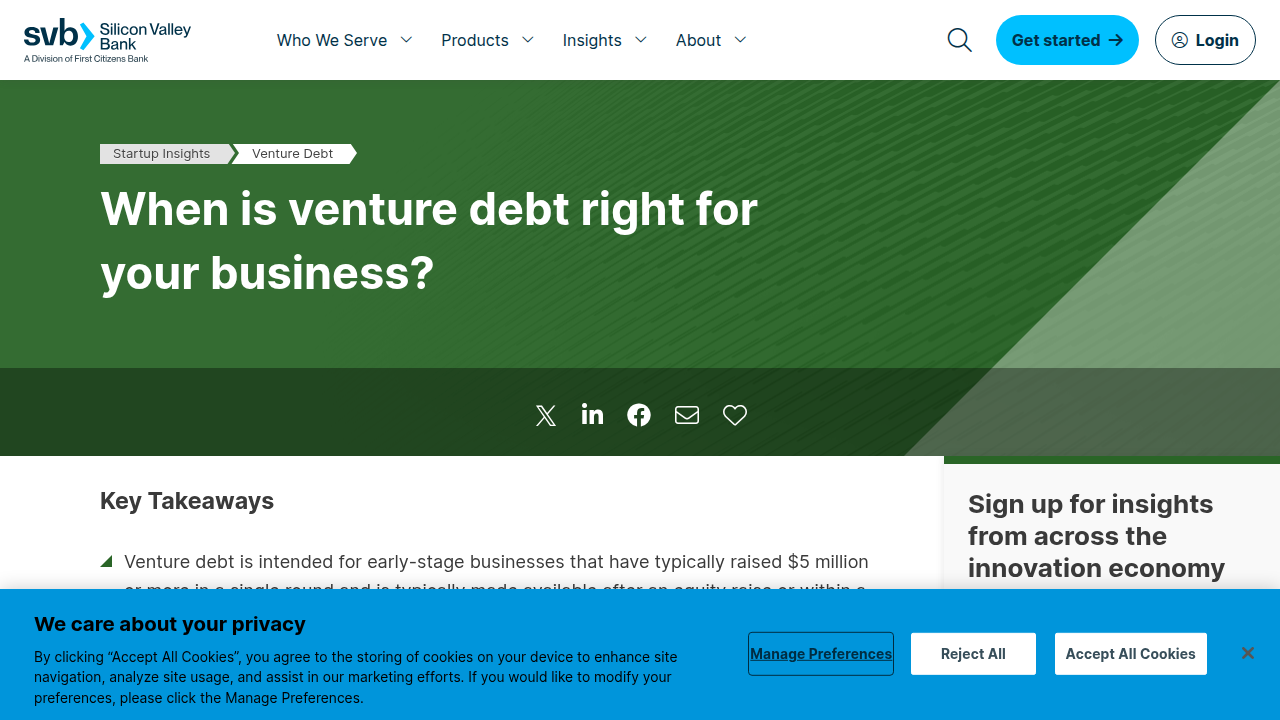
The experts at Silicon Valley Bank cover this in their guide on when venture debt is right for your business. Lenders look for these qualities.
Choose equity when you need large amounts of cash for high-growth plans or uncertain market validation. Giving up ownership makes sense here because there is less repayment risk.
Many founders use a hybrid strategy. They raise an equity round and add venture debt on top to minimize dilution. For more on choosing between funding options, see this private equity funds guide for founders.
And to stay ahead of trends that influence your fundraising, get The AI Newsletter Worth Reading for clear daily updates.
Typical Structures and Covenants in Venture Debt Deals
Venture debt comes in a few common forms. The most basic is a term loan, where you get a lump sum and pay it back over time.
Some lenders offer equipment financing, which lets you fund hardware or servers. Enterprise value loans are for larger, later-stage startups and are tied to the company’s overall value. Many deals also include an interval funding structure, where you can draw cash in stages as you hit certain milestones.
Lenders also add conditions called covenants. These often require you to keep a minimum amount of cash on hand. They may also set a floor for monthly recurring revenue. And they typically limit how much other debt you can take on.
Most venture debt deals include warrants. A warrant gives the lender the right to buy shares in your startup later. According to the key features to watch for in venture debt, warrants usually cover between 5% and 20% of the loan amount. This is how lenders get a piece of your upside.
Understanding these terms helps you negotiate better. For a broader view on preparing for your next raise, check out these fundraising for deep innovation in 2026 strategies.
Convertible Instruments: SAFEs, Convertible Notes, and KISSes
Not every startup takes on venture debt or priced equity rounds. Many early-stage founders use convertible instruments instead. These tools let you delay setting a company valuation until a future funding round. The most popular option today is the SAFE (Simple Agreement for Future Equity).
A SAFE is not a loan. It gives an investor the right to convert their money into shares later. The terms usually include a valuation cap or a discount rate. The valuation cap sets the maximum price per share at conversion. A discount rate gives the investor a percentage off the next round’s share price. Some SAFEs also include a Most Favored Nation (MFN) clause, which lets the investor adopt better terms if you offer them later. For a deeper look, see this breakdown of SAFE note mechanics, caps, and dilution examples.
Convertible notes work similarly but are actual debt that earns interest. KISSes (Keep It Simple Securities) offer a simpler alternative.
Unlike interval funding structures that pay out in stages, these instruments give you the full amount upfront and convert later. Whether you are exploring cluely funding, apex funding, or just funding a startup for the first time, knowing these terms helps you negotiate smarter.
For more context on where the market is heading, read about cell tech investment trends reshaping startup funding in 2026.
Stay ahead of the curve. The AI Newsletter Worth Reading delivers clear daily AI updates to sharpen your fundraising strategy.
The Evolution of SAFE Notes Since Y Combinator
Y Combinator introduced the SAFE in 2013 to make early-stage investing faster and simpler. Since then, the instrument has evolved into several variants. The most widely used today is the post-money SAFE, which YC made the standard in 2018. It sets the investor’s ownership percentage at signing based on a valuation cap.
You will also see other types. A capped SAFE includes a valuation cap but no discount. A discount SAFE gives the investor a fixed percentage off the next round’s share price with no cap. Some combine both. And an uncapped MFN SAFE gives the investor the right to adopt better terms offered to later investors. For a full breakdown of each type and typical caps, read this SAFE note explained with key terms and 2026 caps.
These variations give founders flexibility to match terms to their stage and traction. As you build your funding strategy, understanding which variant fits your situation helps you avoid giving away too much equity too early. For a broader look at how startups are raising capital in 2026, explore seed enterprise investment strategies 2026.
Negotiating Cap and Discount in Convertible Rounds
The valuation cap and discount rate are the two most important terms in any SAFE or convertible note.

They protect early investors from overpaying when your startup grows. So how do you find a fair balance?
A higher cap is better for you as a founder. It means you give away less equity. A lower cap helps investors get more ownership. Discount rates typically range from 10% to 25%, with 20% being standard. Caps vary widely by stage, as explained in this 2026 SAFE note guide with cap and discount details. Whether you are exploring nterval funding or a traditional round, these terms shape your final deal.
When a SAFE has both a cap and a discount, it uses whichever gives the investor the lower price per share. That combination can be very dilutive for founders. Most experienced investors will accept a cap OR a discount, not both. Avoid stacking both unless you have modeled the worst case.
To see how different funding structures affect your equity, check out this guide on cell tech investment trends shaping startup funding in 2026. And for broader market intelligence as you negotiate, get clear daily AI updates from The AI Newsletter Worth Reading.
Non-Dilutive Funding: Grants, Competitions, and R&D Credits
Not all capital comes from equity deals. Non-dilutive funding lets you advance R&D without giving up ownership or taking on debt. That means you keep full control while building your technology.
Major government programs make this possible. In the US, the SBIR and STTR programs provide grants for early-stage research. The 2026 reauthorization introduced new 2026 SBIR/STTR program changes, including Strategic Breakthrough Phase II awards up to $30 million. The NSF, NIH, and other agencies participate.
In Europe, Horizon Europe offers substantial funding for collaborative research. The 2026-2027 Work Programme has opened new funding opportunities for businesses in 2026. The European Innovation Council also provides grants up to €2.5 million plus equity for deep-tech startups.
Other programs include Innovate UK in the United Kingdom and Canada’s SR&ED tax credit program. Many corporate innovation prizes offer cash awards without equity requirements.
Whether you are exploring nterval funding or another path, non-dilutive options are worth investigating early. They can fund critical milestones and make your startup more attractive to future investors. For a deeper look at different fundraising strategies, check out these seed enterprise investment strategies for 2026.
Top Grant Programs for Startups: SBIR, STTR, Horizon Europe
If you are exploring nterval funding or another path, these top grant programs are worth a close look.
SBIR and STTR are the leading US federal programs for R&D. Phase I awards up to $305,000, Phase II up to $1.25 million, and Fast-Track up to $1.55 million. The 2026 changes also introduced Strategic Breakthrough Phase II awards reaching $30 million with matching capital. The NIH Seed Fund lists current SBIR and STTR funding opportunities for deep-tech, biotech, and health startups.
Horizon Europe is the EU’s flagship program for collaborative innovation. It offers substantial grants through consortia-based projects and the European Innovation Council (up to €2.5 million in grants plus €15 million in equity).

The Horizon Europe official site has full details on the 2026-2027 Work Programme.
National-level programs also matter. Innovate UK provides pump-priming grants like the Horizon Europe Pump Priming grant worth up to £6,000. Germany’s ZIM (Central Innovation Program) and France’s i-Nov competition fund mid-stage R&D without taking equity.
Using grants like these alongside strategic planning can strengthen your position. For deeper strategies on combining non-dilutive funding with equity rounds, check out how to budget and fundraise for deep innovation in 2026.
Staying current on funding trends helps you spot opportunities faster. For daily updates on AI and tech shifts that affect startup fundraising, try The AI Newsletter Worth Reading from The Deep View.
Maximizing R&D Tax Credits: A Guide for Startups
Grants are not the only way to get non-dilutive cash. R&D tax credits can also save you a lot of money. Many countries offer these credits to offset payroll taxes or give you a cash refund. If you are working on nterval funding, cluely funding, or any other form of apex funding, tax credits should be part of your plan.
What counts as eligible activity? Common examples include developing new products, building software, and doing scientific research. Basically, if your team is solving technical problems, you may qualify. This is one of the smarter ways to keep funding a startup without giving up equity.
The key is compliance. You need to track time spent on R&D activities, document experiments and failures, and prepare a solid claim. Good records make audits easier and help you get the full benefit. For more on building a smart financial plan, check out how to budget and fundraise for deep innovation.
Interval Funding: A Structured Approach to Capital
Not all funding arrives in one big lump sum. With interval funding, capital is released in stages tied to specific milestones. You might hear this called milestone-based financing or tranched funding. Each time you hit a key KPI, the next portion of cash unlocks. This approach reduces risk for investors because they only deploy more money once you show real progress.
For founders, interval funding creates clear targets and keeps you focused. Instead of burning through a giant check all at once, you pace your spending around measurable wins. This structure also helps with funding a startup without giving away too much equity early on. You can read more about how milestone-based VC funding works over at Allied Venture Partners to see how smart investors use this model.
Interval funding can take a few forms. You might use tranched equity, where each share release has a price tied to a valuation event. Or you might use convertible notes with triggers that convert upon hitting certain goals. Hybrid instruments combine both approaches. The key is that every dollar is earned, not just given.
If you want to sharpen your overall fundraising strategy, check out these data driven strategies to raise capital for your next round. And to stay on top of the tech trends shaping 2026, The AI Newsletter Worth Reading delivers clear daily AI updates straight to your inbox.
How Interval Funding Works: A Real-World Example
Picture this. A biotech startup needs $5 million to run clinical trials. Rather than collecting the whole sum upfront, the founders set up an interval funding deal tied to clear milestones.
Milestone one: FDA approval to begin human trials. Once the startup gets the green light, $2 million releases right away. That cash covers lab work and patient recruitment.
Milestone two: hitting patient enrollment targets in Phase 1. When those numbers are verified, the remaining $3 million unlocks. This structure mirrors the same milestone-based funding mechanism used across many industries.
The beauty of this approach? Lower dilution. If the startup never reaches milestone two, investors keep the $3 million. Founders only give up equity on the $2 million they actually received, not the full $5 million. That difference matters when funding a startup with high uncertainty, like drug development. Investors also get built-in governance since each tranche requires proof of progress before more cash flows.
For more on applying this model to biotech and deep tech, check out these fundraise for deep innovation strategies to plan your next round.
Comparing Interval Funding to Traditional Rounds
So how does interval funding stack up against the standard way most startups raise money? In a traditional round, investors hand over a single lump sum. The startup gets all the cash upfront based on one valuation. That valuation is set once and does not change, even if the company hits delays. If things go wrong, investors lose everything.
Interval funding flips that model. Capital comes in tranches, with each release tied to a verified milestone. The valuation can reset at each tranche, so early strong performance might earn you better terms later. This setup reduces risk for both sides. Investors only put more money in after seeing proof. Founders give up less equity since they only dilute on funds actually received.
The tradeoff is complexity. You need detailed milestone agreements, regular monitoring, and clear documentation. But for capital-intensive ventures with long timelines like biotech or deep tech, this structure often makes more sense than a traditional round. For more on how different funding structures compare, read about the critical differences between venture capital and private equity.
As you evaluate options for your next raise, staying informed on evolving funding trends matters. For daily insights on AI and tech shifts that affect fundraising, check out The AI Newsletter Worth Reading.
Choosing the Right Funding Path: A Decision Framework
By now you can see that interval funding is not a one-size-fits-all solution. Before you pick any funding type, you need a clear framework. Here is a practical way to decide what fits your startup.
Start with four key factors.
Your stage matters most. A pre-revenue startup has different needs than a company with monthly recurring revenue. Your revenue model also shapes what works. Subscription businesses with predictable cash flow can handle revenue-based financing. Asset-heavy businesses like hardware startups often need milestone-based capital. Growth rate and risk tolerance also play a role. If you are growing fast and can handle strict terms, interval funding might be a strong fit. If you prefer simplicity and speed, traditional rounds may work better.
Map your startup to a profile.
Most startups fall into one of four profiles. Pre-revenue startups often rely on grants, friends and family, or accelerator programs. Subscription businesses can use revenue-based financing or venture debt. Asset-heavy startups with long product timelines benefit from interval funding and milestone-based structures. Deep tech and biotech companies with high capital needs often do best with interval funding because it matches their milestone-driven development cycles.
Take actionable steps.
Start with a capital needs analysis. List exactly how much money you need and when you need it. Then consult with advisors who understand your industry. Finally, model different scenarios. Ask what happens if you hit a milestone early or late. The number of funding options available today continues to grow. In 2026 the global alternative financing market reached USD 1.42 trillion, giving founders more paths than ever before.
For a deeper look at how different funding structures work, read this guide on private equity funds for startups. It will help you compare every option side by side.
Summary
This article demystifies the wide range of specialized startup funding options available in 2026, from revenue-based financing and venture debt to SAFEs, convertible notes, non‑dilutive grants, and interval (milestone) funding. It explains how each option works, when it fits different business models (for example, RBF for predictable SaaS revenue or interval funding for biotech milestones), and the key terms founders must watch—revenue share, cap multiples, interest rates, warrants, and covenants. You’ll find concrete examples (a RBF repayment walkthrough and a tranched biotech deal), pros and cons for each instrument, and a decision framework to map funding choices to stage, revenue profile, and risk. The piece emphasizes hybrid capital stacks to minimize dilution and preserve optionality, and it highlights practical steps—capital needs analysis, scenario modeling, and advisor consultation—to negotiate better deals. After reading, founders will be able to compare alternatives, model trade-offs, and choose funding structures that match their product timelines and growth plans.