

Introduction
Have you ever told an investor that your startup is a "technology company" and watched their eyes glaze over? You are not alone. The word "technology" has become a catch all term that means almost nothing by itself. When founders and investors throw around the same broad labels, real miscommunication happens. An investor looking for "deep tech" may walk right past a promising "disruptive innovation" simply because the wrong synonym technology was used.
Getting your tech synonyms right can make or break a fundraising conversation.

Precise terminology helps you stand out in a crowded market and attract the right kind of capital. The OECD has long worked on classifying high technology sectors because even official bodies know that labeling matters. If a global organization puts this much thought into tech synonyms, your pitch deck should too.
This article gives you a clear taxonomy of technology synonyms and innovation terms that are crucial for fundraising success. You will learn the difference between heavy industry jargon and the phrases that actually open doors. By the end, you will know exactly how to describe your work without relying on the vague "technology" crutch.
If you are actively raising capital in 2026, you might also want to check out our guide on seed enterprise investment strategies to pair your new vocabulary with a solid plan. Let us start by breaking down the most common synonyms of technology and when to use them.
Why Precision in Technology Terminology Matters in Fundraising
Imagine this: you spend months perfecting your pitch deck, only to have an investor scroll past your email because you called yourself a "technology company." In 2026, investors are drowning in deals. They filter by specific verticals like deep tech, clean tech, or health tech. Your vague label makes you invisible. When you use broad terms instead of precise tech synonyms, you reduce your discoverability. As one fundraising guide notes, investors evaluate startups based on clear communication, and vague language only hurts you.
Here is the thing: investors do not have time to guess what you do. They look for specific signals that match their thesis. According to research on what investors want in 2026, they scrutinize founder traits and traction metrics with precision. If your pitch says "disruptive innovation" without context, they move on. Even worse, loose terminology can give investors too much discretion over your milestones. A founder who uses "synonym technology" loosely may find themselves renegotiating definitions later. Clear language from the start builds trust and shows you know your space.

When you pick the right tech synonyms, you also demonstrate domain expertise. An investor who hears "deep tech" combined with a real application knows you understand the market. On the other hand, misalignment between your words and their expectations can cost you funding or lower your valuation. In today’s selective capital environment, every word in your pitch counts. Understand how capital groups categorize startups to speak their language.
So stop hiding behind the word "technology." Break it down. Are you building an AI platform? A hardware solution? A software tool? The more specific you are, the easier it is for the right investors to find you. And once they do, your clear terminology sets the stage for a smoother conversation about your actual business.
Core Technology Synonyms: A Foundational Lexicon
So you know you need to stop calling everything “technology.” But what should you say instead? The good news is there are clear synonyms of technology that carry real weight with investors. Each one signals something different about your startup’s maturity, risk profile, and market focus.
Let’s break down the most important tech synonyms you need to know.
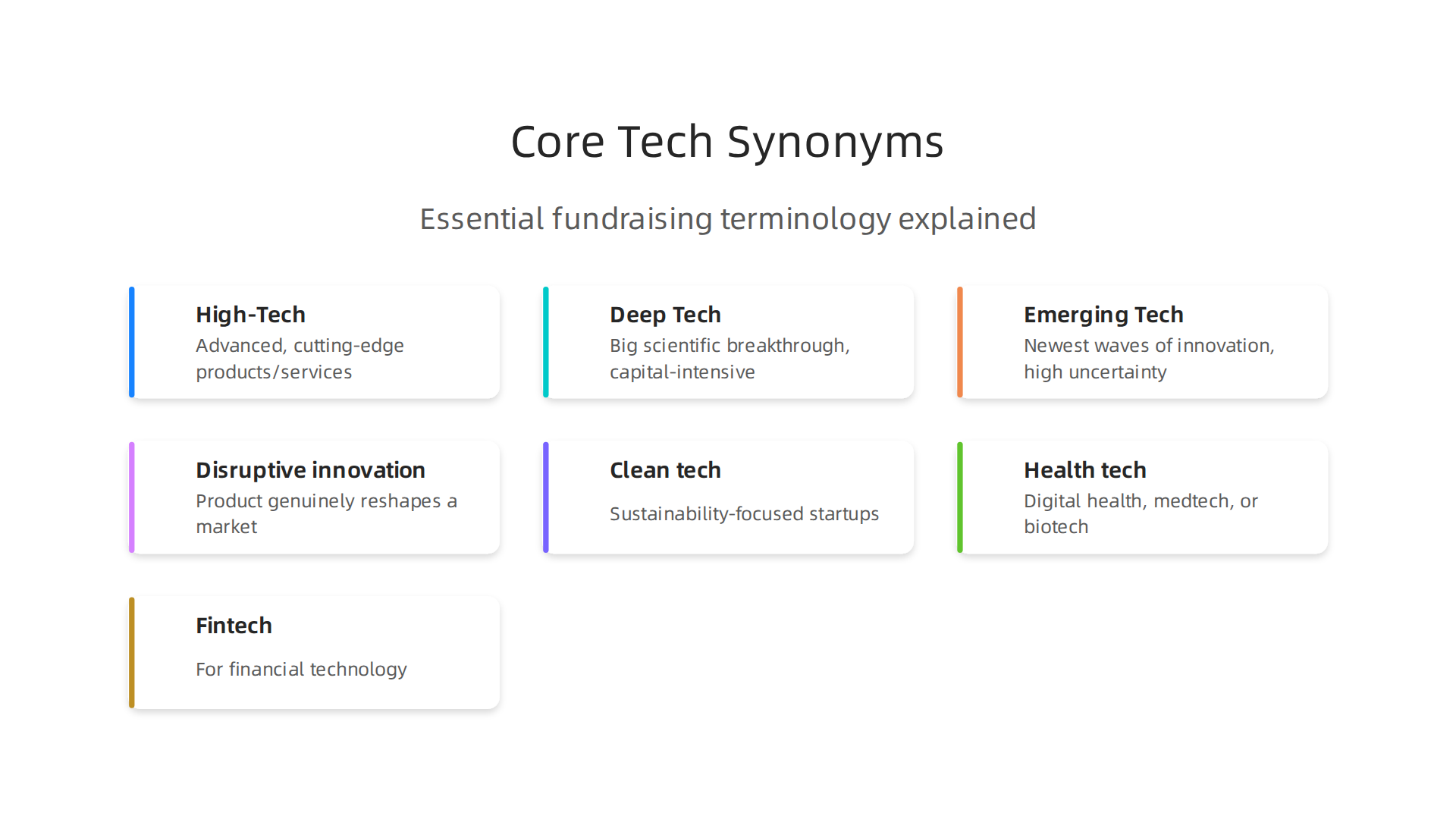
High-Tech
High-tech is the classic term. It describes products or services that use advanced, cutting-edge technology. The OECD has a detailed classification system for high-tech sectors and products. They define high-tech industries based on R&D intensity and other metrics. Using “high-tech” tells investors you are in a well-defined, innovation-driven space. But here is the thing: it is a broad label. It works better for hardware, manufacturing, or established tech sectors. If you are building an AI software tool, you might want something more specific.
Deep Tech
Deep tech is a synonym technology that signals a big scientific breakthrough. Think AI, quantum computing, biotech, or advanced materials. These are hard, capital-intensive innovations that take years to commercialize. The OECD uses technology readiness levels (TRLs) to classify AI systems and other deep tech. Investors who specialize in deep tech look for high scientific risk but also massive long-term payoff. If your startup fits this mold, use “deep tech” proudly. It shows you are not just building another app.
Emerging Tech
Emerging tech covers the newest waves of innovation. The OECD lists emerging technologies like synthetic biology, neurotechnology, immersive tech (VR/AR), and quantum technologies. These are characterized by rapid change and high uncertainty. If you are in a space that is still taking shape, “emerging tech” tells investors you are on the frontier. It is a great label when you want to attract early-stage capital that bets on future trends.
Other Important Terms
- Disruptive innovation: This is overused but still powerful when backed by a real example. Use it only if your product genuinely reshapes a market.
- Clean tech: For sustainability-focused startups.
- Health tech: For digital health, medtech, or biotech.
- Fintech: For financial technology.
The key is to use the exact term that matches what you build. Standardized definitions from industry bodies like the OECD lend credibility. They show you have done your homework.
When you master these synonyms of technology, you stop being a vague startup and start being a clear opportunity. Investors know exactly where you fit. And that is half the battle in fundraising.
If you want to go deeper on how investors categorize startups, check out our guide on capital group American funds. It helps you align your language with investor expectations.
High-Tech vs. Deep Tech
Now let’s zoom in on two of the most important synonyms of technology you need to understand clearly: high-tech and deep tech.
They sound similar, but they attract very different types of investors.
High-tech describes products built on advanced electronics, software, or manufacturing. Think of a faster chip, a better smartphone, or a cloud platform. These are innovation-driven, but the core science is usually well understood. Investors in high-tech expect shorter timelines and lower scientific risk. They want to see a clear path to market in a few years. The OECD has formal classifications for high‑tech sectors that help you prove your place.
Deep tech, on the other hand, is a synonym technology that signals a fundamental scientific breakthrough. It includes AI, quantum computing, biotech, and advanced materials. According to BCG, deep tech now claims about 20% of all venture capital funding, up from roughly 10% a decade ago. That is a big shift. But here is the thing: deep tech comes with higher scientific risk and longer timelines. The MIT REAP report points out that deep tech ventures face steep barriers to entry because of information asymmetry and the sheer complexity of the science. Investors in this space expect to wait years, sometimes a decade, before seeing returns. They also need deeper pockets.
Labeling your startup wrong can attract the wrong investor type. If you call a deep tech project “high-tech,” you might get investors who want quick exits and low capital needs. That mismatch hurts both sides. If you are building a deep tech solution, use that label proudly and seek out funds that understand the long game. Check out our guide on seed enterprise investment strategies in 2026 to see how different technology categories align with fundraising timelines.
Getting the tech synonyms right helps investors see exactly where you fit. And that clarity is worth its weight in runway.
Emerging Technology vs. Disruptive Technology
We just covered high-tech and deep tech. Now let’s look at two more critical synonyms of technology you need to know: emerging technology and disruptive technology. Mixing them up can confuse the wrong investors. Getting them right shows you really know your space.
What is emerging technology?
Emerging tech means the science itself is still being figured out. It is brand new. There is no guarantee it will work yet. Think of artificial intelligence 15 years ago, or quantum computing today. The risks are very high because the science is complex. The MIT REAP report explains that deep tech ventures, which include most emerging tech, face steep barriers to entry because of this complexity. Investors who fund emerging tech know they must be patient. They are betting on a scientific breakthrough, not a quick product launch.
What is disruptive technology?
Disruptive tech is different. The technology usually exists already. What changes is how you apply it to a market. Think about Netflix shaking up video stores or Uber changing taxis. The tech was not brand new. The application was new, and it completely transformed the market. BCG reports that deep tech now claims 20% of all venture capital funding. A big part of that goes towards disruptive innovation that reshapes industries.
Why founders must pick the right label
Using the wrong synonym technology sends the wrong signal to investors. Here is how to tell the difference:
-
If your startup depends on unproven science, you are building emerging technology. You need to find deep tech VC funds that understand long timelines. Traditional VCs often expect very high growth each year, as noted in a European deep tech landscape study. Emerging tech usually cannot deliver that growth fast. You need patient capital. Check out our guide on seed enterprise investment strategies in 2026 to see how early-stage tech aligns with fundraising plans.
-
If your startup uses proven technology to attack a stagnant market, you are building disruptive technology. You need growth capital and strong go-to-market firepower. See how other founders have positioned their game-changing companies on our list of startups in the USA.
Getting your tech synonyms right is not just fancy vocabulary. It is a signal that you understand your own risks and timelines. That clarity builds trust with investors and helps you raise the right kind of capital.
Defining Innovation in the Fundraising Context
So far we have explored how using the right synonyms of technology like high tech or deep tech helps you talk about what you build. But here is something many founders miss. Innovation is not just another tech synonym on the list. In fact, it is a completely different concept.
Innovation includes changes in your business model, your processes, and how you deliver value. You can have a brilliant piece of deep tech that never changes a market. That is invention, not innovation. Real innovation shifts how people behave or how an industry operates.
When you sit down with investors, you cannot just say "we are innovative." They need to know what kind of innovation you are pursuing. That is because each type comes with a different risk profile and a different path to market.
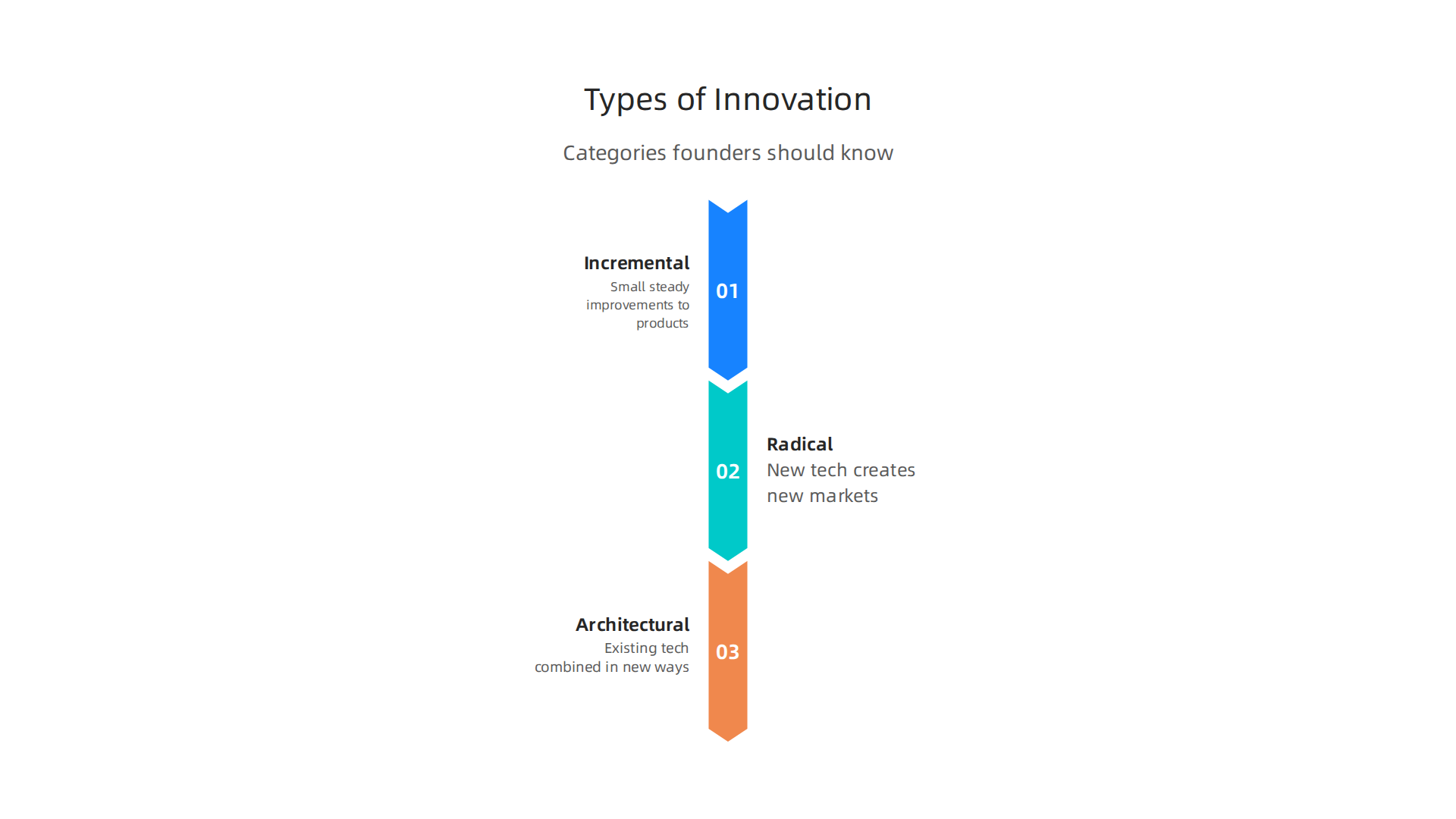
The most common categories founders should know are:
-
Incremental innovation. Small, steady improvements to an existing product or service. Think of software updates or better battery life. Investors see this as low risk but limited upside. You usually need a strong execution story, not a scientific breakthrough. A comprehensive guide on types of innovation breaks down these categories in detail.
-
Radical innovation. A completely new technology or approach that creates a brand new market. Many deep tech startups fall here. The risk is high because the science is unproven, but the potential return is massive. Investors funding this need deep patience and deep pockets.
-
Architectural innovation. You take existing technologies and put them together in a new way to serve a new market. Think of how Tesla combined existing battery tech with software to transform cars. This often sits between incremental and radical. It can be easier to explain to investors because the parts are proven, but the combination is new.
Why does this matter for your fundraising? Clear innovation classification helps investors gauge potential market impact. A venture capital firm that loves radical deep tech will not be excited by your incremental product update. And a growth equity firm that wants steady, proven markets will run from your unproven radical bet.
As one deep tech conceptual study from 2026 points out, the term "deep tech innovation" itself is often used inconsistently. That confusion costs startups time and money. When you can precisely label your innovation type, you save everyone from misunderstanding your risk profile.
Understanding the synonyms of technology is step one. Knowing how your innovation fits into the bigger picture is step two. And if you want to match your innovation type with the right kind of capital, check out our guide on capital group American funds. It will help you see which investor categories align with different levels of risk and novelty.
Get the label right, and your pitch becomes clearer. Get it wrong, and you waste months chasing the wrong investors.
Niche Terms: Hard Tech, Clean Tech, Biotech, and More
So we’ve learned that labeling your innovation type matters. But there’s another layer. The words you choose don’t just describe your technology. They signal which investor community you belong to. And that can make or break your fundraising.
Let’s move past the general synonyms of technology we talked about earlier. Now you need niche terms that point directly to your sector. These aren’t just fancy tech synonyms. They are shorthand that tells an investor exactly what kind of science, risk, and timeline you’re dealing with.
Here are three big ones you’ll hear in 2026:
-
Hard tech. This means physical engineering. Think hardware, robotics, advanced materials, and anything that requires a lab or a factory. It’s different from software because the product takes longer to build and costs more to prototype. According to Pangaea Ventures, hard tech relies on complex physical components and advanced engineering. Investors who specialize in hard tech know they’re in for a longer ride and bigger capital needs.
-
Clean tech. This covers sustainability solutions. Renewable energy, water purification, carbon capture, and circular economy products all fall here. The Cleantech Group maintains a detailed taxonomy that helps define what qualifies. Clean tech investors care about regulation, climate impact, and long infrastructure cycles. If your startup reduces waste or emissions, this is your label.
-
Biotech. Life sciences. Think drug discovery, diagnostics, medical devices, and agricultural biology. Biotech requires deep scientific expertise and often years of clinical trials. The investor pool here is separate from generalist VCs. Many biotech funds understand the regulatory maze and the high failure rate, so they evaluate deals differently.
These three terms overlap with deep tech, which is a broader classification that often includes hard tech, clean tech, and biotech when the science is cutting-edge. A 2026 conceptual study from HAL Science clarifies that deep tech sits at the edge of what’s scientifically possible.
Why does this matter? Because using the right niche term helps you find the right capital. A hard tech investor will usually pass on a simple software app. A clean tech fund won’t touch a consumer social network. When you say “biotech” or “hard tech,” you attract investors who already understand your world. That saves time and gets you better conversations.
So after you nail down your innovation type, get specific about your niche. Then match it with the right investor community. For example, if you’re working on a new battery material, look for hard tech or clean tech funds, not generalist angels. And if you need help identifying which investors focus on your area, check out our guide on seed enterprise investment in 2026 to see how different capital sources align with sector and stage.
How Investors Use Industry Definitions in Decision-Making
Here’s the thing. Investors don’t read every pitch deck that lands in their inbox. They sort them first. The name you give your technology is actually one of the first filters they use.
Think about it this way. A venture fund might see 2,000 deals in a year. They need a fast way to say “yes” or “no.” That’s where industry definitions come in. Your synonyms of technology aren’t just labels. They are signals that tell investors how to think about your startup.
Portfolio Construction Starts With Labels
Fund managers build portfolios on purpose. They don’t just chase shiny objects.

They set targets for how much goes into hardware, software, sustainability, or life sciences. These targets rely on clear tech synonyms to group companies.
For example, a hard tech fund might want 40% in advanced materials and 30% in robotics. A clean tech fund may focus on energy storage and carbon capture. They track their performance against benchmarks in those exact categories. Platforms like Crunchbase help investors move from reactive deal flow to proactive sourcing, prioritizing companies based on funding momentum and financial benchmarks.
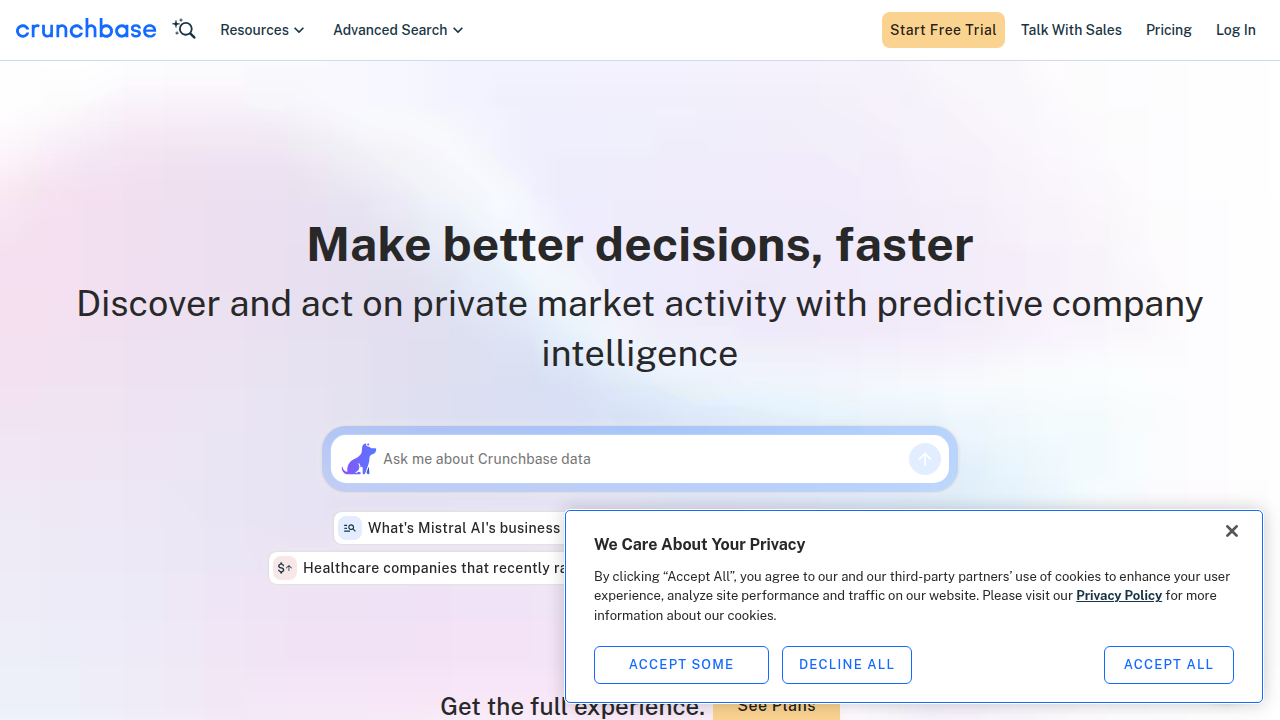
According to Crunchbase’s data team, signal-based sourcing is how modern investors work (Crunchbase data page). If your startup isn’t labeled correctly, you might get missed entirely.
Due Diligence Scope Depends on the Category
Once an investor is interested, the due diligence process changes depending on the sector. A software startup might only need customer interviews and unit economics checked. But a deep tech or biotech company requires scientific validation, regulatory reviews, and clinical trial data.
The OECD has studied how investment firms use platforms like Crunchbase for research. They note that crowd-sourced data, combined with AI validation, helps investors quickly verify which companies fit their thesis (OECD PDF). The more specific your synonym technology, the more targeted the questions an investor will ask. That’s a good thing. It means they’re taking you seriously.
Language Alignment Drives Engagement
Here’s a simple truth. Startups that use the same vocabulary as investors get more meetings. When you call your breakthrough battery “clean tech” instead of just “tech,” you show up in the right investor’s search filters. They see a match. They click.
In 2026, investors rely on data platforms more than ever. They search for terms like disruptive innovation, deep tech, or clean tech to filter deals. If your pitch deck says “mobile app” when you’re really building a biotech diagnostic tool, you’ll miss the right audience. That’s why we put together a guide on seed enterprise investment in 2026. It shows exactly how different capital sources align with specific sectors and stages.
The Takeaway
Investors use industry definitions as shorthand for risk, timeline, and expertise. Get your synonyms of technology right, and you’ll land in the right pile. Get them wrong, and you’ll waste time pitching people who were never a fit. So before you send out that next deck, double check your labels. It might be the easiest change you make all year.
Filtering by Sector in Deal Sourcing
So how do investors actually find deals worth their time? They don’t scroll through random lists. They filter by sector. And the labels you use decide whether you show up in their search results.
Most investors use platforms like Crunchbase, PitchBook, or CB Insights to scan for new opportunities. These tools let them filter companies by industry tags, funding stage, and technology type. For example, an investor looking for deep tech startups can set a filter to only show companies tagged with that label. If your company is tagged as “mobile app” instead of “deep tech diagnostic tool,” you simply won’t appear.
The data team at Crunchbase explains it well. They help investors move from reactive deal flow to proactive, signal-based sourcing. This means investors prioritize companies based on funding momentum and market validation. They search for specific tech synonyms like “clean energy” or “AI hardware” to narrow down their options. If your profile uses vague terms, you get filtered out before anyone reads your story.
Here’s the tricky part. Different platforms use different taxonomies. A term like “disruptive innovation” might mean one thing on Crunchbase and another on PitchBook. That’s why you need consistent terminology everywhere.
The OECD has studied how platforms like Crunchbase work for research. They found that crowd-sourced data, combined with AI validation, helps investors quickly verify which companies fit their thesis. Your synonym technology choices feed directly into these systems. The more aligned your language is with industry standards, the better your chances.
What happens when you get the label wrong? You miss the opportunity. A deep tech company that calls itself “software” might get lumped into a crowded category with thousands of competitors. The investor looking for that specific tech synonyms filter never sees you.
In 2026, the smartest move you can make is to audit your company profiles across every platform. Make sure the tags match. Use the same keywords on your website, Crunchbase page, and PitchBook profile. Consistency is what gets you found.
If you’re unsure which categories fit best, start by researching how similar companies in your space tag themselves. Check out our guide on how to find a trusted list of startups in the USA for examples of proper tagging. It walks through real profiles and shows exactly which labels lead to better search visibility.
Valuation Implications of Terminology
Now here is where the words really matter. The tags you choose don’t just help investors find you. They can change what your company is worth. In 2026, the difference between one label and another can mean millions of dollars.
Let’s start with deep tech. Startups that use this label often build things that are hard to copy. They have patents, strong science, and long development timelines. Investors see that as a moat. A deep tech company can command much higher valuation multiples than a simple SaaS app. For example, a deep tech startup working on hardware for AI might get a multiple of 40x on its revenue, while a regular enterprise SaaS company with the same revenue might get only 8x to 10x. That data comes from a guide on tech company valuation multiples by Aventis Advisors.
Everything changes when you use the phrase platform technology. That term signals that your product can grow across many use cases and markets. Investors hear “platform” and think about scalability. That is a synonym technology that can push your valuation higher. According to the Startup Valuation Guide from Spectup, enterprise SaaS gets a 40 percent lower valuation than AI infrastructure. So if you call your AI tool a “platform,” you might move into a higher bracket.
But here is the risk. Overusing big buzzwords without real substance can backfire hard. If you tag your company as “AI” but you don’t have a serious AI model, investors will find out during due diligence. The same goes for disruptive innovation. That phrase gets thrown around so much that it often signals the opposite. A study on deep tech valuations from Equidam shows that investors now check technology readiness levels to separate real deep tech from hype. If your tech synonyms don’t match reality, you lose trust and money.
So be honest. Pick the label that fits your actual technology. If you are building real deep tech, use that term. If you have a platform model, say so. But don’t borrow a label just for a higher number. Investors are smarter than that in 2026.
If you want to see how proper labeling and metrics affect fundraising, check out our guide on seed enterprise investment strategies. It shows how the right terminology combined with strong data leads to better investor conversations.
Future Terms: Web3, AI, and the Next Wave of Innovation Language
The world of synonyms of technology never stops growing. Just a few years ago, everyone talked about "big data" and "the mobile web." In 2026, the hot terms come from AI and Web3. And the language keeps getting more specific.
Take AI as an example. Broad tech synonyms like "artificial intelligence" are not enough anymore. According to the guide on what investors want in 2026, mastering precise terms like "foundation models," "retrieval augmented generation," or "agentic workflows" is now a key rule for startup success. The same goes for Web3. Calling yourself a "blockchain company" feels dated. Savvy founders use specific labels like "decentralized physical infrastructure networks" or "zero knowledge proofs." This shift from vague to specific synonym technology shows investors you truly know your space.
Why does this matter for your fundraising? Because in 2026, investors check for "Topical Authority" before you even meet. The guide on how to raise capital in 2026 explains that having this authority makes fundraising significantly easier. Your language is the first signal of that authority. If you use the exact right terms for your sector, you sound like an insider.

If you use old or generic words, you sound like an amateur.
This is very different from throwing around disruptive innovation or deep tech without meaning it. The goal is not to use the biggest buzzword. The goal is to use the most accurate word for your actual business.
Want to see how successful founders are positioning themselves with the right language? Check out our list of startups in the USA for smarter fundraising decisions. Understanding what different capital groups look for in 2026 can help sharpen your language even further.
Mastering the new tech synonyms of innovation is not about hype. It is about proving you are up to date and ready to lead.
Conclusion
If you have made it this far, you already understand something that many founders miss. Mastering the right language is not just a nice to have. It is a strategic asset that can shape how investors see you and your company.
Think about it this way. Every time you use a precise synonym technology term in a pitch or a conversation, you send a signal. You signal that you know your space deeply. You signal that you are not just repeating hype. That builds trust fast.
And trust has a direct effect on your fundraising numbers. When an investor believes you truly understand your market, they feel safer putting money into your company. This confidence can influence everything from your valuation to the speed of your deal. For example, knowing the right valuation multiples for your specific sector helps you price your round smarter. According to the tech startup valuation guide by Finro, understanding how multiples differ across niches like AI versus traditional SaaS is a key part of getting funded on fair terms.
The language of synonyms of technology keeps changing too. What worked six months ago might sound dated today. That is why continuous learning matters. You need to stay on top of evolving industry definitions to keep your fundraising efforts competitive. The AI startup valuation report from Qubit Capital shows just how fast these benchmarks shift in 2026.
So here is the real takeaway. Do not treat this as a one time vocabulary lesson. Treat it as an ongoing practice. Every time you learn a new tech synonyms term for your niche, you are making it easier for the right investors to find you and trust you.
Ready to put these strategies to work? Start by exploring how investors research startups in 2026 so you can align your next pitch with what they are actually looking for.
Summary
This article explains why swapping the vague label