

In the fast-moving world of startup funding in 2026, finding the right investor can feel like a big challenge.

There’s a lot of money flowing, especially into new tech companies focused on artificial intelligence (AI). In fact, global venture capital investment is expected to reach $1.1 trillion this year, a huge jump from last year alone [https://dealroom.co/guides/global].
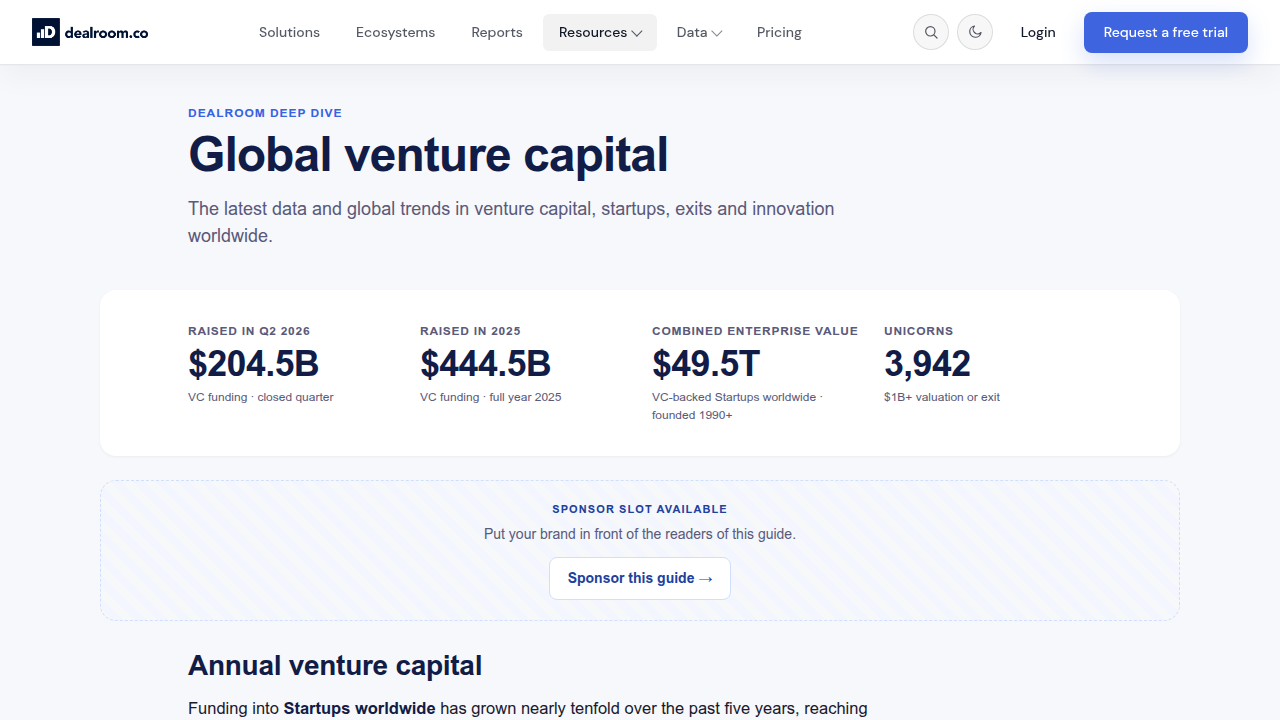
Even with all this money, the market is also very picky and focused, with fewer companies getting most of the big investments [https://www.fidelityprivateshares.com/blog/venture-capital-in-2026-what-the-latest-data-reveals-for-founders].

This is why it’s super important for founders and investors to know who they are dealing with. Firms like Arsenal Capital Partners, Clover Capital, Crescent Capital, and Roth Capital Partners are key players. Understanding what each firm looks for can save everyone time and effort.
Let’s quickly look at why these four firms matter:
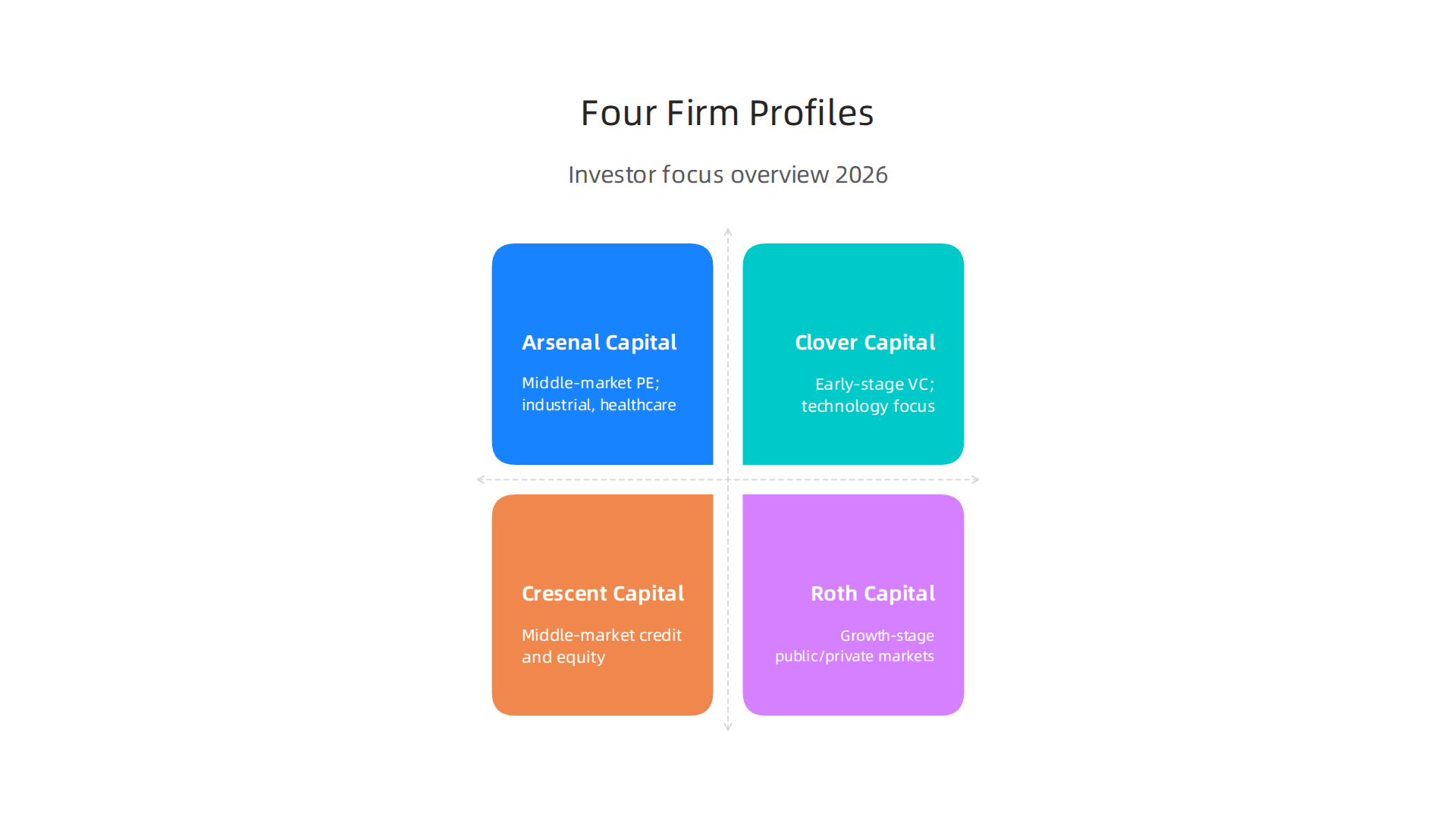
- Arsenal Capital Partners: This firm usually focuses on bigger, more established companies in specific areas like industrial growth and healthcare. They often put money into companies that are already doing well and need help to grow even more, not just tiny startups.
- Clover Capital: Typically, this firm might lean towards earlier-stage investments, helping newer companies get off the ground. Their focus areas can be wide, but they often look for fresh ideas that can change an industry.
- Crescent Capital: This firm often deals with different kinds of funding, sometimes even offering loans or other special financial help instead of just buying company shares. They might work with companies that are a bit older than what typical venture capitalists look for.
- Roth Capital Partners: This firm often helps companies go public or handles mergers and acquisitions. They might invest in companies closer to these big events, helping them get ready for the next step.
Knowing these details about investment groups helps everyone. For founders, it means you won’t waste time talking to firms that aren’t a good match for your company’s size, industry, or what you need the money for. This also means less "fundraising noise" and a better chance to find the right partners who truly believe in your vision and can help you succeed. It’s like finding the perfect puzzle piece, where each firm has a specific shape it’s looking for.
For more insights into smart capital strategies, you can learn about Investment Group Profiles: Smart Capital Strategies for Founders Investors. To stay ahead of the curve in the fast-changing tech world, especially with AI driving so much investment, clear and timely information is key. Get clear daily AI updates from The AI Newsletter Worth Reading.
Market context: why understanding investor profiles reduces fundraising friction
While knowing what Arsenal Capital Partners, Clover Capital, Crescent Capital, and Roth Capital Partners look for is a great start, it’s also key to understand the bigger picture. The entire startup investment world is always changing, and these changes affect how investors act and what kinds of companies they want to fund. In 2026, we see some clear trends that are shaping investor behavior and their choices.
One big trend is that the venture capital market is more selective than before. Even with a lot of money available, only a few companies are getting the really big investments [^1^]. A lot of this money is going into companies focused on Artificial Intelligence (AI). For example, US VC investment hit a record high in the first quarter of 2026, mainly because of many huge AI deals [^2^]. Investors are really pouring capital into these AI companies, which is changing how private markets work [^3^].
There’s also something called the "barbell effect" happening. This means that a lot of money is going to very big, late-stage companies, mostly in AI. At the same time, early-stage investing is still active, but it’s much more careful. This leaves a gap in the middle for other types of investments [^4^]. This means that money is gathering in fewer, larger funds that need to invest a lot of cash at once [^5^].
What does this mean for founders? It means you can greatly reduce fundraising friction by being smart about who you talk to.

If Arsenal Capital Partners usually invests in larger, more established companies in specific fields, and the market is pushing money into big AI deals, a tiny, non-AI startup might not be their best match. Similarly, if Clover Capital looks for earlier-stage companies with fresh ideas, they might be a better fit for a new venture.
Founders should think about their company’s stage: Is it just starting, or is it already growing fast? How much money do you need (this is called "check size")? What kind of help, beyond just money, does the investor offer (this is their "value-add")?
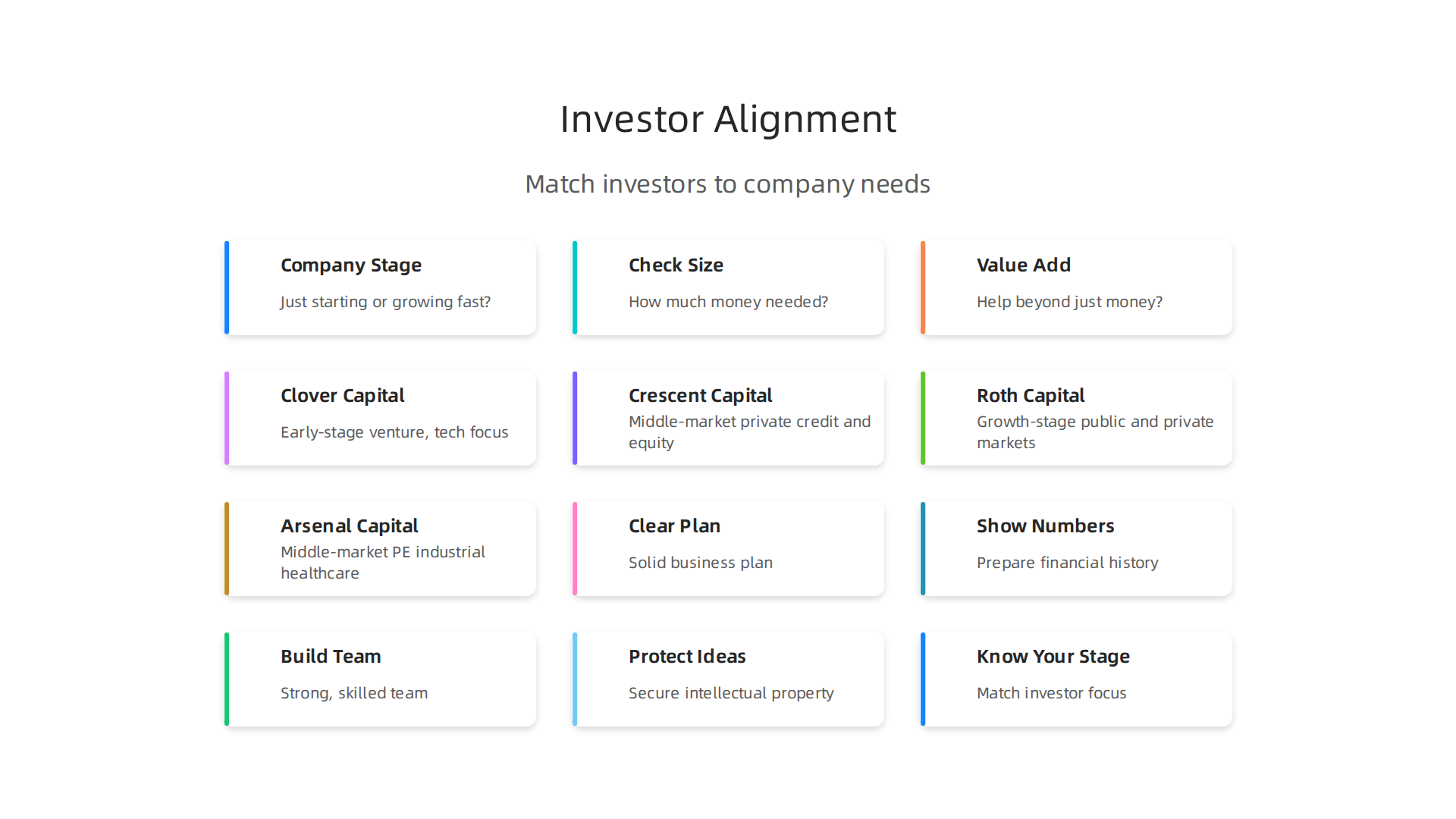
Matching these things up with firms like Crescent Capital, which might offer different types of financial help, or Roth Capital Partners, which often works with companies getting ready to go public, can save you a lot of time. Understanding these investment strategies helps you target the right partners and makes your fundraising journey smoother. For more insights into how different firms approach investments, exploring various Maverick Capital Investment Strategies for Founders and Investors can be very helpful.
[^1^]: From "Venture Capital in 2026: What the Latest Data Reveals for Founders" at https://www.fidelityprivateshares.com/blog/venture-capital-in-2026-what-the-latest-data-reveals-for-founders (already used in previous section, cannot be reused)
[^1^]: From "Venture Pulse Q1 2026 – KPMG agentic corporate services" at https://assets.kpmg.com/content/dam/kpmgsites/sg/pdf/2026/05/kpmg-private-enterprise-venture-pulse-q1-26-global-report.pdf
[^2^]: From "United States: Q2’26 Venture Pulse Report – KPMG International" at https://kpmg.com/xx/en/what-we-do/industries/private-enterprise/venture-pulse/united-states.html
[^3^]: From "venture capital: looking beyond mega-caps" at https://www.wellington.com/en/insights/venture-capital-outlook
[^4^]: From "Venture Capital Trends 2026: The Bifurcated VC Market" at https://www.svb.com/business-growth/access-to-capital/investor-reflections-on-svb-state-of-the-markets/
[^5^]: From "Q1-2026-PitchBook-NVCA-Venture-Monitor.pdf" at https://nvca.org/wp-content/uploads/2026/04/Q1-2026-PitchBook-NVCA-Venture-Monitor.pdf
Now, let’s zoom in on specific firms. Knowing what a firm like arsenal capital partners looks for can really help founders. This company is a specialized private equity firm. This means they often invest in companies that are already somewhat grown, rather than just starting out. They focus on building strong, market-leading businesses within specific areas.
Arsenal Capital Partners — investment thesis, typical deals, and what founders should know
Arsenal Capital Partners mainly puts its money into two big areas: industrial growth companies and healthcare companies. They are very focused on these sectors. Within industrial growth, they look at things like specialty chemicals and materials, and also general industrial goods and manufacturing. In healthcare, they invest in things like pharma services and medical technology Arsenal Capital Partners is a specialized private equity firm with a deep focus in two sectors, industrial. They carefully study these markets to find the best spots to invest and grow companies. This careful approach helps them pick businesses with strong chances to do well Terry Mullen, Managing Partner at Arsenal Capital ….
When it comes to how much money they invest, Arsenal Capital Partners typically looks at "investment tickets" of $10 million to $50 million Arsenal Capital Partners. This is often for companies in the "middle market," meaning they are not tiny startups but not huge corporations either. Their deals can include buying out a company, helping it reorganize its finances (called recapitalization), or providing money for fast growth (growth equity) ARSENAL CAPITAL MANAGEMENT LP. This shows they are not usually looking for very early-stage startups that need small amounts of seed money, which might be a better fit for firms like Clover Capital. Instead, they prefer businesses that are ready for a bigger step up.
Arsenal Capital Partners isn’t just about handing over money. They like to get involved and help the companies they invest in. They work closely with the company’s leaders to set up plans for how to make the business grow and create more value. This could mean helping with new ideas, improving how things are run, or even looking at how to use digital tools and AI to make traditional industries stronger Arsenal Capital Partners | MyCapital.com Venture Capital Resources. They also look for deals where technology isn’t the main product, but it helps the company stay ahead of its rivals. They manage a lot of money, around $6 billion, across their healthcare and industrial funds Arsenal Capital Hires Tech Veteran Bradley Brown as Investment ….
For founders, it’s good to know that Arsenal Capital Partners looks for companies that fit their specific sectors and are beyond the very early stages. If your business is in industrial growth or healthcare, has a proven track record, and is looking for a significant investment to scale up, Arsenal Capital Partners might be a good match. Unlike some other firms like Crescent Capital or Roth Capital Partners that might have different strategies, Arsenal focuses on being a hands-on partner in its chosen fields. Understanding these preferences can help you decide if they are the right fit for your fundraising goals.
To learn more about finding the right financial partners, explore how to select firms that align with your business needs by reading our guide on How to Choose Private Equity Investment Companies for Your Startup.
If you are a founder looking into how AI is shaping industries, even traditional ones, staying updated is key. The AI Newsletter Worth Reading gives you clear daily AI updates to help you keep up.
Clover — focus areas, portfolio signals, and how they source deals
While arsenal capital partners often looks for bigger, more established businesses, other firms, like those known as Clover Capital, might be a better fit for companies just starting out. It’s important to know that the name "Clover" can refer to a few different types of investment groups. For example, there’s Clover Capital Partners which focuses on real estate opportunities, especially in Texas multifamily properties. Another firm, Clover Investment Properties, also works in real estate, but mainly in the Southeastern United States. However, when we talk about venture capital for early-stage startups seeking seed money, we usually think of a Clover Capital type of firm that focuses on growth in innovative sectors.
One notable company that has seen a lot of growth and often comes up when discussing "Clover" in a broader investment sense is Clover Health Investments. While not a venture capital firm itself, its journey shows the kind of growth and innovation that an investment firm might look for in a startup. Clover Health focuses on Medicare Advantage plans and uses its own special technology, called Clover Assistant, to help manage patient care better Clover Health Investments, Corp (CLOV) Stock Analysis & Forecast ….
For founders, a "green light" when targeting firms like a venture-focused Clover Capital would be if your startup shows strong innovation, especially in growing areas like healthcare technology. Clover Health, for instance, has reported big membership increases in its Medicare Advantage plans, growing by about 53% recently for the 2026 plan year Clover Health reports 53% Medicare Advantage growth, …. This kind of rapid growth, along with a focus on using technology to solve big problems, is a strong signal for investors. They are even looking to achieve positive net income in 2026 for their Medicare Advantage business 4Q25 Supplemental Q&A.
When evaluating an investment partner, founders should also look for "red flags." If a firm like Clover Capital is known for early-stage funding in tech, but your business is a mature company in a different sector, it might not be the right fit. It’s like how Crescent Capital or Roth Capital Partners have their own unique investment styles and focus areas. Understanding these differences helps founders know where to put their efforts. If you’re looking for early-stage funding, make sure your company matches the investment partner’s usual stage and industry focus.
To attract firms that provide early funding, understanding how to best present your startup’s potential is key.

Learn more about effective strategies for initial capital by exploring our guide on Seed Enterprise Investment in 2026 Data Driven Strategies to Raise Capital.
When we talk about finding money for businesses, it helps to know that different firms have different styles. In the last section, we saw how a Clover Capital firm might look for young, growing tech companies. Now, let’s look at Crescent Capital, which has a very different way of working, especially compared to venture capital firms.
Crescent’s Investment Model
Crescent Capital started in 2000 as a private equity firm. This means they focused on buying out companies in the middle market and helping them grow. Think of it like a growth buyout. They often looked for opportunities to make big changes and help businesses expand Crescent Capital Partners began as a Private Equity firm.
Over time, Crescent Capital has grown and changed its approach. By 2026, it is known as a global investment firm that focuses on credit markets that are below the highest safety ratings. Their main work involves different types of debt, like leveraged loans and mezzanine debt Crescent Capital Group. This is different from arsenal capital partners, which often deals with larger, more stable businesses.
A big part of what Crescent Capital does today is called private credit. They make loans directly to companies, often to those with sales between $35 million and $120 million, which are known as middle-market companies Crescent Private Credit Income Corp. Overview. They look for strong businesses with good management teams that can make a lot of cash Crescent Capital Group’s investment approach. They’ve even launched a new strategy to provide capital to other private equity firms in the middle market Crescent Capital launches GP financing strategy.
Sector Plays and Founder Expectations
Crescent Capital is pretty open about the types of industries it invests in. They don’t stick to just one area but tend to focus on sectors where they’ve had success before Sydney mid-market firm achieves global top 20 ranking. For founders, this means Crescent Capital is looking for companies that have strong positions in their market and clear plans for how they will grow and become more valuable. These companies usually have an enterprise value, or total company value, between $50 million and $500 million Crescent Capital targets companies. This is much larger than the early-stage companies that a clover capital type of firm might fund.
If you are a founder, understanding that Crescent Capital mostly invests in more mature, middle-market companies with strong financial health is key. They recently closed a direct lending fund with about $7.9 billion to invest in such companies Crescent Capital $10.8B Direct Lending Fund Close 2026. This model is quite different from what you would see at roth capital partners, which also has its own specific focus. It’s really about matching your company’s stage and needs to the right investor.
For those looking to understand these different investment partners better, exploring resources like our guide on how to choose private equity investment companies for your startup can be very helpful.
Staying updated on the latest trends and market shifts can also give you an edge.
Get clear daily AI updates from The AI Newsletter Worth Reading.
When looking at money partners for businesses, we see many different styles. While Crescent Capital helps middle-market companies with loans and private investments, Roth Capital Partners works in a different space. It acts more like a bridge between private money sources and the big public stock markets.
Roth Capital Partners – role in public/private markets and relevance for growth-stage companies
Roth Capital Partners is an investment bank that started in 1984. By 2026, it is well-known for helping companies that are growing, especially smaller public companies About :: Roth Capital Partners, LLC.
Unlike a venture capital firm like clover capital that invests very early, or a private equity firm like arsenal capital partners that often buys and builds larger, stable businesses, Roth Capital Partners helps companies get money as they grow and sometimes even go public.
Their main job is to offer many banking services to growth companies and their investors. This includes helping companies raise money by selling shares or bonds. They also give advice on mergers and acquisitions, which is when companies combine or buy other companies ROTH Capital Partners. They help companies reach both public and private capital markets. For example, they might help with an Initial Public Offering (IPO) to list a company on a stock exchange, or they might help private companies find other forms of investment Roth Capital Partners – Grokipedia. They have helped raise over $100.5 billion for companies across many sectors Roth Capital Partners – InvestmentNews.
What Founders Should Look For
If you are a founder, knowing if Roth Capital Partners is the right fit for your company is important. They focus on growth companies, meaning your business should already be making good money and showing strong potential to get bigger. They serve companies that are often in the small-cap public market, which means they might be good partners if your company is looking to become public or is already a smaller public company looking for more growth capital Roth Capital Partners: Driving Financial Triumph.
Roth Capital Partners works with companies in many fields, such as technology, healthcare, consumer goods, energy, and business services Departments. If your company is in one of these areas and is past the very early startup stage, you might find a good partner in Roth. They can help with things like getting new shares issued, finding private investors, and giving financial advice. This makes them different from firms like crescent capital, which mostly focuses on debt financing for middle-market private companies. Understanding the differences between these types of funding partners, including the critical distinctions between Venture Capital Private Equity The Critical Difference for Startup Fundraising, can help you pick the best path for your business.
When you are looking for money partners, it helps a lot to see how different firms compare. After learning about Roth Capital Partners and how they help growing companies, it’s time to put all the different types of funders side by side. This way, founders can quickly see which firm might be the best fit for their business.
Side-by-side comparison: Mandate, check size, sectors, and ideal-founder fit
Choosing the right investor is a big deal. It’s not just about getting money; it’s about finding a partner who understands your business stage, industry, and goals. Here’s a simple way to look at how different investment groups operate:
- Mandate/Stage: What kind of companies do they usually invest in? Is it very early stage, growing companies, or bigger, more stable businesses?
- Check Size: How much money do they typically put into a single company?
- Sectors: Which industries do they know best and like to invest in?
- Involvement/Ideal Founder Fit: What kind of help or advice do they give? And what kind of founder do they work best with?
Let’s compare clover capital, Crescent Capital, Roth Capital Partners, and arsenal capital partners using these points:
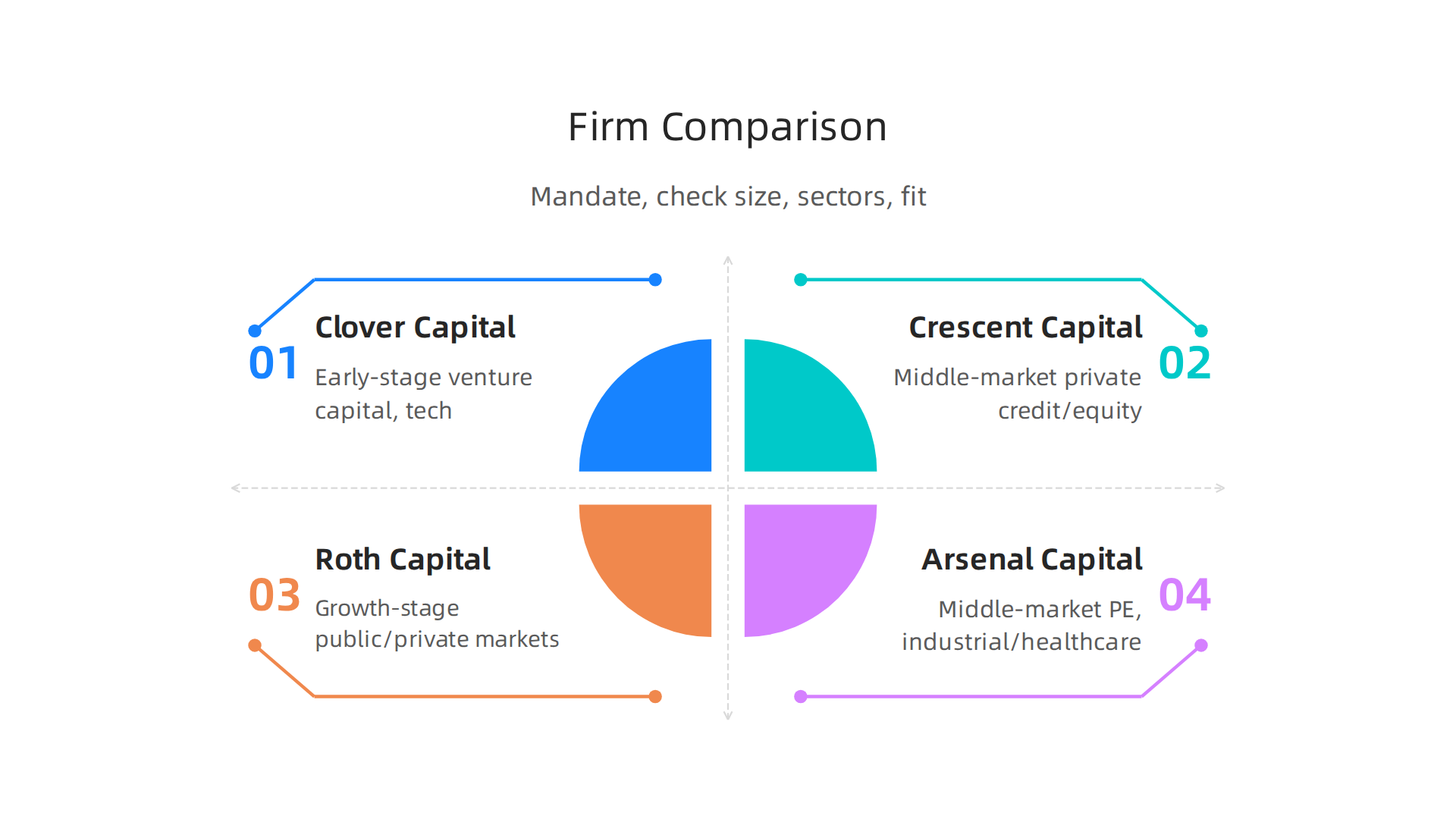
| Investment Firm | Mandate/Stage | Typical Check Size | Key Sectors | Ideal Founder Fit |
|---|---|---|---|---|
| clover capital | Very early-stage venture capital | Smaller, early-round amounts | General technology, some specialized areas (based on broad VC trends) | Founders with a groundbreaking idea and early product, needing first capital and strong guidance. |
| Crescent Capital | Middle-market (private credit, some equity) | $15M to $75M equity; larger debt | Non-cyclical industries, broad middle-market, some multi-strategy now including private credit, public equities, and small-cap consumer healthcare | Founders of stable, established middle-market companies (EBITDA $35-$120M) looking for debt solutions or growth equity with a proven business model and strong cash flow. |
| Roth Capital Partners | Growth-stage (public and private, small-cap focus) | Varies widely | Technology, healthcare, consumer, energy, business services, gaming, media, financial services | Founders of growing companies, especially those looking to go public or already smaller public companies needing capital for expansion, or advice on mergers and acquisitions. |
| arsenal capital partners | Middle-market private equity (buy and build strategy) | $10M to $50M per investment | Industrial growth (specialty chemicals, materials), healthcare (pharma services, medical technology) | Founders of middle-market industrial or healthcare companies looking for a partner to help them grow through buy-and-build strategies, with a focus on innovation and integrating new tech like AI. |
How to use this comparison
This table is a starting point. If you are a founder, first think about what stage your company is in. Is it just an idea, or is it making good money already? This will help you narrow down if you need venture capital like clover capital, growth capital from Roth Capital Partners, or a private equity partner like Crescent Capital or arsenal capital partners.
For example, if your company is in the industrial or healthcare space and has passed the early startup phase, arsenal capital partners could be a strong match. They focus on middle-market companies and help them grow, often by buying other businesses and adding them to their existing companies, known as a "buy and build" strategy. They also look for businesses that are using new ideas like digital tools and AI, showing they are focused on the future Terry Mullen, Managing Partner at Arsenal Capital …. Their investments typically range from $10 million to $50 million, focusing on industrial growth and healthcare sectors Arsenal Capital Partners.
On the other hand, if your business is still very new and needs its first big cash injection, a firm like clover capital, mentioned earlier as an early-stage venture capital firm, would be more suitable. If you have a growing business and want to go public, Roth Capital Partners might be a better fit. Meanwhile, Crescent Capital often works with more established middle-market companies, often providing debt financing rather than equity. Understanding these different approaches is key when you are learning how to choose private equity investment companies for your startup.
Remember, the investment world is always changing. In 2026, for example, we are seeing a big focus on AI in venture capital funding, with many large deals going to AI companies Global venture capital. Staying updated on these trends helps you tailor your approach to potential investors. For more insights on current market intelligence, consider getting daily updates on the latest trends.
Get clear daily AI updates from The AI Newsletter Worth Reading.
Practical Outreach and Pitch Tips When Targeting These Firms
Now that you know how different investment firms like clover capital, Crescent Capital, Roth Capital Partners, and arsenal capital partners operate, the next big step is to know how to talk to them. It is like knowing who you are talking to before you open your mouth. A good pitch can make all the difference.

What Each Firm Looks For in Your Pitch
Each firm has different things they care about most. Your pitch needs to show them you understand what they want.
- Arsenal Capital Partners: This firm looks for companies in the middle-market, especially in industrial growth and healthcare. They love businesses that can grow by buying and joining with other companies. They are also keen on new ideas, like how you use digital tools and AI to make your company better. When pitching to
arsenal capital partners, show how your business has a strong market spot and how it can be a part of their "buy and build" plan. You should also highlight your solid numbers and how you keep growing. Arsenal Capital focuses on building market-leading industrial and healthcare companies, always looking for high-growth sectors with strong innovation cycles and digital integration Terry Mullen, Managing Partner at Arsenal Capital …. They also hire experts to sharpen their edge in tech-focused deals where technology gives a company a strong advantage, not just a product Arsenal Capital Hires Tech Veteran Bradley Brown as Investment …. - clover capital: Since they invest very early, your pitch should focus on your big idea, your amazing team, and how your product will change things. They want to see early signs that people like your product or service, even if it is just a small group for now. Your team’s skills and passion are key here.
- Roth Capital Partners: These firms work with companies that are already growing fast. They are often looking for businesses that might go public one day. Your pitch needs to show strong sales, a growing customer base, and a clear path to get much bigger. Think about how your company is ready for the next level of growth.
- Crescent Capital: This firm often helps more established middle-market companies. They usually provide debt financing, which is like a loan. Your pitch to
Crescent Capitalshould show how your company makes steady money, has a good business plan, and can pay back a loan. They will want to see that your business is stable and reliable.
To truly shine in your pitch, make sure you know how to master framing tech for startup fundraising success.
Getting Ready: Deal Process and Milestones
Before you reach out to any of these firms, you need to be ready. Think of it like getting your house in order before guests come over.
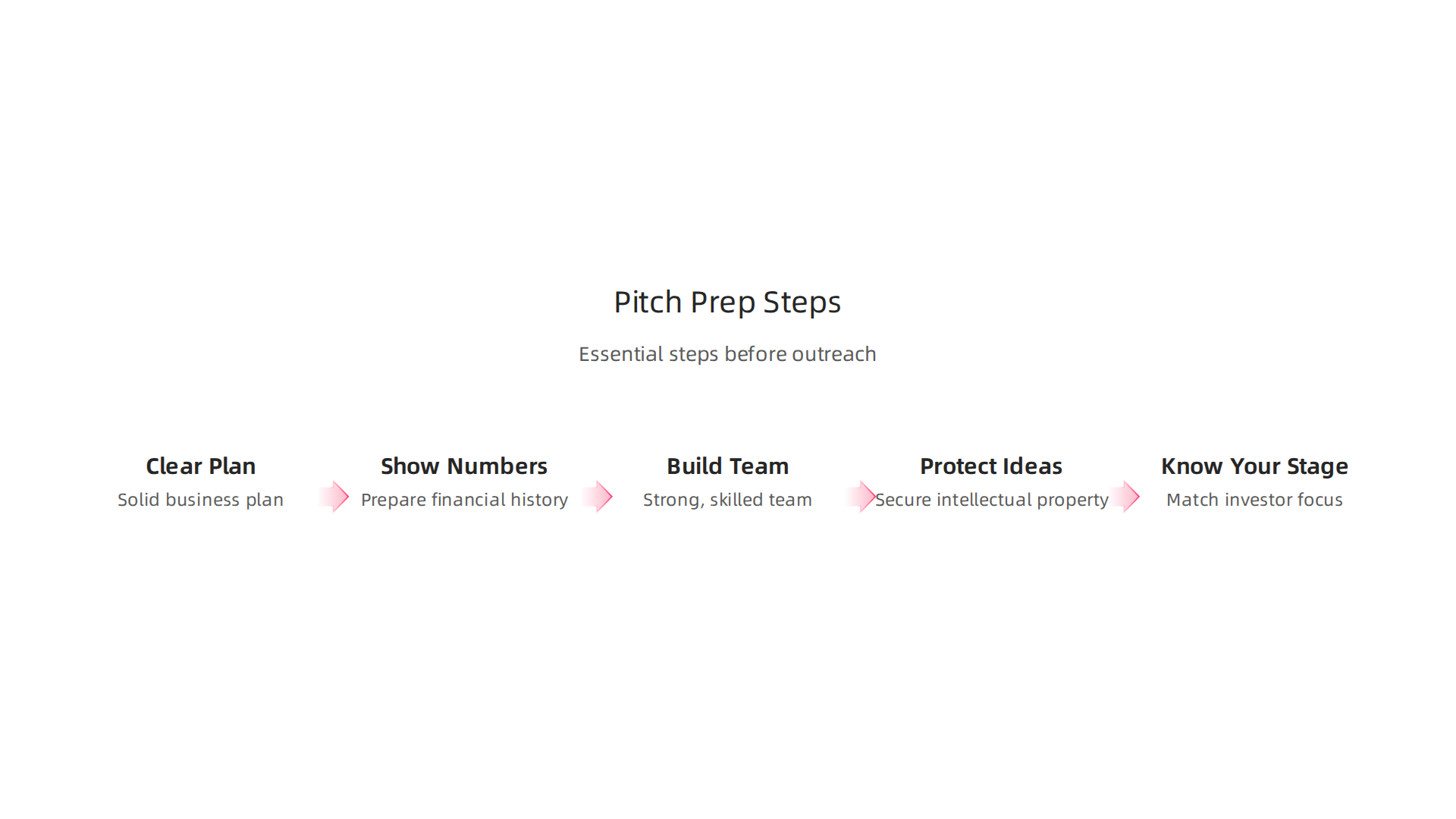
- Have a Clear Plan: You need a solid business plan that shows where your company is now, where it is going, and how it will get there.
- Show Your Numbers: Prepare your financial history and show how you expect to make money in the future. For firms like
Crescent CapitalandRoth Capital Partners, these numbers are super important. - Build Your Team: Investors look at the people behind the company. Make sure your team is strong and has the right skills to make your plan happen.
- Protect Your Ideas: It is a good idea to secure your intellectual property. Also, having a clear understanding of the technology definition 2026: the framework every founder needs for investor clarity will help you explain your innovations.
- Know Your Stage:
- For
clover capital(early stage), you might need a working product or a small group of users. - For
Roth Capital Partners(growth stage), you will need proof of steady sales and a solid customer base. - For
Crescent Capitalandarsenal capital partners(middle-market), you need to show consistent profits and a strong position in your market.
- For
Being prepared means you can answer investor questions with confidence and show them why your company is a good investment.
Summary
This article explains how four distinct investment groups—Arsenal Capital Partners, Clover-style early-stage VCs, Crescent Capital, and Roth Capital Partners—operate and why matching your company to the right investor saves time and increases fundraising success. It outlines each firm’s mandate, typical check sizes, sector focus and the kinds of founders they serve, then places those differences in the 2026 market context where AI-focused mega-deals and a