

Why global tech intelligence matters for fundraising today
In 2026, the world of startups and investing moves faster than ever. Founders and investors often feel lost in a sea of information.

There is so much data out there about new technologies, market changes, and what different investors are looking for. It can be hard to tell what information is real, what is important, and what truly helps you make smart choices. This problem is even bigger when you look at global tech markets, where rules and trends change from one country to the next.
For anyone trying to raise money or find the next big idea, this information overload makes things tough. It is hard to know where your company stands against others around the world. You might not have clear ways to measure your progress or see what makes a startup successful in different places. This lack of clear benchmarks and transparent data can lead to missed chances or bad decisions. Understanding the bigger picture of global tech and computing innovation is key.
This guide is here to help. We will break down the most important and trustworthy types of information. We will look at real market data, what investors truly care about, new signals from different tech areas, and any risks from new laws. Think of it as a clear map to help you navigate the complex world of global tech fundraising. We want to show you exactly how to use this intelligence to get your startup funded or make smart investment choices. After all, when it comes to technology and business, we believe all tech is human and its success relies on smart decisions. You can learn more about picking the right locations in our guide to World Tech Centers 2026: How to Pick the Best Hub for Your Startup Fundraising.
In today’s fast-paced tech times, staying updated is super important. Get clear daily AI updates from The AI Newsletter Worth Reading. It helps you keep up with all the big changes. You can also explore the IT Companies in USA 2026: The Market Leaders, Tech Hubs, and Trends Shaping the Industry to see local trends.
To make smart choices in these busy tech times, you need good information you can trust. It is not enough to just have data; you need data that is accurate and shows you the real picture of the global tech market. This means looking at trusted reports and benchmarks.
One of the first things to look at is how much money is being spent on technology around the world. Knowing this helps you understand the size of the market your startup is in. For example, some experts predict that global technology spending will grow to about $5.6 trillion in 2026. Others see worldwide IT spending reaching an even higher $6.31 trillion this year, largely because of more money going into AI. These numbers, like those from Forrester’s Global Tech Forecast, 2025 To 2030 and Gartner: Global IT Spending to Hit $6.31 Trillion in 2026, act as important anchors. They help founders figure out their company’s value and estimate the total market they can reach, also known as TAM.
Next, you should pay close attention to cross-border investment and sector benchmarks. These tell you where money is flowing across different countries and into which types of technology. For instance, global venture capital (VC) investment saw a huge jump in the first part of 2026, reaching a record $330.9 billion. A big part of this growth came from large investments in AI companies, showing a focus on advanced computing innovation. This means that investors are looking for startups that are pushing the boundaries of what technology can do. You can see these trends detailed in reports like Global VC investment surges to record $330.9 billion in Q1’26.
Understanding these global tech investment patterns is key to predicting how likely your startup is to get funded. If you know which sectors are attracting the most capital, like AI and defense tech, you can better position your company. For example, venture capital investment in defense tech has been on the rise, supported by partnerships between public and private groups. This kind of insight can help you craft your fundraising story. It helps to explore different kinds of funding like those for Breakthrough Tech 2026 How to Budget and Fundraise for Deep Innovation or for Defense Tech Companies Raise Record Funding Through Public Private Partnerships.
By using these high-confidence global datasets and benchmarks, founders can show investors that they understand the bigger picture. It proves that their startup is not just a good idea, but also fits into the larger trends of where the world is heading in technology. Because remember, all tech is human and its true success depends on smart decisions backed by real data.
As we dive deeper into 2026, it is clear that investment in global tech is not staying in one place. Venture capital (VC) firms and investors are looking beyond their home countries, creating a lively scene for cross-border deals. This means that money is flowing across borders more than ever, showing that investors are interested in new ideas from all over the world.

Signals point to a big shift in where investors are putting their money. For example, reports show that global venture capital investment rose sharply in the first quarter of 2026. While the Americas still get a lot of this money, other regions are quickly gaining ground. In fact, some investors are planning to increase their focus on Asia-Pacific and Europe, even reducing their investments in US stocks to do so. This tells us that many investors are seeking opportunities for growth in diverse markets. You can learn more about these trends in the 2026 Institutional Outlook.
These shifts are not happening by accident. Big changes in the economy and new government rules are reshaping how capital moves between important tech hubs. Investors are carefully watching global events, and this caution affects where they choose to invest. For example, some studies suggest that countries with good tax rules and strong legal systems for venture capital tend to attract more cross-border investment. This highlights how government policies can directly lead to more money flowing into a country’s startups. If you want to dive deeper into this topic, reading about What Lures Cross-Border Venture Capital Inflows can be very helpful.
Also, new computing innovation in areas like AI continues to pull in a lot of capital, no matter where the companies are located. This means that if your startup is working on advanced AI, you might find investors from many different countries eager to support you. It’s truly a time when all tech is human, and its potential for impact attracts global attention.
For founders, understanding these cross-border VC flows is super important. It is not just about finding investors in your local area anymore. It is about knowing which regions are hot, what kinds of projects are getting funded, and how big global changes might affect your fundraising journey. Keeping up with these trends is key to knowing where your startup fits in the bigger picture of global tech in these fast-paced tech times. To stay ahead with important trends, you might consider The AI Newsletter Worth Reading. It gives clear daily AI updates.
By tracking these movements, you can better decide where to look for funding and how to present your company to a worldwide audience of investors. Knowing these regional differences can help you choose your next steps wisely, whether that means looking for funds from specific areas or even setting up your company in a new global tech center. For more insights on global tech landscapes, explore guides like World tech centers 2026.
To keep finding funding, you need to know which areas of global tech are attracting the most money. In these fast-paced tech times, some tech subsectors are truly catching the eyes of investors more than others.
The Rise of AI Infrastructure and Computing Innovation
When we look at where the money is going, one area stands out: artificial intelligence (AI) infrastructure. This includes everything that helps AI work, like powerful computer systems, special chips, and big data centers. Experts say that worldwide IT spending is expected to reach an amazing $6.31 trillion in 2026. This huge growth is mainly because people are investing so much in AI infrastructure and advanced computing solutions [Gartner: Global IT Spending to Hit $6.31 Trillion in 2026, Driven by AI…]. It shows how important this kind of computing innovation is to the future of global tech.
Actually, AI has changed how money is given out, taking more than half of all venture funds in 2025. This means if your startup is building the foundations for AI, you’re likely in a good spot to attract investors.
Beyond AI, other subsectors are also seeing a lot of action:
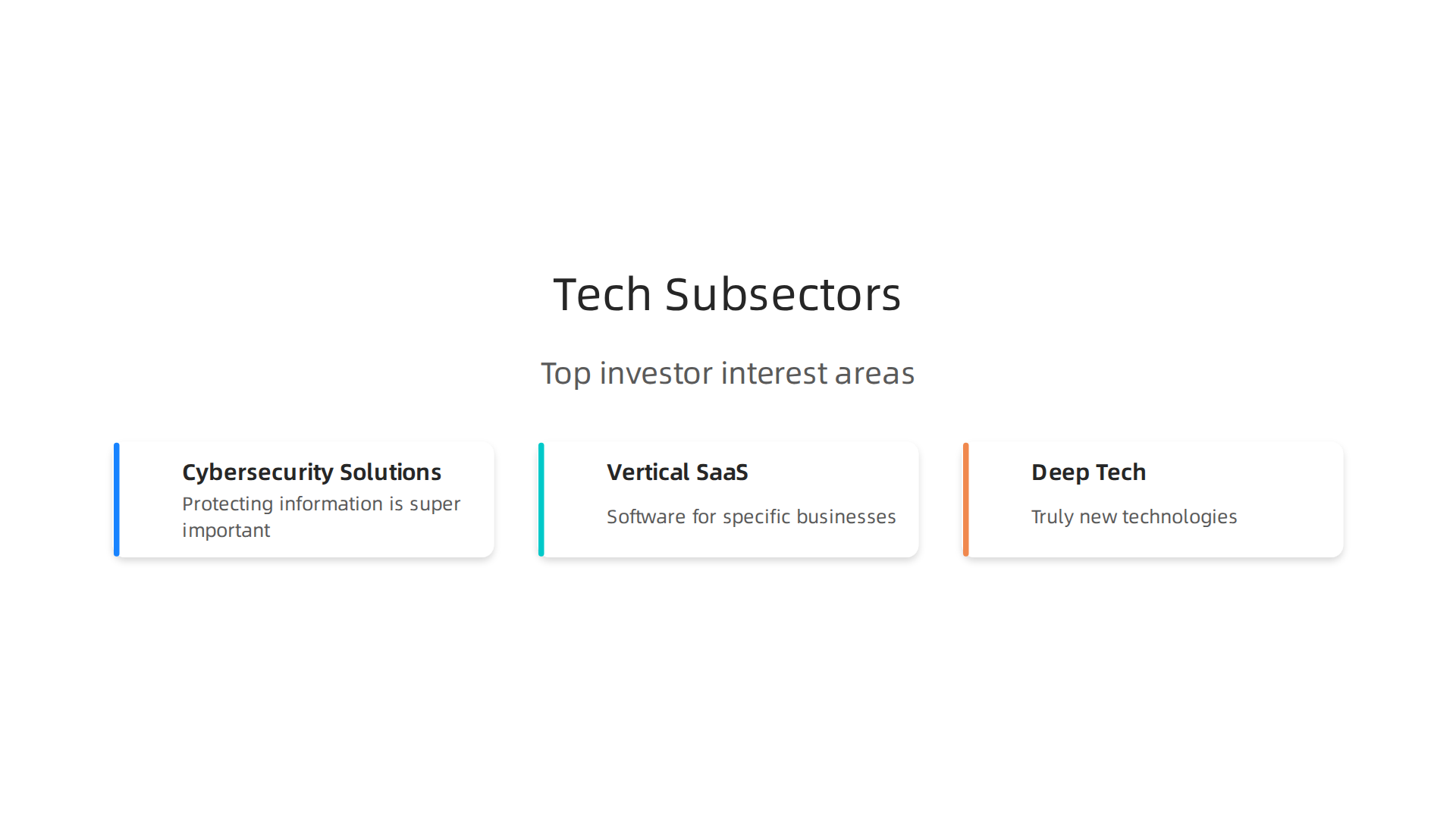
- Cybersecurity Solutions: As more and more of our lives move online, protecting information becomes super important. So, companies that offer strong cybersecurity are always needed and attract a lot of investor interest.
- Vertical SaaS: This simply means software made for a very specific type of business. For example, software just for dentists or just for farmers. These solutions are popular because they solve real, everyday problems for those specific groups.
- Deep Tech: This covers truly new and groundbreaking technologies, like advanced robotics, quantum computing, and space technology. These are not just small improvements; they are about big changes that can shape the future. Investors are putting money into these areas because they promise big returns over a longer time, showing how all tech is human in its potential to change our world. You can learn more about how unique technologies are funded in a guide about Breakthrough 2026 How To Budget And Fundraise For Deep Innovation.
Investor Appetite Varies by Region
It is also important to remember that investors in different parts of the world might prefer different types of tech. For example, Europe might see more investment in green tech and sustainability solutions, while Asia-Pacific could be a hot spot for mobile innovations or digital consumer services. Knowing these regional differences can help you aim for the right investors.
How to Position Your Startup for Success
For founders, understanding these signals is key to better target investors and manage what you expect for your company’s value.
- Map Your Startup: Look at your company and see where it fits into these hot subsectors. Are you directly in AI infrastructure? Or do you use AI to improve cybersecurity?
- Highlight Your Problem-Solving: Even if you’re not in one of the "hottest" areas, you can still attract funding by clearly showing how your technology solves a big, painful problem for your customers. This is especially true for vertical SaaS solutions.
- Know Your Market: Research where investors are placing their bets. This means looking beyond your local area to see global trends. If your tech is in a booming area, you might find investors from far away who are eager to support you.
- Show Your Potential: For deep tech, investors want to see the long-term potential for big impact, even if profits are still a ways off. Clearly explain your vision for the future.
By understanding these trends, you can fine-tune your fundraising strategy. Knowing which tech areas are currently drawing the most attention helps you to connect with the right investors and show them why your startup is a smart choice in today’s global tech market. You can also explore Tech Company Categories 2026 How Founders Can Attract The Right Investors for more details.
For founders, understanding these signals is key to better target investors and manage what you expect for your company’s value. By understanding these trends, you can fine-tune your fundraising strategy. Knowing which tech areas are currently drawing the most attention helps you to connect with the right investors and show them why your startup is a smart choice in today’s global tech market.
Investor preferences, term-sheet trends, and due diligence signals
In 2026, investors are looking for specific things when they decide where to put their money. It’s not just about a cool idea anymore. They want to see real proof that your startup can grow and make money. This means focusing on what investors care about most.
What Investors Prioritize
When investors look at your company, they pay close attention to a few main things:
- Growth KPIs (Key Performance Indicators): These are like report card grades for your business. Investors want to see how fast your company is growing. Are you getting more customers quickly? Is your income going up? Strong growth numbers show that your product or service is truly hitting the mark with people. Investors are getting more selective, meaning they want to see clear evidence of success and good returns on their money 2026 Views: Income, Selectivity and Dispersion.
- Unit Economics: This is a fancy way of saying how much money you make from each customer or each sale, compared to how much it costs you. If it costs you more to get a customer than that customer brings in, that’s a problem. Good unit economics means your business model works and can be profitable. When you make your financial plans, show that you understand these costs and earnings per unit Fundraising Investor Outreach Guide | Startup Guide 2026 | Noizz.io.
- Team Composition: Investors aren’t just betting on your idea; they’re betting on you and your team. They want to see that you have the right people with the right skills and experience to make the dream a reality. A strong team can overcome many challenges, showing that all tech is human in its core. Having a clear, consistent story about your team and your product is vital for your pitch deck

The 2026 Pre-Seed Fundraising Guide for Founders.
Many investors agree that politics and how money is managed are big worries for them in 2026, alongside the big changes AI is bringing. They want to see that companies are careful with their money What investors want: The 2026 investor survey.
Term-Sheet Shifts and Clauses to Watch For
A term sheet is like a pre-agreement that lays out the main points of an investment. It’s super important to understand what’s in it, as some parts can really affect your company’s future.
- Valuation: This is how much your company is thought to be worth. In today’s tech times, investors might be more careful with how high they value companies, especially if they don’t see super-fast growth or clear paths to profit.
- Liquidation Preferences: This clause decides who gets paid first if your company is sold or closes down. Investors usually want to get their money back before founders or other shareholders.
- Board Seats: Investors might ask for seats on your company’s board of directors. This means they’ll have a say in big decisions. For founders, it’s a balance between getting valuable advice and keeping control of your vision.
- Protective Provisions: These are clauses that protect the investor’s money. They might say you can’t sell the company or borrow a lot of money without their permission.
It’s common for investors to want strong protection for their money. This is even more true now, as many investors are being careful with how much they commit in the short term, even if they plan to invest more over time Investor Outlook: H1 2026.
Knowing these details helps you negotiate better and ensures you’re ready for the due diligence process, which is when investors dig deep into your company’s numbers and operations. Across the global tech landscape, understanding investor expectations is vital for securing the capital you need.
Want to stay on top of the latest AI trends impacting investment? Get clear daily AI updates from The AI Newsletter Worth Reading.
Beyond what investors look for in your business itself, founders in 2026 must also pay close attention to big world changes. Geopolitics and new rules can deeply affect how easy it is to raise money. These outside forces add new risks that investors think about very carefully.
Geopolitical and regulatory risks that change the fundraising playbook
In today’s global tech world, political events and government rules often change how investors see risk. This is especially true for startups that work across different countries or use advanced technology. Founders need to understand these complex issues to better secure funding.
How Global Politics and Rules Affect Investor Risks
Many investors are worried about how global politics and new rules can hurt their money. This means they are looking much harder at a startup’s location, its customers, and where its technology comes from.
- Sanctions: These are like penalties placed by one country on another. If your startup does business with a country or company under sanctions, investors might see that as a big risk. They don’t want to get into trouble themselves or have their investment frozen. For example, some countries have tightened rules around trade and investment, creating new hurdles for businesses US International Trade and Investment: Key Shifts in 2025 and What Businesses Should Know for 2026.
- Data and Localization Rules: Many countries now have strict rules about where data must be stored and how it can be used. If your startup handles a lot of customer data, you need to know these rules inside and out. Investors want to be sure you won’t face big fines or have your operations shut down because you didn’t follow the local laws. These rules are especially important for tech times where information travels fast.
- Export Controls: These rules control what kinds of technology can be sent out of a country. If your startup makes advanced technology, like some forms of computing innovation or AI, you might need special permission to sell it in other countries. Investors will check to see if your product could be held back by these controls, especially for sensitive areas like semiconductors and AI Global Private Market Trends in 2026. Some countries are even tightening oversight on cross-border technology and data outflow China’s New June Outbound Investment Rules Restrict Unlicensed Cross-Border Tech.
These changes mean that investment is becoming more complex. For instance, global venture capital investment has surged in 2026, but much of it is in a small number of big deals, often related to AI, showing where capital is concentrating despite geopolitical concerns Global VC investment surges to record $330.9 billion in Q1’26.
What Founders Should Do
To get ready for fundraising in this environment, founders should take clear steps:
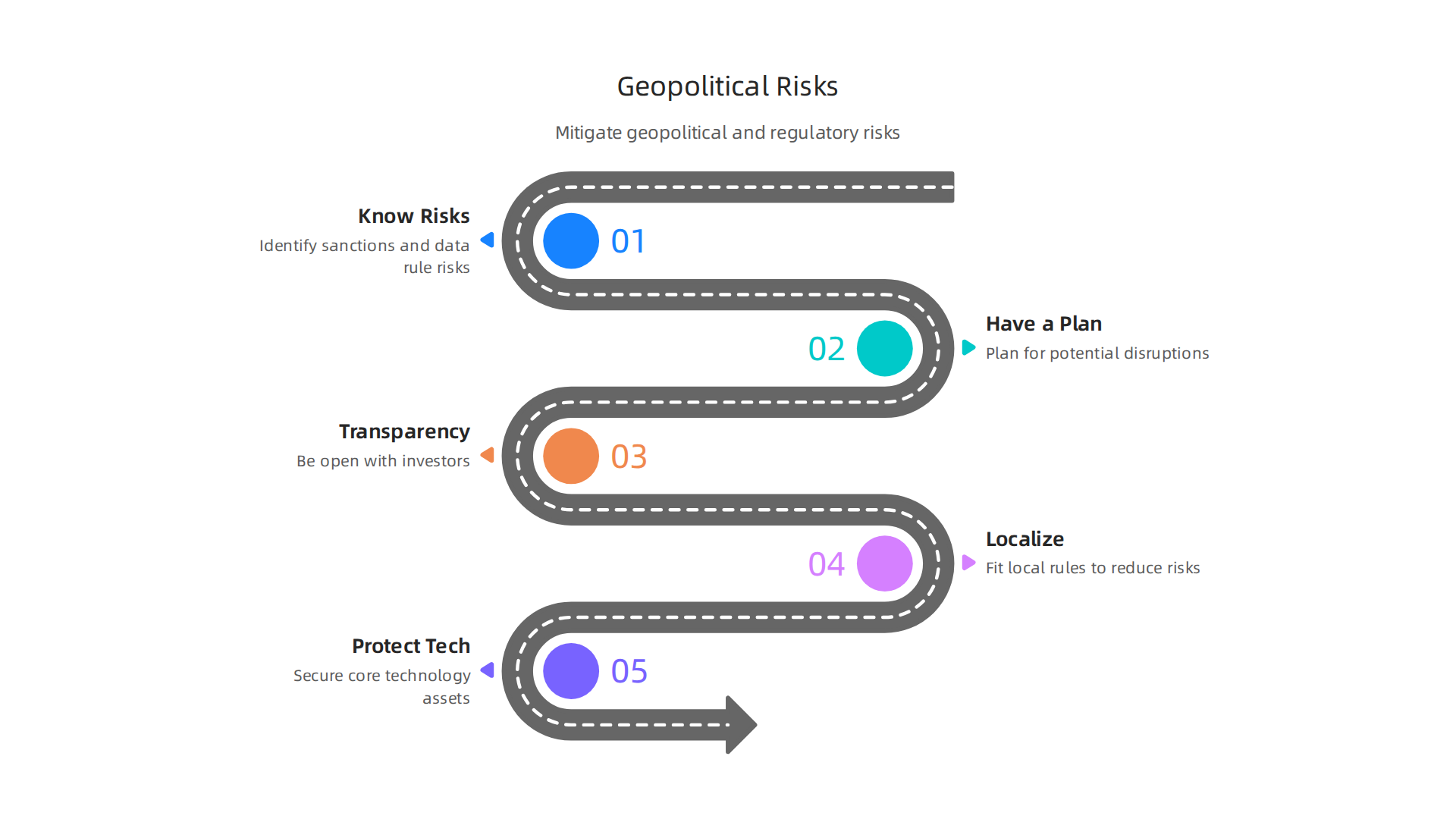
- Know Your Risks: Understand which countries your business touches, from where your team members are located to where your customers live and your data is stored. Identify any potential issues with sanctions, data rules, or export controls early on. For startups dealing with complex international relationships, understanding the risks tied to specific entities like Dahua Technology’s profile, strategy, and financials can be very helpful.
- Show You Have a Plan: Don’t just identify problems. Show investors you have a plan to deal with them. This might mean having legal advice, setting up different systems for data in various regions, or showing how you will get necessary licenses for your technology.
- Transparency is Key: Be open with potential investors about any risks you’ve found and how you plan to lessen them. This builds trust and shows you are prepared.
- Consider Localizing: Sometimes, changing your business model to fit local rules better can reduce risks. This might mean having local servers for data or setting up local teams. Learning about world tech centers in 2026 can guide these decisions.
- Protect Your Tech: With rising concerns about intellectual property and national security, especially in areas like defense tech, securing your core technology and knowing its origin is more important than ever.
By being proactive about geopolitical and regulatory risks, you show investors that you’re not just building great computing innovation but also a smart, safe, and future-proof business. This careful approach is another way to show that even when dealing with global challenges, all tech is human in its impact and management.
Moving from understanding big world challenges, let’s talk about how you can use smart information to get money for your startup. In 2026, just knowing your business isn’t enough. You also need a clear plan for finding investors and showing them your worth. This plan should be based on real facts and numbers.
Actionable intelligence: building a data-driven fundraising plan
To get funding today, founders need to use market intelligence, which means looking at data to make smart choices. This helps you figure out which investors to talk to and how much your company might be worth. It’s like having a map for your fundraising journey.

Why Data is Your Best Friend in Fundraising
In these tech times, the global tech market is always changing. Knowing what is happening in the wider world helps you find the right investors. For example, worldwide IT spending is expected to reach $6.31 trillion in 2026, thanks to a lot of money going into AI. This kind of information tells you where the big money is flowing and what areas investors are excited about Gartner: Global IT Spending to Hit $6.31 Trillion in 2026, Driven by AI ….
Step 1: Know Your Market and Score Your Investors
Before you reach out to anyone, do your homework.
- Understand the Big Picture: Look at reports about what’s happening in the global tech market. Are there new kinds of computing innovation that everyone is talking about? Which regions are growing the fastest? This helps you see where your startup fits in.
- Research Investors: Find out which investors like companies similar to yours. Check what companies they have invested in before. What stage of growth do they usually fund (early stage, growth stage)? A good way to do this is to learn about different investment group profiles smart capital strategies for founders investors.
- Score Your Investors: Make a simple list to score how good an investor might be for you.
This helps you focus your time.
| What to Look For | Score (1-5, 5 is best) |
|---|---|
| Invests in your type of business | |
| Invests at your stage of growth | |
| Has invested in your region | |
| Has money to invest right now | |
| You have a warm connection to them |
By scoring investors, you can create a targeted list. This approach makes your outreach much stronger, rather than just sending emails to everyone. For more detailed plans, check out guides on building an investor outreach plan for 2026.
Step 2: Set Smart Valuation Targets
Your startup’s worth isn’t just a guess. It should be based on data. Look at similar companies that recently got funding. How much were they valued at? What were their sales or user numbers? This helps you set a fair price for your company and shows investors you’ve done your research. Using data means you can explain why your company is worth what you say it is.
Step 3: Craft Your Pitch with Data
Your pitch deck and conversations with investors should use this data to tell a strong story.
- Translate Data into a Story: Don’t just list facts. Show how these facts make your business strong. For example, "The global demand for [your product type] is growing by X% each year, and we are perfectly placed to meet that need because…"
- Target by Region: If your research shows certain regions have more active investors or a better market for your product, focus your efforts there. For instance, some reports show that Europe and emerging markets are becoming more popular for equity risk Global Investment Outlook 2026: Key Trends Shaping Markets. Knowing this helps you decide where to spend your time. You can also explore how to compare investment firms Arsenal Clover Crescent Roth for your startup to find those active in your target areas.
- Show You’re Prepared: When you use data, you show investors you’re serious and thoughtful. You’re not just hoping for the best; you have a clear, data-backed strategy. This makes your startup look less risky and more appealing.
Building a data-driven fundraising plan means you are not just building great technology, but also a smart, ready-for-anything business. It reminds us that even with all the numbers and data, all tech is human in its goals and how it helps real people.
Want to keep up with the latest in technology and AI to boost your fundraising smarts?
The AI Newsletter Worth Reading
Summary
This article explains why high-confidence global tech intelligence is essential for founders and investors raising capital in 2026. It covers how to use trusted market benchmarks—like global IT spending and VC flows—to size your opportunity (TAM), pick the right regions, and identify hot subsectors such as AI infrastructure, cybersecurity, vertical SaaS and deep tech. The guide also outlines what modern investors look for (growth KPIs, unit economics, and team), term-sheet shifts to watch, and rising geopolitical and regulatory risks that can derail cross-border deals. Finally, it shows how to turn these signals into an actionable, data-driven fundraising plan: score and target investors, set valuation targets from comparable deals, and craft a pitch that proves your place in global trends. After reading, founders will know which datasets to trust, how to position their startup by region and sector, and practical steps to improve fundraising outcomes.